Global Strategic Outlook 2027 · Chapter 9 of 10
Chapter 9. The disclosure duty shrank, the border price rose
Which sustainability investments survive on economics alone, and who carries an unpriced carbon-border exposure.
Bruno Hounkpati, Founding Partner and Chief Executive Officer
20 October 2026
Chapter 9
The disclosure duty shrank, the border price rose: which sustainability investments survive on economics alone, and who carries an unpriced carbon-border exposure
Mandatory sustainability reporting in the European Union now starts at 1,000 employees and 450 million euros of turnover, while the carbon border certificate price rose from 75.36 to 82.32 euros in three quarters of 2026 and certificates go on sale on 1 February 2027. The 2027 decisions are which efficiency, solar and water measures pay on the site's own numbers, and whose export contracts say who pays the border cost.
- The decision: which energy-efficiency, captive-solar and water measures to fund in 2027 because they pay on the site's own costs, and whether the carbon border cost of goods shipped into the Union is written into 2027 contracts; owners, the chief financial officer with the chief operating officer, and the commercial director for exporters in Morocco, Tunisia and Cameroon.
- What the evidence says: the disclosure duty shrank and the border price rose. EU sustainability reporting now binds only companies above 1,000 employees and 450 million euros of turnover, and France has not yet transposed; the certificate price rose from 75.36 to 82.32 euros across three quarters of 2026, certificates go on sale on 1 February 2027 and 2026 imports are surrendered by 30 September 2027. Morocco's exposure sits mostly in fertilisers (press), and models of the wider exposure disagree in size and, for Mozambique, in sign.
- The test: a border-exposure ledger by product code, default against verified emissions, with a verified-data pilot on the line carrying the largest 2028 exposure, and a payback model for each efficiency, solar or water measure on the site's own costs at Brent 84 and 110 dollars. The number the evidence lacks: the share of the certificate cost that EU importers pass back to Moroccan, Tunisian and Cameroonian suppliers.
Decision at stake
For a company of 30 to 500 million euros of revenue in francophone Europe, or one exporting to the European Union from Morocco, Tunisia or Cameroon, the 2027 budget carries two decisions that the regulatory retreat has pulled apart. The first is which energy-efficiency, captive-solar and water measures to fund because they pay on the site's own costs, now that mandatory EU reporting binds only the largest companies. The second is whether the carbon cost of goods shipped into the Union is written into 2027 contracts. The owners are the chief financial officer with the chief operating officer for the first, the commercial director for the second. The dated moments are 1 February 2027, when certificates go on sale; 19 March 2027, France's transposition deadline; 31 March 2027, the first quarter end at which an EU importer must hold certificates for at least half its imports' embedded emissions; 30 September 2027, the first surrender, for 2026 imports; and 1 January 2028, the proposed start of the downstream extension (law-firm note).
The cost of error runs both ways. A measure funded on the reporting duty's logic loses its sponsor when the duty goes, though the energy bill that justified it has not gone; a supplier whose contracts are silent on carbon learns its share from a customer who has pre-funded certificates since the first quarter. United States rules are not printed and no captive-solar payback was found.
What the evidence shows
What changed, 2024 to 2026
The reporting duty now binds only the largest companies. Directive (EU) 2026/470, published on 26 February 2026 and in force on 18 March, confines sustainability reporting to undertakings and groups with net turnover above 450 million euros and more than 1,000 employees on average, both conditions together. A value-chain cap protects companies of no more than 1,000 employees, and the due-diligence directive now starts at 5,000 employees and 1.5 billion euros, for all companies in scope from 26 July 2029. The only official count found is the Commission's estimate for its own February 2025 proposal, made on looser thresholds, that the number of undertakings subject to mandatory reporting "would be reduced by about 80%". No count for the adopted text was found on 21 October 2026. CH09-C1
France has not yet written its own reversal, and the only legislative text found keeps the 2025 report due. On 12 February 2026 the Senate adopted a Government amendment that limits the first-wave obligation under ordonnance no. 2023-1142 to financial years opened from 1 January 2024 to 31 December 2025 and applies the duty from financial year 2026 to listed companies, credit institutions and certain insurers above decree thresholds. A French legal publisher read the 2025 obligation as still applicable to first-wave companies below the new thresholds on 5 June 2026, and found no transposition on 15 October 2026 (press). The Directive lets member states exempt companies up to 450 million euros of turnover for financial years 2025 and 2026. The Senate text is a first reading, not a law. CH09-C2
The border price moved the other way. The certificate price, set each quarter of 2026 from EU allowance auctions, was 75.36 euros a tonne for the first quarter, 75.28 for the second and 82.32 for the third; the fourth is due on 4 January 2027, with weekly prices after. Certificates are sold from 1 February 2027; at each quarter end an authorised declarant must hold certificates for at least 50 percent of its imports' embedded emissions; and the declaration and surrender for 2026 imports fall due by 30 September 2027. The share paid rises as free allocation is withdrawn: the factor applied to it is 97.5 percent in 2026, 95 in 2027, 90 in 2028 and 51.5 in 2030, and none applies from 2034, so on the usual shorthand importers pay for 5 percent of embedded emissions in 2027 and all of them from 2034 (Exhibit 9.1). CH09-C3
The border price phases in: share of embedded emissions paid as free allocation is withdrawn, 2026 to 2034
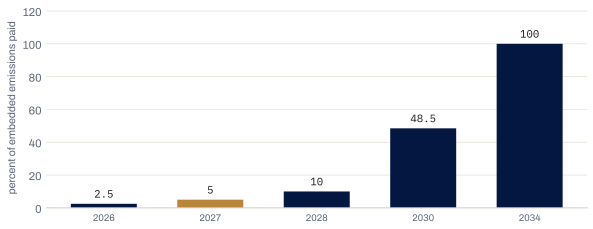
The usual shorthand for the phase-out of free allocation; the deduction for a given good was not computed.
Source · EUR-Lex, Directive (EU) 2023/959, recital 46; share computed as 100 minus the CBAM factor · read 2026-10-21 · SEG-2
Show the underlying numbers
| Item | percent of embedded emissions paid |
|---|---|
| 2026 | 2.5 |
| 2027 | 5 |
| 2028 | 10 |
| 2030 | 48.5 |
| 2034 | 100 |
The list of goods may lengthen from 2028. The Commission proposed on 17 December 2025 to extend the mechanism to 180 downstream goods at six-digit code level; a Council presidency compromise of 9 June 2026 adds and removes codes without stating its total; and Parliament, voting at first reading on 15 September 2026, sent the file back to committee for negotiations with the Council. The proposed application date is 1 January 2028 (law-firm note). CH09-C4
The size of the exposure depends on the model, and two models disagree on its sign. The African Climate Foundation and LSE study of May 2023, applying 87 euros a tonne to the mechanism's current scope, found the continent's GDP lower by 0.91 percent, about 25 billion dollars at 2021 GDP, with no single country losing more than 0.18 percent in one of its models (executive summary). Sandbag's October 2025 simulation put African exporters' fees at about 1.5 billion euros and their net cost near 670 million once higher EU selling prices are counted, with Cameroon, Ghana and Mozambique more profitable. The World Bank's exposure index, pricing carbon intensity above the EU average at 100 dollars a tonne, puts Mozambique highest at 0.6 percent of GDP and every country other than Mozambique, Ukraine and Egypt below 0.1 percent (Exhibit 9.2). The World Bank counts no pass-through; Sandbag counts it. All three are projections. CH09-C5
One exposure, three sources in percent of GDP
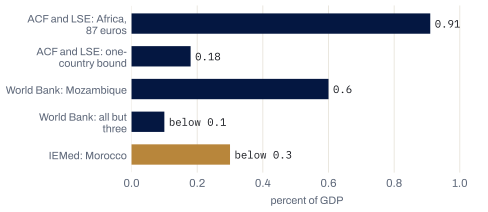
GDP losses (ACF and LSE; IEMed) and excess payments with no pass-through (World Bank) share one scale; bars marked below are drawn at the bound. Sandbag's estimate is in euros, not a share of GDP, and is not drawn: about 1.5 billion euros of fees and a net cost near 670 million for African exporters, with Cameroon, Ghana and Mozambique more profitable (projections).
Source · ACF and LSE Firoz Lalji Institute (9 May 2023); World Bank, The Trade Post (2 Jul 2025); IEMed, Policy Study 33 (Apr 2024); Sandbag, in the note · read 2026-10-20/21 · SEG-1, projections
Show the underlying numbers
| Item | percent of GDP |
|---|---|
| ACF and LSE: Africa, 87 euros | 0.91 |
| ACF and LSE: one-country bound | 0.18 |
| World Bank: Mozambique | 0.6 |
| World Bank: all but three | below 0.1 |
| IEMed: Morocco | below 0.3 |
In Morocco the exposure sits in one product family, and no domestic carbon price was found. Morocco's economic, social and environmental council put the exports concerned at no more than 3.7 percent of trade with the Union, 2.9 points of it fertilisers, largely OCP's nitrogen products, called the short-term impact "relatively limited", and recommended recognition of Moroccan verifiers and, later, a domestic carbon market (press). Europe took 69.7 percent of Morocco's exports in 2025 (Office des Changes, via press). IEMed's 2024 study put Morocco's EU exports in covered sectors at about 1 percent of GDP, with a projected GDP loss below 0.3 percent, and Tunisia's at about 1.1 percent, dominated by iron and steel. No sustainability-reporting roadmap was found for Morocco or for the UMOA's market authority, and no francophone African jurisdiction appears among the eight African ones on the IFRS Foundation's 2025 list. CH09-C6
The physical case for water spending is local, and the national figure hides it. Morocco's dams stood at 65.95 percent of capacity on 19 October 2026 against 31.89 percent a year earlier (ministry figures, via press), but Souss-Massa read 47.18 percent and Draa-Oued Noun 37.11, after 17.5 and 29 percent on 6 October 2025 (press) (Exhibit 9.3). No Moroccan insurance figure was found; two reinsurers' aggregates (commercial) point to little cover: one put 2025 natural-disaster losses in Africa at about 3 billion dollars, "less than a fifth" insured; the other wrote that 80 to 90 percent of catastrophe losses in emerging economies "are typically not covered by insurance". CH09-C7
The national rate doubled, two basins stay below it: Morocco's dams, October 2025 and October 2026
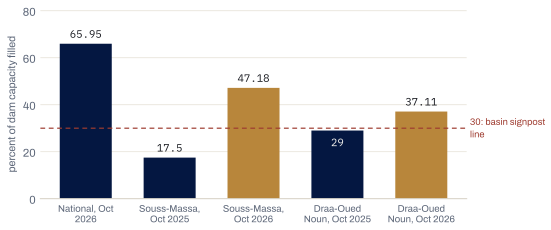
Read on 6 October 2025 and 19 October 2026 from two press reports of official data; national rate 32.4 percent on 6 October 2025.
Source · Le Matin (6 Oct 2025, press, citing the Maa Dialna platform); Hespress English (20 Oct 2026, press, citing the Ministry of Equipment and Water) · read 2026-10-20 and 2026-10-21 · SEG-1
Show the underlying numbers
| Item | percent of dam capacity filled |
|---|---|
| National, Oct 2026 | 65.95 |
| Souss-Massa, Oct 2025 | 17.5 |
| Souss-Massa, Oct 2026 | 47.18 |
| Draa-Oued Noun, Oct 2025 | 29 |
| Draa-Oued Noun, Oct 2026 | 37.11 |
What lost its sponsor is the report; the energy bill, the water allocation and the border price did not.
What is contested
The first objection is that, with the duty gone, sustainability spending is a cost to cut. It merges two policies that moved apart: the reporting scope shrank while the border mechanism's 50-tonne threshold removed about 182,000 importers yet kept "over 99% of emissions in scope" on the Commission's figure, and the certificate price rose 9.2 percent from the first quarter of 2026 to the third. What lost its sponsor is the report; the energy bill, the water allocation and the border price did not.
The second objection is that green capital pays for green investment through cheaper funding. The evidence read does not support it. An ECB working paper found a euro-area greenium of about 4 basis points, significant only at the 10 percent level, across 124 bond pairs from 2016 to 2021; Banque de France analysis found the French corporate greenium gone in 2024 and absent for industry.
The third objection is that efficiency pays for itself and needs no mandate. On paper the price gap supports it: the Draghi report put EU electricity prices at 2 to 3 times US levels and gas at 4 to 5 times. The outturn does not: the IEA estimates EU intensity improvement below 1 percent in 2025, and global industrial improvement under 0.5 percent a year since 2019. The edition reads the gap as capital constraints, split incentives and EU construction costs up more than 20 percent since 2021 (IEA), a reading, not a tested finding. Conceded in part, which is why the test runs on the site's own numbers, not a vendor's.
The corridor
What we expect in 2027
First, the Council and Parliament agree the downstream extension by 31 December 2026, the regulation is published in the Official Journal during 2027, and it applies from 1 January 2028 to at least the Commission's 180 goods. Falsified if no political agreement is announced by 31 December 2026, if no regulation is published by 31 December 2027, if the adopted application date is later than 1 January 2028, or if the adopted list covers fewer than 180 six-digit codes. Baseline hypothesis (Scenario 1). CH09-H1
Second, no government in Morocco, Tunisia or Cameroon enacts a carbon tax or emissions-trading law in 2027, and the weekly certificate price averages above 80 euros across 2027, so exporters there carry the EU price with nothing to set against it at home. Falsified if any of the three enacts such a law during 2027, or if the 2027 average of weekly prices is 80 euros or below. The price leg's link to the 2026 shock is the edition's reading; the second-quarter price fell. Stress-case hypothesis (Scenario 2). CH09-H2
Third, France promulgates its transposition by 19 March 2027, keeping the report on financial year 2025 due for first-wave companies outside the new scope and exempting them from financial year 2026, as the Senate text does. Falsified if no act appears in the Journal officiel by 19 March 2027, if the act lifts the 2025 obligation for those companies, or if it requires them to report on financial year 2026. Baseline hypothesis (Scenario 1). CH09-H3
Signposts
| Indicator | Definition fixed | Reading, date | Threshold | Crossing means |
|---|---|---|---|---|
| 16. EU carbon border dates and allowance price (chapter 6) | EUR-Lex dates; Commission quarterly certificate price; allowance price via aggregator, daily | certificates 75.36, 75.28, 82.32 euros (Q1 to Q3 2026); sale 1 February 2027; surrender 30 September 2027; allowances 85.54 euros, 20 October 2026 · inside | allowances above 100 euros; or an act delaying the 1 February sale | up: the 2027 cash cost on 2026 imports exceeds budgets for steel, aluminium and fertiliser importers; delay: extend the working-capital plan |
| Certificate price, weekly from 2027 | Commission price page; average of auction closing prices for each calendar week; annual average of the weekly prices | 82.32 euros, Q3 2026 (published 5 October 2026); Q4 due 4 January 2027 | 2027 average at or below 80 euros; or a quarter averaging above 100 | at or below 80: H2 fails; above 100: rerun the exposure ledger and contract clauses at the new price |
| Downstream extension, adopted text | Official Journal; Council and Parliament statements; event-driven | 180 six-digit goods proposed (17 December 2025); Parliament first reading 15 September 2026, referred back for negotiations; no agreement found, 20 October 2026 | no political agreement by 31 December 2026; application later than 1 January 2028; fewer than 180 codes | H1 fails; the 2028 exposure list for metal fabricators is reopened |
| French transposition of Omnibus I | Journal officiel; promulgated law amending ordonnance 2023-1142; event-driven | Senate text of 12 February 2026 keeps first-wave reports on financial years 2024 and 2025; not transposed, 15 October 2026 (press) | no act by 19 March 2027; or an act lifting 2025 or requiring 2026 for companies outside the new scope | H3 fails; French first-wave companies reset their 2025 and 2026 reporting budgets |
| Morocco dam filling, national and by basin | Ministry of Equipment and Water, daily, via press while the ministry's site refuses automated reading | 65.95 percent, 19 October 2026; Souss-Massa 47.18, Draa-Oued Noun 37.11 | national below 40 percent at the end of April 2027; Souss-Massa or Oum Er-Rbia below 30 | industrial water rationing risk returns for agri-food, phosphate processing and textiles; water measures move from optional to necessary |
| Domestic carbon price: Morocco, Tunisia, Cameroon | enacted carbon tax or emissions-trading law; Commission default carbon prices for third countries, possible from 2027; event-driven | none found, 20 October 2026; domestic market recommended by Morocco's council (September 2025, press) | any such law enacted in 2027 | H2 fails; part of the carbon cost is paid at home and can be set against the importer's bill |
The two arenas
Francophone Europe. In France the question is whether the law due by 19 March 2027 keeps the 2025 first-wave report, as the Senate text does. In Luxembourg the government's environment portal, naming the Environment Agency as contact point, confirms certificate purchases from 1 February 2027 and the 50 percent holding at each quarter end; for an importer of steel or aluminium inputs that is working capital pre-funded all year, not one September settlement. For a French metal fabricator the downstream extension decides whether competing imports of the proposed goods carry a carbon cost from 2028.
Francophone Africa. Morocco's exposure is concentrated in one group whose group-wide renewable-electricity target and carbon-capture modules at Jorf Lasfar are dated 2027 (press); from 2027 the Commission may set default carbon prices for third countries that price carbon, and no Moroccan carbon price was found. A phosphate-processing, agri-food or textile site in Souss-Massa or Draa-Oued Noun reads its own basin, not the national 65.95 percent. Tunisia's exposure sits in iron and steel. Cameroon is the counter-intuitive case, a hydro-based aluminium exporter that Sandbag finds better off under the mechanism. For Côte d'Ivoire and Senegal, BOAD, the UEMOA's development bank, raised 25 billion yen in sustainable Samurai bonds in July 2026 (press); with no coupon stated, no premium can be read.
What a board should ask
The test before commitment
The test runs in three steps of the STREDGE Evidence-to-Decision Cycle. For the commercial director, in the Diagnose step, a border-exposure ledger: every code shipped to the Union in 2024 and 2025 against the current groups and the Commission's 180 downstream goods, the emissions value each customer declares, default or verified, and the price clause in each 2027 contract. The arithmetic per tonne of anhydrous ammonia, with the third-quarter price of 82.32 euros held constant and on the shorthand share paid: at the global default intensity of 4.36 tonnes of CO2, about 17.95 euros in 2027 (5 percent) and 174.07 in 2030 (48.5 percent); at Egypt's default of 2.05 tonnes, about 8.44 and 81.85 euros. A verified-data pilot in the Experiment step measures that gap on the product line with the largest 2028 exposure. For the finance and operations owners, in the Simulate step, a payback model for each efficiency, solar and water measure on the site's own tariff, diesel and water costs, with Brent at the EIA's 84-dollar base case for 2027 (projection, chapter 6) and at chapter 6's 110-dollar stress line. The test is built to survive Scenario 1: a measure that pays back only while the shock persists is a wager on Scenario 2.
The number the evidence does not contain is the share of the certificate cost that EU importers are passing back to Moroccan, Tunisian and Cameroonian suppliers in 2026 and 2027 contracts; no filing, interview or survey read records it, and it is the first primary-research item.
The verdicts. Deploy, when a measure pays back within the board's threshold at both 84 and 110 dollars, or when the carbon cost is written into 2027 contracts with a named price reference and emissions basis. Rethink, when payback clears only at 110, or the ledger places most 2028 exposure in downstream codes. Keep testing, when no verified emissions value is available for the product line, or, for a French reporting system, until the act is published. Stop, when a measure pays only through a subsidy or a funding discount the evidence does not show; and, once the French act is published and exempts financial year 2026, stop building a mandatory French report beyond financial year 2025 for a company outside the new scope, after finishing the 2025 report where it was in the first wave. Sequence the treasury line before the 1 February sale, the ledger before 2028 contracts are negotiated, and Moroccan water measures after the end-of-April 2027 basin reading.
What to instrument: energy cost and water drawn per unit of output, by site; tonnes shipped to the Union by code each quarter; embedded emissions per tonne, default against verified; the share of export contracts with a carbon clause.
- Which of our products shipped to the Union in 2025 fall under the current groups or the Commission's 180 downstream goods, and on what emissions value will our customers declare them?
- Which of our 2027 contracts says who pays the certificate cost, and at which weekly price?
- Which of our planned efficiency, solar or water measures still pays back at 84 dollars Brent on our own tariff and water costs?
- If we were in France's first wave, who signs our 2025 report, and what do we stop building after it?
Evidence cards
CH09-C1SEG-1The EU reporting duty now binds only companies above 1,000 employees and 450 million euros of turnover.
- Context
- EUR-Lex, Directive (EU) 2026/470 (CELEX 32026L0470; adopted 24 February 2026), Articles 19a and 29a of Directive 2013/34/EU as amended, recitals 8, 26, 37 and 46 (operative Article 40a not read); European Commission, COM(2025) 81 final (26 February 2025) for the 80 percent estimate; DG FISMA reporting page (last updated 3 July 2026), which gives no count.
- Method
- thresholds read in the text, not in summaries.
- Contradictory evidence
- none on the thresholds; the size of the reduction under the adopted text is unknown, and the proposal's estimate refers to more than 1,000 employees with either more than 50 million euros of turnover or more than 25 million of balance sheet.
- Transferability
- binds every member state once transposed.
- Review date
- 21 October 2026.
CH09-C2SEG-1press for the publisher's readingsFrance: no act promulgated; the Senate text keeps the 2025 first-wave report due.
- Context
- Sénat, amendment 429 to text 348 (12 February 2026) and finance committee note on bill 118 (February 2026; Government bill under the accelerated procedure); Lefebvre Dalloz (5 June 2026 and 15 October 2026, press); EUR-Lex, Directive (EU) 2026/470, Article 3(1)(c) and recitals 31 and 33 for the option.
- Contradictory evidence
- the bill may change at later readings, and the adoption the publisher expected "d'ici à fin juillet 2026" (5 June 2026, press) had not happened by 15 October; Légifrance and the Senate dossier were not read.
- Causal confidence
- not applicable.
- Review date
- 21 October 2026.
CH09-C3SEG-1; SEG-2 for the percentage change and the complement of the factorThe certificate price rose 9.2 percent across three quarters of 2026, and the Regulation fixes the sale, holding and surrender dates.
- Context
- EUR-Lex, Regulation (EU) 2025/2083, Articles 6(1), 20(1), 21, 22(1) and 22(2) and recital 3; DG TAXUD price page and notice of 20 October 2025; Directive (EU) 2023/959, recital 46.
- Method
- the share paid is the complement of the factor applied to free allocation, a shorthand for the phase-out of free allocation; the deduction for a given good was not computed.
- Contradictory evidence
- none on the dates once the Regulation was read; a World Bank slide's earlier date is superseded.
- Review date
- 21 October 2026.
CH09-C4SEG-1; law-firm note for the application dateThe downstream extension: 180 goods proposed, negotiations open, application proposed for 2028.
- Context
- Council, presidency note ST 10208/26 (9 June 2026); European Parliament, Legislative Observatory, 2025/0419(COD), proposal COM(2025) 989; a law-firm note of 18 December 2025, named under prior art.
- Contradictory evidence
- the Council and Parliament totals were not read in a primary document and are not printed; Parliament's adopted text refused automated access.
- Review date
- 21 October 2026.
CH09-C5SEG-1model projectionsThree models of exposure disagree in size and, for one country, in sign.
- Context
- ACF and LSE Firoz Lalji Institute (9 May 2023; the dollar figure is the study's own conversion, the report body mixes dollars and euros, and the press release says "up to $25 billion per annum"); Sandbag (14 October 2025; 2023 trade, current scope, business-as-usual intensity; no carbon price or phase-in year stated); World Bank, The Trade Post (2 July 2025; 2017 intensities, 2022 trade, sector averages).
- Contradictory evidence
- World Bank ESMAP (19 March 2026) puts the macroeconomic impact at "less than 1% of GDP", below 0.1 percent for most countries.
- Causal confidence
- that pass-through explains the opposite signs for Mozambique is the edition's reading of the methods, not a tested finding.
- Transferability
- none at firm level.
- Review date
- 21 October 2026.
CH09-C6SEG-1press for the council's opinion, the trade shares and OCP's targetsMorocco's exposure is concentrated in fertilisers; no domestic carbon price or sustainability-reporting roadmap was found in the francophone arena.
- Context
- Hespress English (24 September 2025, 16 December 2025 and 16 October 2026, press) and TelQuel (28 October 2025, press), the council's own document not fetched; IEMed Policy Study 33 (April 2024, projections); IFRS Foundation, World Standard-setters Conference 2025 presentation (information to 15 September 2025); AMMC news item (June 2025); DG TAXUD notice (20 October 2025) for third-country default prices.
- Contradictory evidence
- the Policy Center for the New South, via press, puts about 4 percent of Morocco's exports to the EU under the mechanism, a different denominator from the council's 3.7 percent of trade.
- Review date
- 21 October 2026.
CH09-C7SEG-1press for the dam readings, commercial for the reinsurersMorocco's national dam level doubled while two basins remain below it; no Moroccan insurance figure was found, and two reinsurers' aggregates show most catastrophe loss uninsured in Africa and in emerging economies.
- Context
- Hespress English (20 October 2026, press, citing the Ministry of Equipment and Water); Le Matin (6 October 2025, press, citing the Maa Dialna platform); Munich Re (13 January 2026); Swiss Re Institute press release (19 March 2026).
- Contradictory evidence
- the two reinsurers' 2025 global totals differ (224 billion dollars overall and 108 billion insured, against 220 billion of natural-catastrophe economic loss and 107 billion insured) and are separate estimates.
- Transferability
- the 2025 basin readings are dated 6 October, the 2026 readings 19 October, and the two sources differ.
- Review date
- 21 October 2026.
CH09-H1 to H3SEG-0Hypotheses for 2027.
Falsification conditions stated above; scenario mapping stated in each.
Sources and limitations
Sources read on 20 and 21 October 2026. EUR-Lex, Directive (EU) 2026/470 (ELI page and full text), Regulation (EU) 2025/2083 (full text) and Directive (EU) 2023/959 (recital 46); European Commission, COM(2025) 81 final (26 February 2025), DG FISMA corporate sustainability reporting page (3 July 2026), DG TAXUD price of CBAM certificates (5 October 2026) and notice on the simplifications (20 October 2025); European Parliament, Legislative Observatory, procedures 2025/0045(COD) and 2025/0419(COD); Council of the European Union, ST 10208/26 (9 June 2026); Sénat, amendment 429 to text 348 (12 February 2026) and finance committee note on bill 118 (February 2026); Lefebvre Dalloz (5 June 2026, 15 October 2026, press); Luxembourg government, environment portal (emwelt.lu), CBAM certificates and price; World Bank ESMAP, CBAM webinar (19 March 2026); World Bank, The Trade Post (2 July 2025); African Climate Foundation and LSE Firoz Lalji Institute, report and press release (9 May 2023); Sandbag, CBAM Africa impact (14 October 2025); IEMed, Policy Study 33 (April 2024); Hespress English (24 September 2025, 16 December 2025, 16 October 2026, 20 October 2026, press); TelQuel (28 October 2025, press); Le Matin (6 October 2025, press); IFRS Foundation, World Standard-setters Conference 2025 presentation; AMMC, news item (June 2025); Capmad (30 July 2026, press); Munich Re, natural disaster figures 2025 (13 January 2026, commercial); Swiss Re Institute, press release on sigma 1/2026 (19 March 2026, commercial); IEA, Energy Efficiency 2025, executive summary (20 November 2025); European Commission, The future of European competitiveness, Part A (9 September 2024); Pietsch and Salakhova, ECB Working Paper 2728 (September 2022); Banque de France, Bloc-notes Éco, Chouard and Jourde (13 December 2024, updated 3 January 2025); chapter 6, row 16, for the allowance reading of 20 October 2026 (aggregator), and row 7 and hypothesis H1 for the EIA's 2027 Brent base case of 84 dollars (projection) and the 110-dollar stress line.
Prior art. Porter and Kramer, "Creating Shared Value" (Harvard Business Review, January to February 2011); Draghi, The future of European competitiveness (9 September 2024); Pleeck, Denton and Mitchell, Center for Global Development (10 February 2022); Berk and van Binsbergen, "The Impact of Impact Investing" (2021, revised 2024); Berg, Kölbel and Rigobon, "Aggregate Confusion" (Review of Finance, 2022); the ACF and LSE, IEMed, Sandbag and World Bank models named above; South Pole, Net Zero and Beyond (2022), not used. Law-firm and advisory notes, named here only and the source of no figure in this chapter: Mayer Brown (18 December 2025 and 7 October 2026), for the proposed 1 January 2028 application date; CMS Luxembourg (2026), Norton Rose Fulbright (24 February 2026), AKD, Garrigues, Gide (29 January 2024), Proskauer (11 March 2026), Cooley (26 January 2026) and LexBlog (27 March 2025), read and not used. Two advisory estimates of the reporting-scope reduction, by Deloitte Société d'Avocats (2026) and BDO (May 2026), were read and are not used under house rules.
Limitations. No count of companies remaining in scope under the adopted Directive was found; the 80 percent is the Commission's estimate for its proposal. The transposition deadline of 19 March 2027 rests on the Parliament's procedure summary and a legal publisher (press), the Directive's final articles not having been read. No French transposition act was found, and the Senate text may change. A 31 May 2027 declaration date on a World Bank slide is superseded by the Regulation's 30 September. The Council and Parliament product counts and the 2028 application date rest on two notes by one law firm; the Parliament's adopted text refused automated access. The World Bank index's values for Morocco, Tunisia, Cameroon, Côte d'Ivoire, Senegal and Guinea sit in a dashboard that did not load; Sandbag gives no Moroccan or Tunisian figure. The Moroccan council's opinion, the trade shares and OCP's targets are press-read. The dam readings are press reports of official data. No domestic carbon price was found for Morocco, Tunisia or Cameroon on 20 October 2026, no sustainability-reporting roadmap for Morocco or the UMOA, no verified embedded-emissions value for any Moroccan, Tunisian or Cameroonian product, no captive-solar or diesel cost for Morocco, Côte d'Ivoire or Senegal, and no peer-reviewed greenium study from 2024 to 2026. The ammonia arithmetic uses the shorthand share paid and the published default intensities for Egypt and the global default, not a Moroccan value. United States disclosure facts rest on law-firm notes and are not printed. The allowance reading in row 16 is chapter 6's, from an aggregator page.
Exhibits for the web edition: Exhibit 9.1, share of embedded emissions paid as free allocation is withdrawn, 2026 to 2034 (Directive (EU) 2023/959, recital 46; complement computed); Exhibit 9.2, one exposure, three sources in percent of GDP (ACF and LSE; World Bank; IEMed), with Sandbag's euro figures in the note; Exhibit 9.3, Morocco's dams, national and two basins, October 2025 and October 2026 (Le Matin and Hespress, press, citing official data).
Corrections and challenges: through the channel on this page; logged with their dates.
Download the PDFs
The full edition, the executive summary and the eleven parts are free to download. Leave your work email and the files open on this page.