Global Strategic Outlook 2027 · Chapter 8 of 10
Chapter 8. Finance arrives years before tonnage
On-corridor or off-corridor, which corridor, under whose rules.
Bruno Hounkpati, Founding Partner and Chief Executive Officer
20 October 2026
Chapter 8
Finance arrives years before tonnage: on-corridor or off-corridor, which corridor, under whose rules
Lobito's financing closed in July 2026 on a capacity aim of 4.6 million tonnes a year; the line's best month had carried 37,000. Mali's cargo is moving toward Abidjan, Cotonou's growth came with a pipeline and a closed border, and Nador opened beside Tanger Med. The 2027 decision is which corridor to site on, and under whose rules, read from published tonnage and governing documents rather than from financing dates.
- The decision: for the next plant, warehouse or processing unit serving Morocco, Senegal, Côte d'Ivoire, Guinea, Togo or Benin and the Sahel markets behind them, whether to site on a corridor or off it, which corridor, and under whose rules; owners, the chief executive and the chief operating officer, then the investment committee.
- What the evidence says: finance arrives years before tonnage. Lobito's 753 million dollars closed in July 2026 on a capacity aim of 4.6 million tonnes a year, after a 2025 outturn of more than 200,000 tonnes against a plan of 430,000. Mali-bound transit through Abidjan rose to 1.47 million tonnes in 2025, a rise press puts at 76.4 percent, while Dakar's director claims nearly 65 percent of Mali's transit (press). Cotonou's 2025 rise coincided with pipeline crude and Niger's 2023 border closure. Nador's first container terminal opened in September 2026, after Tanger Med's vehicle traffic fell 12 percent in 2025 (press for Nador).
- The test: a corridor-rules dossier naming the operator and governing document of every link, then a landed-cost run for one 40-foot container to Bamako, Ouagadougou or Niamey with a 90-day closure line, built to survive Scenario 2. The number the evidence lacks: the door-to-door time and cost of that container from Dakar, Abidjan, Conakry, Lomé or Cotonou, measured on one method.
Decision at stake
For the next plant, warehouse or processing unit serving Morocco, Senegal, Côte d'Ivoire, Guinea, Togo or Benin, or Mali, Burkina Faso and Niger behind them, the decision has three parts: on a corridor or off it, which corridor, and under whose rules, those of a port concessionaire, a zone developer, a rail concession or the customs regime at the border that matters. The owners are the chief executive and chief operating officer, then the investment committee. The dated moments are the 2026 port figures, due in early 2027 (the 2025 figures appeared on 2 February 2026 at Tanger Med and 17 February at Abidjan); Nador West Med's second container terminal, projected for 2027 (press); Conakry's new quay, due between late 2026 and early 2028 (press); and the ECOWAS and Alliance of Sahel States framework talks opened in Dakar on 17 October 2026 (chapter 6, row 15). The cost of error is a site chosen on a financing date rather than tonnage: a processing unit waiting for trains carrying under a tenth of financed capacity, or a warehouse behind a border that closes.
What the evidence shows
What changed, 2024 to 2026
Lobito shows the sequence: the money closed in 2026, the tonnage was planned for 2025, and the two have not met. The Lobito Atlantic Railway in Angola signed reserved-capacity agreements on 7 February 2024 for up to 450,000 tonnes a year with Trafigura and 120,000 to 240,000 with Kamoa-Kakula, from 2025 (press). It carried 125,000 tonnes in 2024 on the concessionaire's own presentation, which planned 430,000 for 2025; the 2025 outturn was "more than 200 000 t", with a highest month of 37,000 tonnes in December (press citing the concessionaire). Loans of 753 million dollars from the US International Development Finance Corporation and the Development Bank of Southern Africa were signed on 17 December 2025 and financial close was announced on 3 July 2026, with a capacity aim of 4.6 million tonnes a year, a projection (press): on the edition's arithmetic about 383,000 tonnes a month, ten times the best month. Flooding closed part of the line for about two months in 2026 (press), and the 2026 aim is now about 400,000 tonnes, against 800,000 announced in April 2025 (targets, press) (Exhibit 8.1). No 2026 year-to-date total was found. CH08-C1
Finance arrives years before tonnage: the Lobito line, contracted, carried and financed
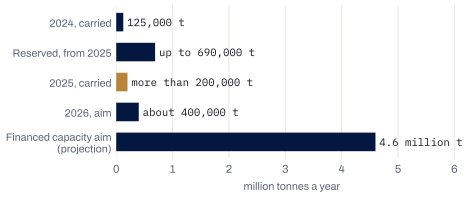
Signed 7 Feb 2024 (reserved capacity) and 17 Dec 2025 (loans); close of 753 million dollars announced 3 Jul 2026. 2025 plan 430,000 t; best month 37,000 t (Dec 2025). 690,000 t is the edition's sum of the two agreements' upper bounds (450,000 and 240,000 t).
Source · Lobito Atlantic Railway (June 2025); Railway Gazette, Expansão, Engineering News, Mining Weekly, ANGOP (2024 to 2026, press) · read 2026-10-20 and 21 · SEG-2
Show the underlying numbers
| Item | million tonnes a year |
|---|---|
| 2024, carried | 125,000 t |
| Reserved, from 2025 | up to 690,000 t |
| 2025, carried | more than 200,000 t |
| 2026, aim | about 400,000 t |
| Financed capacity aim (projection) | 4.6 million t |
Finance arrives years before tonnage, and a site chosen on the financing date is chosen on a forecast.
Mali's cargo is moving east, on the record of the port that gains it. The Ivorian ministry of economy, citing the Port Autonome d'Abidjan, gives Mali-bound transit of 1.47 million tonnes in 2025 against 835,216 in 2024, a rise APA News puts at 76.4 percent (press). Dakar handled 2.6 million tonnes of Malian transit in 2024 (press citing official data); its director general said in November 2025 that "nearly 65 percent" of Mali's transit passes through it (press), and no 2025 Malian tonnage for Dakar was found (Exhibit 8.2). Guinea is the third route: on 28 January 2026 Mali's Council of Ministers adopted a draft decree ceding Guinea, free of charge, 10 hectares near the Kouremalé to Bamako road for storage, after Guinea made 20 hectares at Kankan available to Mali, under agreements giving Mali use of the port of Conakry (press reproduction of the communiqué). Conakry Terminal handled 416,892 TEU in 2025 (press). No Malian tonnage through Conakry was found, and the shift rests on one year of Abidjan figures. CH08-C2
Where Mali's cargo goes: Dakar's last published year against Abidjan's two
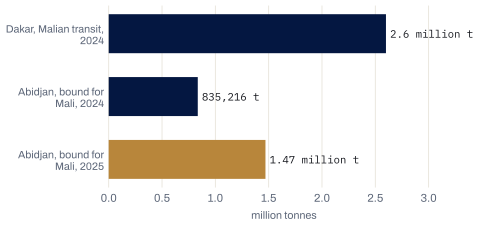
No 2025 Malian tonnage for Dakar and no Malian tonnage for Conakry was found; Dakar's director general said in November 2025 that nearly 65 percent of Mali's transit passes through Dakar (press). The two ports' definitions are not shown to be identical.
Source · Ecofin Agency (30 Jan 2026, press, citing official data) for Dakar; Côte d'Ivoire, Ministère de l'Économie, citing the Port Autonome d'Abidjan (17 Feb 2026) for Abidjan; APA News (24 Jun 2026, press) for the rise · read 2026-10-20 and 21 · SEG-1
Show the underlying numbers
| Item | million tonnes |
|---|---|
| Dakar, Malian transit, 2024 | 2.6 million t |
| Abidjan, bound for Mali, 2024 | 835,216 t |
| Abidjan, bound for Mali, 2025 | 1.47 million t |
A port's tonnage is not its hinterland's demand. Cotonou in Benin handled 14.7 million tonnes in 2025, up 52 percent, in a year when about 4.3 million tonnes of mostly Nigerien crude passed through the Sèmè-Podji terminal while Niger's classic transit declined and Burkina Faso, with nearly 1 million tonnes, mainly hydrocarbons, became the port's first transit partner (press, citing the port's commercial director; the sources do not say whether the crude is inside the port total). Niger has kept the land border closed since the July 2023 coup, and no physical reopening was found after talks whose "first phase" closed on 16 June 2026 without a reopening date (press). Lomé in Togo handled 30,641,830 tonnes in 2024, of which 20,233,379 were transhipment, 66 percent on the edition's arithmetic from the port's newsletter; its capacity aim of 2.5 million TEU by 2027 (press, a target) sits barely above the 2.4 million TEU reported for 2025 (press; chapter 6, row 18) (Exhibit 8.3). A 2025 transit series by destination country from a port authority or ministry was found for Abidjan alone. CH08-C3
A port's tonnage is not its hinterland's demand: Lomé 2024 and Cotonou 2025
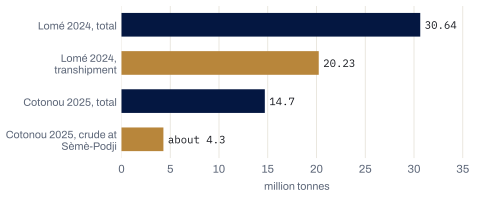
Lomé's share is the edition's arithmetic from two published figures (20,233,379 of 30,641,830 t). The sources do not say whether Cotonou's total includes the Sèmè-Podji crude, so the two Cotonou figures are shown side by side, not as a share.
Source · Port Autonome de Lomé, Pilotine no. 039 (2025); La Nouvelle Tribune (5 Oct 2026, press, citing the Port Autonome de Cotonou's commercial director) · read 2026-10-20 and 21 · SEG-2
Show the underlying numbers
| Item | million tonnes |
|---|---|
| Lomé 2024, total | 30.64 |
| Lomé 2024, transhipment | 20.23 |
| Cotonou 2025, total | 14.7 |
| Cotonou 2025, crude at Sèmè-Podji | about 4.3 |
In Morocco the on-corridor automotive case shrank in 2025 and a second gateway opened in 2026. Tanger Med handled 526,862 vehicles, down 12 percent, of which 327,569 were exported from Renault's Melloussa and SOMACA plants and 126,874 from Stellantis' Kénitra plant, 454,443 together on the edition's sum of the port authority's figures. The Office des Changes records vehicle-assembly exports down 13.5 percent in value while wiring rose 9 percent. In January 2026 Nador West Med's chairman projected a first container terminal of 3.5 million TEU and a second adding 1.8 million in 2027 (projections, press); on 10 September 2026 the concessionaire, a joint subsidiary of Marsa Maroc and MSC's terminal arm, declared the East terminal fully operational (press). Three press sources give three capacities for Nador, and no volume was found. CH08-C4
The rules on these corridors are written by few operators, and the access document that matters most was not found. Africa Global Logistics, an MSC subsidiary, states 24 port concessions and 2 rail concessions; it runs Conakry Terminal and Abidjan's second container terminal (press). The Compagnie du TransGuinéen, owner of the Simandou railway in Guinea, is held 42.5 percent each by Rio Tinto's SimFer and WCS, and 15 percent by the state (chapters 2 and 7); the line is multi-use, SimFer itself holds access on non-discriminatory terms (chapter 7), and no third-party tariff or timetable was found. The developer of the Adétikopé zone in Togo and Glo-Djigbé in Benin is Arise IIP, 50.76 percent owned by the Africa Finance Corporation, an interested party. The concentration was observed; its effect on tariffs was not measured. CH08-C5
Announced corridors reach construction slowly; the line already running is a better guide. The Abidjan to Lagos highway was to start construction in 2026 on the AfDB's November 2024 statement (press); on 25 June 2026 the Bank reported "ongoing discussions" on 500 million dollars for 1,081 km at an estimated 15 billion dollars (ECOWAS gives 1,028 km), and its release mentions no Board approval of investment finance. The Dakar to Bamako railway fiche carries no cost, with studies by 2027 and financial structuring in 2028 (projections). The Abidjan to Ouagadougou line carried 795,286 tonnes in 2024 against 1,016.2 thousand in 2019, on an Ivorian ministry series that stops at 2024. CH08-C6
What is contested
The first objection is that finance leads and tonnage follows once the money closes. The record shows the lag, not its end: the Lobito concessionaire planned 430,000 tonnes for 2025, carried more than 200,000, and now aims at about half the 800,000 it announced for 2026 (press). Conceded in part: its chairman reported in April 2025 round trips from Luau cut from 20 days to 7 or 8 (press), and the AfDB approved a 255 million dollar loan and a 10 million dollar grant for the Zambian leg on 6 August 2026, in a country rated at high risk of external debt distress (IMF list, 30 September 2025).
The second objection is that port growth is hinterland growth. For Abidjan, in part, it is: hinterland transit rose 34.1 percent in 2025. Cotonou's rise coincided with the pipeline's crude, and in the third quarter of 2024 its director attributed a 15 percent fall in turnover to the Niger closure (press). At Lomé two tonnes in three were transhipment in 2024; a plant at Adétikopé, 20 to 30 km inland, needs the third.
The third objection, that Mali's rerouting is a security episode rather than a structure, is partly conceded. Crisis Group reported attacks "of unprecedented scale on several towns in Mali" on 25 April 2026; a December 2025 headline reported fuel-tanker attacks resumed on the corridor linking Bamako to Côte d'Ivoire (press, no count); one trade publication puts Conakry's penalty at up to 1,000 dollars per container (press, indicative). Against it stand two land grants between governments, one dated 28 January 2026.
The corridor
What we expect in 2027
First, the Lobito Atlantic Railway carries less than 1 million tonnes in any twelve months ending in 2027, and its published 2026 outturn falls short of the 400,000 tonne aim; the corridor remains a pilot even with copper and cobalt demand at its strongest. Falsified if any published twelve-month total ending in 2027 exceeds 1 million tonnes, or if the published 2026 outturn reaches 400,000 tonnes; an outturn unpublished by 31 December 2027 leaves that clause unscored. Live-alternative hypothesis (Scenario 3). CH08-H1
Second, Abidjan's Mali-bound transit rises again in 2026, above the 1.47 million tonnes of 2025, while Dakar keeps the larger Malian tonnage in 2026 and 2027: the eastward shift continues without ending Dakar's primacy. Falsified if Abidjan's published 2026 Mali figure is at or below 1.47 million tonnes, or if any port authority or ministry figure puts Abidjan's Malian tonnage above Dakar's for 2026 or 2027. Where Dakar publishes no Malian figure for the year, Abidjan's is compared with Dakar's last published 2.6 million tonnes (2024); the 2027 clause is scored on releases of early 2028. Baseline hypothesis (Scenario 1). CH08-H2
Third, Tanger Med's 2026 vehicle total, due in its early 2027 release, falls below 2025's 526,862, a second year of decline, and Nador West Med publishes a twelve-month container volume of at least 500,000 TEU (the edition's threshold, about a seventh of the first terminal's projected capacity) by the end of 2027: the northern Moroccan gateway splits between two concession regimes. Falsified if Tanger Med's 2026 vehicle figure is at or above 526,862, or if no Nador volume of at least 500,000 TEU over twelve months is published by the port, its concessionaire or Marsa Maroc by 31 December 2027. Live-alternative hypothesis (Scenario 3). CH08-H3
Signposts
| Indicator | Definition fixed | Reading, date | Threshold | Crossing means |
|---|---|---|---|---|
| Lobito Atlantic Railway tonnage | concessionaire figures as relayed by ANGOP or trade press; calendar year and any twelve consecutive months | more than 200,000 t in 2025; 37,000 t in December 2025; at least 27,000 t in July 2026 (press) | above 1 million t in twelve months; or 2026 below 400,000 t | the pilot is a utility and a processing unit in Benguela or Huambo can plan on scheduled trains; or the 4.6 million t aim stays a financing case and the trucking fallback goes in the budget |
| Malian transit, Abidjan against Dakar | tonnes bound for Mali, port authority or ministry figures, annual | Abidjan 1.47 million t (2025); Dakar 2.6 million t (2024, press); Dakar 2025 not found | Abidjan above Dakar in a calendar year; or Abidjan's 2026 at or below 1.47 million t | Mali-facing bonded storage belongs on the Abidjan to Ferkessédougou axis; or the 2025 rise was an episode |
| Niger to Benin border at Malanville and Gaya | official communiqués of both governments; event-driven | closed by Niger since July 2023; first phase of talks closed 16 June 2026, no date (press) | trucks cleared at Malanville and Gaya for 90 consecutive days | Cotonou regains Niger; otherwise Niger's cargo stays on Togolese and Nigerian routes |
| Conakry Terminal volume and roadstead waiting | operator and ministry statements; TEU a year; days at anchor | 416,892 TEU (2025); five to six days (July 2026) (press) | 500,000 TEU in 2026, the new quay in service by early 2028, waiting below seven days | Conakry becomes a second outlet for Mali and storage at Kankan and near Kouremalé is worth costing |
| Tanger Med vehicles; Nador West Med containers | port authority annual release; first published Nador volume | 526,862 vehicles (2025, down 12 percent); Nador East terminal declared operational 10 September 2026, no volume (press) | 2026 vehicles below 2025; Nador at or above 500,000 TEU in twelve months by end 2027 | the northern Moroccan gateway splits and a new supplier prices two concession regimes |
| Third-party access on shared rail | a published tariff and timetable for non-anchor cargo on the Simandou railway or the Lobito line | none found, 20 and 21 October 2026 | a first published tariff | a non-mining user can cost the line; until then it cannot |
The two arenas
Francophone Europe. Renault and Stellantis are the clearest on-corridor case, exporting through one Moroccan complex under its platform's rules in 2025; a second gateway opened in September 2026 under another concessionaire. A French retailer, Kiabi, took the first garments made at Glo-Djigbé in Benin (AFP, press), from a zone where a manager declined questions and workers were not allowed to speak to journalists (AP, press). In Belgium, Antwerp-Bruges's crude oil throughput fell 40.8 percent in 2025, which the port attributes mainly to lost exports to West Africa, especially Nigeria. European corridor money is announced by programme, 150 billion euros and 12 listed corridors with Lobito among them, and no progress figure by corridor was found.
Francophone Africa. In Côte d'Ivoire, Mali-facing storage on the northern axis has the 2025 transit figure and 235 million dollars signed by the Islamic Development Bank on 19 June 2026 for the Tafiré to Ferkessédougou motorway section (press). In Senegal, Ndayane, due in the third quarter of 2028 (projection, press; chapter 3), is a container decision. In Togo, Adétikopé reports 12 of 25 partner companies operational and more than 6,580 direct jobs (press, June 2026); the Africa Finance Corporation's undated page gives 3,200. In Benin, a Glo-Djigbé plant serves Burkina Faso and the coast or must absorb the risk of Niger's 2023 border closure. In Morocco, a royal speech of 6 November 2023 offered the Sahel states access to Moroccan ports, and Dakhla's port was physically 57.16 percent complete in April 2026, with commissioning projected in July 2024 for 2029 (press).
What a board should ask
The test before commitment
The test is a corridor-rules dossier and a landed-cost run, built in two steps of the STREDGE Evidence-to-Decision Cycle. In the Diagnose step the dossier names, for each candidate corridor, the operator of every link (port, terminal, zone, rail concession, border regime) and the dated document governing third-party access, tariff, land tenure and exit; an unread document is marked unread. In the Simulate step the run prices one 40-foot container from the candidate port to Bamako, Ouagadougou or Niamey: port and terminal charges, plus line haul, plus days at borders and checkpoints times the daily cost of the truck and of the stock it carries, plus a fallback line for a 90-day closure of the weakest link, trucks around a break as at Lobito in 2026 or a second port as for Niger since 2023. The method is the East African corridor observatories'; no West African one was found. The test is built to survive Scenario 2, in which a border closes and the question is who stays operational; under Scenario 3 a deploy verdict must also hold when a shared line gives its anchor mining cargo priority.
The verdicts: deploy, when every link has a governing document read and the closure case leaves the margin positive; rethink, when one link's rules are unpublished, as with third-party access on the Simandou railway; keep testing, when the deciding figures are unpublished, as with Dakar's 2025 Malian tonnage; stop, when the hinterland depends on a closed border, as a Niger-facing plant in Benin did at the last dated reading, in June 2026. What to stop: reading a financial close, a programme envelope or a capacity aim as tonnage. What to sequence: the dossier before the shortlist, the February 2027 port releases before the land option, a lease with an exit before ownership wherever a corridor carries less than its financed case. Finance arrives years before tonnage, and a site chosen on the financing date is chosen on a forecast. The number the evidence does not contain is the door-to-door time and cost of one 40-foot container from Dakar, Abidjan, Conakry, Lomé or Cotonou to Bamako or Ouagadougou on one method; it is the first primary-research item.
What to instrument: landed days and cost per container per corridor from our own shipments; days held at each border post; the share of hinterland volume through each port; the links with a governing document in hand; trucking-fallback days per year.
- For the shortlisted site, can we name the operator and governing document of every link from quay to gate, and which have we not read?
- What did our last container to Bamako or Ouagadougou cost door to door, and how long did it wait at the border?
- If our hinterland's border closed for 90 days, which port would we use and what would it add per container?
- Which published tonnage figure, from whom, would make us reverse the site choice?
Evidence cards
CH08-C1SEG-1(SEG-2 for the reserved-capacity sum of up to 690,000 tonnes a year and the monthly equivalent of the capacity aim)Lobito's financing closed in July 2026 after a 2025 outturn of about half the plan.
- Context
- the concessionaire's presentation to the ATECFA technical conferences, Luanda, 3 to 4 June 2025 (2024 outturn of 125,000 tonnes; 2025 plan of 430,000 tonnes; 1,555 container wagons and 49 line locomotives planned; capital expenditure "up to USD 100 million over three years of works"); Expansão (14 April 2025, press, for the 800,000 tonne 2026 target and cycle times; 18 December 2025, press, for the signing); Engineering News (27 March 2026, press citing the concessionaire) for the 2025 outturn and the December month; ANGOP via AllAfrica (16 September 2026, press) for July 2026, which it calls "a first for the concessionaire", not a record, and the 2026 aim; Railway Gazette International (7 February 2024, press); Mining Weekly (3 July 2026, press, reporting the Africa Finance Corporation's statement) and RTP with Lusa (7 July 2026, press, reporting the Angolan transport ministry's communiqué); Engineering News with Bloomberg (15 June 2026, press) for the flood and the restoration on 13 June.
- Contradictory evidence
- cycle times fell from 20 days to 7 or 8 (press).
- Causal confidence
- the sequence is described, not explained; part of the 2026 shortfall may belong to the flood.
- Transferability
- one concession in Angola with a Congolese export base.
- Review date
- 21 October 2026.
CH08-C2SEG-1press for the 76Mali-bound transit through Abidjan rose 76.4 percent in 2025; Dakar's 2025 Malian tonnage was not found; Guinea and Mali exchanged land for storage.
4 percent, Dakar and Conakry.
- Context
- Côte d'Ivoire, Ministère de l'Économie portal citing the Port Autonome d'Abidjan (17 February 2026), which settles the year of the 835,216 tonne base; APA News (24 June 2026, press) for the 76.4 percent; Ecofin Agency (30 January 2026, press, citing official data) for Dakar 2024, 2.6 of 24.5 million tonnes; Le Soleil via AllAfrica (20 November 2025, press) for the director's quotation; L-Frii reproduction of the Council of Ministers communiqué of 28 January 2026 (press; not stated to be complete; no date for the Kankan allocation); Managers.tn (16 September 2026, press) and Guinéenews (20 July 2026, press) for Conakry.
- Contradictory evidence
- the same Dakar newspaper's reporter wrote 70 percent of Malian imports four days after the director's quotation; Seneweb (7 May 2026, press) gives Malian traffic "regularly" above 20 percent of Dakar's goods volumes, a different denominator.
- Causal confidence
- security events and route disruption are rival readings of the 2025 rise.
- Review date
- 21 October 2026.
CH08-C3SEG-1(SEG-2 for the 66 percent share), press for Cotonou and for Lomé 2025Cotonou's 2025 rise coincided with pipeline crude and a closed border; two thirds of Lomé's 2024 tonnage was transhipment.
- Context
- La Nouvelle Tribune (5 October 2026, press) and Bénin Web TV (6 October 2026, press), both reporting the port's commercial director at Media Connect 2026; Afrique Sur 7 (18 December 2024, press) for the third quarter of 2024; APA News and Seneweb (17 June 2026, press) for the joint communiqué; Port Autonome de Lomé, Pilotine no. 039 (2025), with 3.8 million tonnes of transit for 2023 and no country breakdown; Togonews via AllAfrica (11 January 2026, press) for the 2027 capacity aim; Le360 Afrique with AFP (21 September 2026, press) for 2025 TEU.
- Method
- the sources read do not state whether Cotonou's total includes the Sèmè-Podji crude, so Exhibit 8.3 shows the two figures side by side.
- Contradictory evidence
- Abidjan's hinterland transit grew with its total; a Timbuktu Institute note of 27 July 2026 states that reopening "was agreed", and no physical reopening was found.
- Review date
- 21 October 2026.
CH08-C4SEG-1(SEG-2 for the 454,443 sum), press for Renault and NadorTanger Med's vehicle throughput fell 12 percent in 2025; Nador West Med's first container terminal was declared operational in September 2026.
- Context
- Tanger Med Port Authority release of 2 February 2026, re-read 21 October 2026 (39,751 vehicles transhipped); Hespress FR (27 January 2026, press, figures not attributed to a named release; Renault's Moroccan production 394,474 vehicles, down 5 percent, and exports 327,552, down 11 percent and 17 fewer than the port's count); Office des Changes, Rapport annuel du commerce extérieur 2025 (automotive exports 159.2 billion dirhams against 159.6 billion; values only; automotive data revised in May 2026); Le360 (29 January and 10 September 2026, press); TelQuel (17 September 2026, press, partly paywalled; gas terminal suspended).
- Contradictory evidence
- Nador's capacity is given as 3.5 million TEU, "5 millions de conteneurs" and "environ 3 millions" by three press sources; wiring exports rose while assembly fell.
- Transferability
- Morocco's 2025 national production in units was not found.
- Review date
- 21 October 2026.
CH08-C5SEG-1press for the Abidjan terminalA few operators and one zone developer hold the links named in this chapter; no third-party tariff for the Simandou railway was found.
- Context
- Africa Global Logistics home page (undated); Abidjan.net (26 July 2024, press; Côte d'Ivoire Terminal in operation since November 2022); Managers.tn (16 September 2026, press) for Conakry Terminal; Rio Tinto Simandou page and Rio Tinto Guinée release of 3 December 2025; Rio Tinto release of 16 July 2024, as read for chapters 2 and 7, for SimFer's access clause; Africa Finance Corporation investee page for Arise IIP (undated; an interested party; shareholding of AFC Equity 50.76 percent, FEDA 25.51 percent, Africa Transformation and Industrialization Fund 23.73 percent).
- Contradictory evidence
- AGL's 24 port concessions are group-wide, not counts within these corridors; the corridors read here have at least eight rule-setters, among them Tanger Med's port authority, Marsa Maroc at Nador and the Lobito concessionaire; Abidjan's second terminal followed a tender won by an AGL and APM Terminals consortium (press).
- Causal confidence
- none claimed; the effect of operator concentration on tariffs was not measured.
- Review date
- 21 October 2026.
CH08-C6SEG-1press for the 2024 AfDB statementThe Abidjan to Lagos highway showed no investment approval at 25 June 2026, and the operating Abidjan to Ouagadougou line carried less in 2024 than in 2019.
- Context
- News Agency of Nigeria via Gazette Nigeria (27 November 2024, press); ECOWAS Commission (5 May 2026); African Development Bank release via AllAfrica (25 June 2026); AUDA-NEPAD PIDA fiche, Dakar to Bamako (October 2025); Côte d'Ivoire, Ministère de l'Économie, transport ferroviaire page (updated 26 November 2025; series to 2024, 2024 up 7.7 percent); European Commission, DG INTPA corridors page (undated).
- Contradictory evidence
- the two highway lengths disagree.
- Review date
- 21 October 2026.
CH08-H1 to H3SEG-0Hypotheses for 2027.
Falsification conditions stated above; scenario mapping stated in each.
Sources and limitations
Sources read on 20 and 21 October 2026. Lobito Atlantic Railway, presentation by its chief operating officer to the IIIº Ciclo Internacional de Conferências Técnicas Ferroviárias (ATECFA, Luanda, 3 to 4 June 2025, hosted by ADFERSIT); Expansão (14 April 2025 and 18 December 2025, press); Engineering News (27 March 2026, press); Engineering News with Bloomberg (15 June 2026, press); ANGOP via AllAfrica (16 September 2026, press); Railway Gazette International (7 February 2024, press); Mining Weekly (3 July 2026, press); RTP with Lusa (7 July 2026, press); African Development Bank via AllAfrica (25 June and 7 August 2026); IMF, List of LIC DSAs for PRGT-Eligible Countries (30 September 2025); Côte d'Ivoire, Ministère de l'Économie, du Plan et du Développement, Port Autonome d'Abidjan 2025 (17 February 2026) and transport ferroviaire page (updated 26 November 2025); Ecofin Agency (30 January and 16 October 2026, press); Le Soleil via AllAfrica (20 and 24 November 2025, press); Seneweb (7 May and 17 June 2026, press); L-Frii, Council of Ministers of Mali (28 January 2026, press); Managers.tn (16 September 2026, press); Guinéenews (20 July 2026, press); La Nouvelle Tribune (5 October 2026, press); Bénin Web TV (6 October 2026, press); APA News (17 and 24 June 2026, press); Afrique Sur 7 (18 December 2024, press); Port Autonome de Lomé, Pilotine no. 039 (2025); Togonews via AllAfrica (11 January and 11 June 2026, press); Le360 Afrique with AFP (21 September 2026, press); Tanger Med Port Authority, Bilan de l'activité portuaire en 2025 (2 February 2026); Hespress FR (27 January 2026, press); Office des Changes, Rapport annuel du commerce extérieur 2025; Le360 (29 January, 1 May and 10 September 2026, press); TelQuel (17 September 2026, press); Challenge (6 July 2024, press); Royaume du Maroc, maroc.ma, royal speech of 6 November 2023; Africa Global Logistics, home page (undated); Abidjan.net (26 July 2024, press); DP World, Ndayane release (27 July 2026), and Le Soleil (17 September 2026, press), both as read for chapter 3; Rio Tinto, Simandou project page, and Rio Tinto Guinée (3 December 2025); Africa Finance Corporation, Arise IIP investee page (undated); AFP via Connaissance des Énergies (10 July 2026, press); AP via NY1 (13 September 2026, press); News Agency of Nigeria via Gazette Nigeria (27 November 2024, press); ECOWAS Commission (5 May 2026); AUDA-NEPAD, PIDA project fiche Dakar to Bamako (October 2025); European Commission, DG INTPA, EU-Africa strategic corridors and Global Gateway Africa-Europe package pages (undated) and infrastructure factsheet (November 2022); Port of Antwerp-Bruges, 2025 annual figures factsheet (FR); International Crisis Group, Sahel page; intellinews (12 December 2025, press, headline only); Logistafrica (14 October 2025, press); Timbuktu Institute (27 July 2026).
Prior art. Roberts, Bougna, Xu and Melecky, "Transport Corridors and Their Wider Economic Benefits" (World Bank Policy Research Working Paper 8302, January 2018), a review of 234 estimates from 78 studies finding gains on average with wide variation by place and group; the Asian Development Bank's Greater Mekong Subregion programme (since 1992); the Northern Corridor and Central Corridor transport observatories, the method precedent for the landed-cost run; Khanna, Connectography; AUDA-NEPAD PIDA fiches; the Africa Finance Corporation's State of Africa's Infrastructure Report 2024 (via Ecofin, not read directly). Named here only, their figures not used: CrossBoundary Advisory on the Lobito corridor (14 July 2025); Boston Consulting Group on stalled infrastructure (13 October 2025, as cited by NTU-SBF); Oxford Economics for DP World Senegal (commissioned); Agence Française de Développement on special economic zones (July 2025, via AFP).
Limitations. No 2025 tonnage, transhipment share or transit by country was found from the Port Autonome de Lomé or the Port Autonome de Cotonou; Cotonou's 2025 figures rest on press reports of the commercial director, and the sources do not say whether the Sèmè-Podji crude sits inside the port total. Dakar's Malian tonnage after 2024 was not found; no Malian or UEMOA source gives Mali's cargo by port, and Conakry's Malian tonnage is unpublished. Lobito's 2025 outturn and monthly figures rest on press citing the concessionaire; no 2026 year-to-date total was found and the financiers' own pages could not be read. Nador West Med's opening and capacity rest on press; no volume was published. Morocco's 2025 vehicle production in units was not found. Whether the Niger to Benin border physically reopened after July 2026 was not found and should be read again before publication. No published third-party access tariff was found for the Simandou railway or the Lobito line. Zone figures for Adétikopé and Glo-Djigbé come from the zones, their shareholders or press relaying them. The chapter assumes the 2026 port figures follow the 2025 publication calendar.
Exhibits for the web edition: Exhibit 8.1, finance before tonnage on the Lobito line, 2024 outturn to financed capacity, with the financing dates in the note (concessionaire presentation; press citing the concessionaire and financiers); Exhibit 8.2, where Mali's cargo goes, Dakar 2024 and Abidjan 2024 and 2025 (Ecofin, press; Ivorian ministry citing the port); Exhibit 8.3, port tonnage beside its composition, Lomé 2024 and Cotonou 2025 (Pilotine no. 039; La Nouvelle Tribune, press).
Corrections and challenges: through the channel on this page; logged with their dates.
Download the PDFs
The full edition, the executive summary and the eleven parts are free to download. Leave your work email and the files open on this page.