Global Strategic Outlook 2027 · Chapter 10 of 10
Chapter 10. The premium is financial flexibility, not resilience
How much slack to carry into 2027, and the calendar of the ten decisions.
Bruno Hounkpati, Founding Partner and Chief Executive Officer
20 October 2026
Chapter 10
The premium is financial flexibility, not resilience: how much slack to carry into 2027, and the calendar of the ten decisions
In the 2020 crash the measured premium sat on the balance sheet: US listed firms with more cash and less debt fell 9.7 points less, about a quarter of the average fall, while ESG scores had no significant explanatory power once finances were controlled for. French mid-sized firms still hold more cash than in 2019, and under one central bank new lending rose 13.9 percent in Côte d'Ivoire and fell 23.7 percent in Mali in 2025. The 2027 decision is how much slack to carry, and in which quarter each of the edition's ten decisions passes its evidence gate.
- The decision: how much financial flexibility to carry into 2027 (days of cash, net debt to earnings, undrawn lines), and in which quarter each of the edition's ten decisions passes its evidence gate before an irreversible commitment; owner, the chief executive with the chief financial officer, answerable to the board.
- What the evidence says: the best-measured crash premium is financial. Among 1,857 US listed firms in early 2020, high cash and low debt went with returns 9.7 points higher, a gap equal to about a quarter of the average fall, and ESG scores had no significant explanatory power once finances were controlled for. French mid-sized firms held a median 52 days of cash in 2025, 6 days above 2019, while the share with very weak ratings rose for a fifth year. Under one central bank, new lending rose 13.9 percent in Côte d'Ivoire and fell 23.7 percent in Mali in 2025.
- The test: the calendar itself. Each irreversible commitment goes after the reading that decides it, with slack sized against the stress case; seven more days of cash cost a company with 200 million euros of turnover about 88,000 to 150,000 euros a year. The number the evidence lacks: what that slack is worth to an unlisted company of 30 to 500 million euros.
Decision at stake
How much financial flexibility does the company carry into 2027, counted in days of cash, net debt to earnings and undrawn lines, and in which quarter does each of the edition's ten decisions pass its evidence gate before an irreversible commitment? The owner is the chief executive with the chief financial officer, answerable to the board. The dated moments are the budget and financing round from the fourth quarter of 2026 into the first of 2027, the four dashboard readings of chapter 6, the capex committee dates, and two readings of 2026: the BCEAO's annual report on UEMOA bank credit, expected in late September 2027, and the Banque de France's next reading of French mid-sized firms, expected in the second half of 2027. The cost of error runs both ways: too little slack can leave a company with the options a single-site glassmaker took from late 2022, stopping the furnaces and borrowing from the state; too much pays yearly for protection that staged commitments may buy at lower cost, a comparison no source read has measured.
The measured premium is a financial-flexibility premium on listed firms in a crash; no resilience test for unlisted companies of 30 to 500 million euros was found.
What the evidence shows
What changed, 2024 to 2026
The best-measured premium sits on the balance sheet. Among 1,857 US listed non-financial firms, one with cash at the 75th percentile and both debt ratios at the 25th had cumulative excess returns 9.7 percentage points higher from 3 February to 23 March 2020 than one with the reverse profile, within industry and with market beta controlled; the gap equals 26 percent of the average firm's 37-point fall. The working paper's abstract adds that a firm with the average payout ratio would have fallen about 2 points less with no payouts over the prior three years; the version published in 2021 drops this: "No evidence suggests that recent payouts worsened the average firm's drop in stock price". Reading the premium as leverage and liquidity rather than operating adaptability is the edition's inference, on working-paper figures. CH10-C1
The best-measured premium sits on the balance sheet.
The same ordering was found across 6,135 listed firms in 56 economies, in other units. On weekly returns from 2 January to 27 March 2020, the predicted weekly reaction of a firm at the 75th percentile of leverage was 27 percent larger than at the 25th, a ratio rather than a cumulative fall; a firm at the 75th percentile of customers' exposure to affected economies was predicted to fall 3.25 points more over two months than one at the 25th. The published version uses more than 6,700 firms in 61 economies; its magnitudes were not read. These figures and those above differ in sample, window and unit, and the chapter does not add them. CH10-C2
The shocks of 2022 and 2025 repeat parts of the pattern on thinner evidence. Among Italian industrial firms whose fixed-price energy contracts expired, the probability of a positive profit margin fell 10 points in 2022; cash and leverage were not tested. Among Danish manufacturers, credit growth of energy-intensive firms fell 8.75 points relative to others in the second quarter of 2022, concentrated in high-liquidity firms, which the authors of the ECB working paper read as precaution. Around the April 2025 tariff announcement, exposed US firms showed lower abnormal returns, strongest where leverage was high, among other traits, and US importers shifted volumes almost one for one to lower-risk countries rather than reshoring (both abstracts only). No sample is a francophone mid-sized company. CH10-C3
Two popular proxies for resilience failed their tests. Among US stocks in 2020, ESG scores had no significant explanatory power once industry, risk, accounting performance, financial position and intangibles investment were controlled for; internally generated intangibles did. A 64-country trade model found that renationalising supply chains would not in general have made countries more resilient, and the OECD judged in February 2021 that "the economic case for policy-induced reshoring of GVCs is therefore weak". These results on US equities and country models bound what a resilience programme can claim. CH10-C4
French mid-sized firms still hold more cash than before COVID-19, while their weakest tail has grown. INSEE counts 7,031 ETI in 2023. Median ETI cash on the Banque de France's FIBEN data stood at 52 days of turnover in 2025, down from 59 in 2024 but 6 days above the 46 of 2019, against 50 for PME (Exhibit 10.1). The share with the bank's best ratings fell from 68 percent in 2022 to 58 percent in 2025, and the very weak share reached 8.4 percent, up for a fifth consecutive year. The bank suggests, without testing it, that firms may have raised the level of cash they consider satisfactory since COVID-19. CH10-C5
Slack held, then drawn: median cash of French mid-sized firms (ETI)
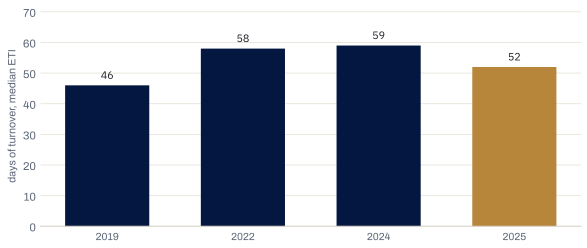
Two bulletins, each on its own year's FIBEN population; PME excluding micro held 50 days in 2025. The 2019 level of 46 days is the line in hypothesis H3.
Source · Banque de France, Bulletin 249/5 (Nov to Dec 2023; 2019 and 2022) and Bulletin 265/3 (Jul to Aug 2026; 2024 and 2025), FIBEN data · read 2026-10-21 · SEG-1
Show the underlying numbers
| Item | days of turnover, median ETI |
|---|---|
| 2019 | 46 |
| 2022 | 58 |
| 2024 | 59 |
| 2025 | 52 |
One central bank, opposite moves in new lending. New bank lending in the UEMOA rose 6.0 percent in 2025 at an average rate of 6.69 percent, 6.06 for large enterprises and 7.03 for MPME. It rose 2.5 percent in Benin, 0.2 in Burkina Faso, 13.9 in Côte d'Ivoire, 84.7 in Guinea-Bissau, 4.8 in Senegal and 23.5 in Togo, and fell 23.7 percent in Mali and 10.8 in Niger (Exhibit 10.2). With PME capped at 1 billion FCFA of turnover, about 1.5 million euros, a company in this edition's range is not a PME on the BCEAO's definition, so the 6.06 percent large-enterprise average is its nearer reference and the 7.03 percent MPME average that of its PME suppliers. Senegal reached a staff-level agreement with the IMF on 1 September 2026, for about 2.2 billion dollars; no Board approval was found by 21 October. CH10-C6
One central bank, opposite moves: 2025 new lending, 2024 = 100
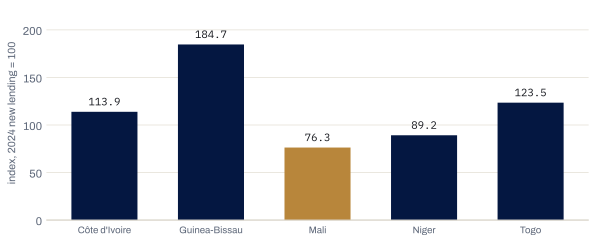
Alphabetical order, not a ranking. Below 90 is the signpost line (a fall of more than 10 percent). Not shown: Benin 102.5 (1,977.9 billion FCFA in 2025), Burkina Faso 100.2 (2,418.6), Senegal 104.8 (5,974.7); Union 106.0 (22,857.9). The report gives no 2025 rate by country.
Source · BCEAO, Rapport annuel sur les conditions de banque dans l'UEMOA, 2025 (25 Sep 2026), Table 3, p. 13; index computed by the edition from new lending in billion FCFA · read 2026-10-21 · SEG-2
Show the underlying numbers
| Item | index, 2024 new lending = 100 |
|---|---|
| Côte d'Ivoire | 113.9 |
| Guinea-Bissau | 184.7 |
| Mali | 76.3 |
| Niger | 89.2 |
| Togo | 123.5 |
Base rates for irreversible commitments are poor, and decision success varied with process in the one peer-reviewed decision study read. Across 245 large dams in 65 countries, the mean cost overrun in constant local currency was 96 percent, the median 27, and eight in ten finished late. In 356 decisions in medium and large US and Canadian organisations, Nutt reports that "half the decisions made in organizations fail", with sustained use at 53 percent under implementation by edict against 80 by participation, and success at 70 against 56 percent when more than one option was considered. Neither sample covers investment by mid-sized companies. CH10-C7
What is contested
The first objection is that operating disruption costs value whatever the balance sheet. Conceded in part: across 827 disruptions announced by US listed firms from 1989 to 2000, the mean abnormal return from a year before to two years after was minus 40.66 percent, with no recovery in the second year (working-paper version). The chapter claims only that the crash premium was found on the balance sheet; operating exposures are the decisions of chapters 2 and 3.
The second objection is that slack is waste. For buffers bought by localising supply the OECD agrees, and so does the chapter. For cash the French figures answer: the direct cost of carrying it, estimated short-term borrowing cost net of money-market return, averaged 2.3 percent for French private firms in 2016, down from 3.9 percent in 2011, and the authors who measured it call cash hoarding "an active economic stabilizer". The objection lands on one point: the 2-point payout estimate appears only in the working paper's abstract.
The third objection is that foresight, not balance sheets, separates firms. The one longitudinal test found followed 70 large European firms for seven years: those classed "vigilant" were 33 percent more profitable than the average (university news page, secondary), with no causal identification and no mid-sized firm. Two practitioner studies of resilient companies named in the prior-art declaration select on the returns they credit.
The corridor
What we expect in 2027
First, by 31 December 2027 at least one firm-level study of the 2026 energy shock, from a central bank, the NBER or a peer-reviewed journal, finds that firms with higher pre-shock leverage or lower cash fared worse in returns, credit or margins. Falsified if the studies published by that date find no significant difference in that direction by leverage or by cash, or find the opposite sign; if none is published, the hypothesis is reported as untested. Stress-case hypothesis (Scenario 2), in which the shock runs longest. CH10-H1
Second, the BCEAO's report for 2026 shows new lending falling in Mali and in Niger and rising in Côte d'Ivoire and in Togo, with the Union's MPME rate above 7.0 percent. Falsified if new lending rises in Mali or in Niger, falls in Côte d'Ivoire or in Togo, or if the MPME rate is at or below 7.0 percent; if the report is not published by 31 December 2027, the hypothesis is reported as untested. Baseline hypothesis (Scenario 1). CH10-H2
Third, French ETI enter 2027 with slack on average and stress in the tail: the Banque de France's reading for 2026 shows median ETI cash at or above 46 days of turnover while the very weak rating share rises for a sixth year, above 8.4 percent. Falsified if median ETI cash is below 46 days, or if the very weak share is at or below 8.4 percent; if no reading for 2026 is published by 31 December 2027, the hypothesis is reported as untested. Baseline hypothesis (Scenario 1). CH10-H3
Signposts
| Indicator | Definition fixed | Reading, date | Threshold | Crossing means |
|---|---|---|---|---|
| Median ETI cash, France | Banque de France FIBEN, days of turnover, as published in the bank's Bulletin; no fixed publication date found | 52 days, 2025 (59 in 2024; 46 in 2019), bulletin of July to August 2026 | below 46 days | the post-2020 buffer is spent: debt-financed French capex waits for a cash-funded first phase |
| ETI with very weak ratings (6 to 8), France | Banque de France rating distribution, end of year | 8.4 percent, end 2025, fifth consecutive rise | above 10 percent | tighten credit limits on French ETI customers and suppliers; review days sales outstanding monthly |
| New bank lending by UEMOA country; MPME rate | BCEAO annual report on banking conditions, September | Union up 6.0 percent; Mali down 23.7, Niger down 10.8; MPME 7.03 percent (2025, report of 25 September 2026) | new lending down more than 10 percent in a target country, or MPME rate above 8.0 percent | that country is treated as credit-constrained, on a one-year flow that is not a measure of access: debt-financed capex there sits behind a cash-funded pilot |
| Senegal's IMF arrangement | IMF press releases, event-driven | staff-level agreement of 1 September 2026, SDR 1,537.1 million; no Board approval found, 21 October 2026 | Board approval; or none by 30 June 2027 | approval: Senegal-facing capex returns to the normal gate; none: Senegal-facing commitments stay cash-funded and receivable terms shorten |
| ECB deposit facility rate | chapter 6, row 13 | 2.50 percent, raised 10 September 2026 | 3.00 percent | cash earns more and debt costs more: raise the slack target before the next refinancing |
| World Uncertainty Index, simple average | chapter 6, row 17, quarterly via FRED | 43,566, third quarter of 2026 | above the 56,813 peak of the third quarter of 2025 | an attention gauge: capex gates move to the second half of 2027 only if a non-attention row of chapter 6 crosses in the same quarter |
The two arenas
Francophone Europe. In France the 2022 energy shock met two glassmakers. Duralex, single-site near Orléans, stopped its furnaces for about five months from late 2022 (secondary compilation of press), borrowed 15 million euros from the state, entered receivership on 24 April 2024 and passed to an employee cooperative on 26 July 2024 (press). Arc, not a mid-sized firm, announced on 8 September 2022 that 3 to 5 of its 9 furnaces would stop over the winter, its gas bill multiplied by four (company release), and entered receivership in January 2026 (press). The 2020 premium was measured over seven weeks, not two energy winters. For Belgium, Switzerland and Luxembourg no firm-level evidence on slack was found.
Francophone Africa. Under one central bank, a company serving Côte d'Ivoire and Mali saw new lending move in opposite directions in 2025, so the gate is set country by country. Senegal's overall fiscal deficit narrowed from 13.4 percent of GDP in 2024 to 6.4 percent in 2025, yet the IMF judged in June 2026 that "fiscal and debt vulnerabilities remain elevated". In Guinea, Simandou's operator expects a 30-month ramp-up to 60 million tonnes a year after the shared rail and port are commissioned (company disclosure): for suppliers adding capacity, the ramp-up is the gate, not the nameplate. No count of mid-sized firms was found for Morocco, Côte d'Ivoire or Senegal.
The 2027 calendar
On the edition's placement, the budget round from the fourth quarter of 2026 into the first of 2027 carries three: the procurement budget (chapter 2), the AI tooling lines (chapter 5) and the financing round (chapter 10); the first-quarter capex rounds carry a fourth, the site (chapter 1), while Morocco's power case closes on 28 February (chapter 4) and the carbon-border outlays begin (chapter 9). This chapter's credit readings are expected in the second half of the year. The rule: commit reversible steps first, and each irreversible one after the reading that decides it.
| Quarter | Date | Event | Decision it opens or closes (chapter number) | Source |
|---|---|---|---|---|
| Q4 2026 | 10 and 27 November 2026 | Suspensions of China's October 2025 export controls and of its 2024 licensing aimed at the United States expire unless a numbered notice extends them | Opens the licence contingency on the site decision (1) and the weeks of stock held against the date (2) | Chapter 1, Decision at stake and board section; chapter 2, Decision at stake and board section |
| Q4 2026 | Fourth quarter of 2026 | Inventory budget round | Opens which single points of failure to remove, at what cost of carry (3) | Chapter 3, Decision at stake |
| Q4 2026 to Q1 2027 | Fourth quarter of 2026 to first quarter of 2027 | 2027 budget and financing round | Opens the slack decision (10); sets the AI tooling and training lines (5); the procurement budget closes on input exposures (2) | This chapter, Decision at stake; chapters 5 and 2, Decision at stake, which give no quarter: the placement is this edition's |
| Q4 2026 | 30 November 2026 | Second trilogue on the downstream extension of the carbon border mechanism, as scheduled in a law-firm note | Opens the scope of exporters' 2028 exposure (9) | Mayer Brown, law-firm note (7 October 2026); chapter 9 found no agreement on 20 October 2026 |
| Q4 2026 to Q1 2028 | Late 2026 to early 2028 | Conakry's new quay due (press) | Reopens Conakry as a second outlet for Mali (8) | Chapter 8, Decision at stake |
| Q1 2027 | 10 January 2027 | The US-China truce, extended in September 2026, runs out again | Bounds the site decision (1) and the input-exposure decision (2) | Chapter 1, Decision at stake; chapter 2, Decision at stake |
| Q1 2027 | January 2027 | Guinea's 2026 bauxite export total becomes known | Reads chapter 2's hypothesis on the processing-partnership decision (2) | Chapter 2, hypothesis H2 |
| Q1 2027 | First quarter of 2027 | First-quarter capex rounds approve the location of the next unit of capacity | Closes the site and standard decision (1) | Chapter 1, Decision at stake |
| Q1 2027 | 1 February 2027 | First sale of carbon border certificates | Opens the importers' working-capital line (9) | Chapter 9, Decision at stake; chapter 6, row 16 |
| Q1 2027 | Early to mid February 2027, expected | Tanger Med's and Abidjan's annual releases for 2026 | Opens the on- or off-corridor read for Moroccan and Ivorian sites (8) | Chapter 8, Decision at stake (the 2025 releases were dated 2 and 17 February 2026); chapter 6, The two arenas |
| Q1 2027 | 28 February 2027 | First period of Morocco's surplus tariff for self-producers ends | Closes the Moroccan self-production case, which must be run before it (4) | Chapter 4, board section |
| Q1 2027 | 19 March 2027 | France's deadline to transpose Omnibus I (date from the Parliament's procedure summary and a legal publisher, press) | Settles whether French first-wave companies outside the new scope still report on financial year 2025 and are exempt for 2026 (9) | Chapter 9, Decision at stake, hypothesis H3 and Limitations |
| Q1 2027 | 26 March 2027, last Friday of March | First quarterly dashboard reading | May reopen any of decisions 1 to 10 on a declared shift (6) | Chapter 6, board section |
| Q1 2027 | 31 March 2027 | Quarterly holding rule of 50 percent for carbon border certificates applies | Turns the carbon-border cost into pre-funding through the year (9) | Chapter 9, Decision at stake |
| Q1 to Q2 2027 | First half of 2027 | Carrier renewals on Asia-to-Europe contracts, on chapter 3's assumption of the contract cycle | Closes the single-points-of-failure decision (3) | Chapter 3, Decision at stake |
| Q1 to Q4 2027 | During 2027, projected (press) | Nador West Med's second container terminal | Reads chapter 8's H3 on the northern Moroccan corridor (8) | Chapter 8, Decision at stake and hypothesis H3 |
| Q2 2027 | 25 June 2027, last Friday of June | Second quarterly dashboard reading | May reopen any decision on a declared shift (6) | Chapter 6, board section |
| Q2 2027 | 30 June 2027 | Test date: whether both Chinese suspensions have been extended by numbered notice through this date | Reads chapter 1's H2 and chapter 2's H1 (1, 2) | Chapter 1, hypothesis H2; chapter 2, hypothesis H1 |
| Q2 2027 | 30 June 2027 | End of the no-gas line a company's 2027 budget for Senegal must carry | Closes the Senegal power-route assumption (4) | Chapter 4, board section |
| Q2 2027 | 30 June 2027 | End of the dispute centre's fiscal year 2027 | Reads chapter 7's H1 on contract structures (7) | Chapter 7, hypothesis H1 |
| Q2 2027 | End of the second quarter of 2027 | Senegal: creditors' agreement in principle or none; IMF Board approval or none | Senegal receivables and bank lines (6); funding of Senegal-facing capex (10) | Chapter 6, row 14 and board section; this chapter, Signposts |
| Q3 2027 | July 2027 | 2026 reading of AI use by French enterprises of 50 to 249 employees | Reads chapter 5's H1 (5) | Chapter 5, hypothesis H1 |
| Q3 to Q4 2027 | Second half of 2027, expected | Banque de France reading of PME and ETI finances for 2026 | Reads H3; resets the French slack target (10) | This chapter, H3; expected date inferred from the two readings read, July to August 2026 for 2025 and November to December 2023 for 2022 |
| Q3 2027 | 24 September 2027, last Friday of September | Third quarterly dashboard reading | May reopen any decision on a declared shift (6) | Chapter 6, board section |
| Q3 2027 | Late September 2027, expected | BCEAO report on banking conditions for 2026 | Reads H2; gates debt-financed UEMOA capex country by country (10) | This chapter, H2; date inferred from the report of 25 September 2026 |
| Q3 2027 | 30 September 2027 | First surrender of carbon border certificates for 2026 imports | Closes the cost of 2026 imports (9) | Chapter 9, Decision at stake; chapter 6, row 16 |
| Q4 2027 | 2 December 2027 | High-risk obligations of the European AI regulation apply to Annex III deployers | Closes the compliance-build window (5) | Chapter 5, Decision at stake |
| Q4 2027 | December 2027 | Kenitra battery-cell line, and at least 40 MW of processor-grade compute in Morocco, due on the chapters' hypotheses | Reads chapter 2's H3 and chapter 5's H3 (2, 5) | Chapter 2, hypothesis H3; chapter 5, hypothesis H3 |
| Q4 2027 | 31 December 2027, last Friday of December | Fourth dashboard reading; end of the Congolese cobalt quota regime; deadline of this chapter's H1 | Opens the slack decision for 2028 (10); input exposures and contract structures (2, 7) | Chapter 6, board section; chapters 2 and 7, Decision at stake; this chapter, H1 |
| Q1 2028 | 1 January 2028 | Downstream extension of the carbon border mechanism applies, if agreed on the proposed date (law-firm note) | Closes the window to price 2028 exposure into 2027 contracts (9) | Chapter 9, Decision at stake |
What a board should ask
The test before commitment
The test is the calendar itself, built in the Simulate step of the STREDGE Evidence-to-Decision Cycle and closed in its Authorise step. For each decision the board records its quarter, the reading that decides it, the chapter test that must return a verdict first and the cash the commitment draws; where two irreversible commitments share a quarter, the one whose reading lands later moves back. The slack is then sized: at 200 million euros of turnover a day of cash is about 0.55 million euros, so returning from the 2025 ETI median of 52 days to the 2024 median of 59 holds about 3.8 million more, which at the only French carrying costs found, 2.3 percent for 2016 and 3.9 percent for 2011, costs about 88,000 to 150,000 euros a year. Capex above a board threshold gets an outside view: the company's own last ten projects or, failing them, the dam median of 27 percent, which would put a 20 million euro line at 25.4 million, a reminder of scale rather than a forecast. The test is built to survive Scenario 2 (persistent shock, ECB tightening, failed Senegal talks); under Scenario 1 a deploy verdict must still hold with the carrying cost written in.
The verdicts, decision by decision: deploy, when the chapter test returns deploy and cash plus undrawn lines cover the reference-class overrun and two quarters of operations under the Scenario 2 case without breaching a covenant; rethink, when it passes only on slack another decision in the same quarter needs; keep testing, when the deciding reading lands after the commitment date, as the BCEAO report does for a debt-financed plant in Mali or Niger; stop, when only debt in a country whose new lending fell more than 10 percent can fund it and no cash-funded pilot is possible.
The number the evidence does not contain is the value of a day of cash or a turn of leverage to an unlisted company of 30 to 500 million euros, in survival, margin or investment through the 2020, 2022 and 2025 shocks. A matched panel of French ETI and UEMOA and Moroccan mid-sized firms is the edition's first primary-research item for 2027.
What to stop, on the evidence above for the first three and on the edition's judgment for the last: resilience scores, ESG ratings as their proxy, reshoring presented as a buffer, and the annual round of forecast, plan, execute and optimise that assumes its own forecast. What to sequence: Diagnose and Simulate before the plan, Experiment before the irreversible step, Authorise at the gate, Verify after it.
What to instrument: cash in days of turnover at each month end; undrawn committed lines and their maturities; net debt to earnings against covenant headroom; capex decisions reversed, re-phased or over budget since 2020 and their cost, the company's own reference class; in the UEMOA, the rate paid by country against the 7.03 percent MPME average.
- How many days of turnover did we hold in cash at each quarter end of 2026, and how many would we have needed had Brent averaged above 110 dollars for a quarter?
- Which of the ten decisions share a quarter with our refinancing, and which waits if the bank says no?
- In which UEMOA country does our next commitment depend on local credit, and would we still sign if new lending there fell by more than a tenth, as it did in Mali and Niger in 2025?
Evidence cards
CH10-C1SEG-1The best-measured crash premium is a financial-flexibility premium among US listed firms.
- Context
- NBER Working Paper 27106, Fahlenbrach, Rageth and Stulz (May 2020, revised June 2020; sample pages 16 to 17, window pages 2 and 18, specification pages 23 to 24 and Table 4, 9.7 points and 26 percent on page 26 and in the conclusion, payout section pages 28 to 29); Review of Financial Studies 34(11), 2021, pages 5474 to 5521, abstract via PubMed Central PMC7798547.
- Method
- cross-section of cumulative daily excess log returns on cash and debt ratios with industry fixed effects.
- Contradictory evidence
- the published abstract replaces the 2-point payout estimate with "No evidence suggests that recent payouts worsened the average firm's drop in stock price"; the working paper dates the window from 2 February on page 18 and 3 February in the introduction.
- Causal confidence
- cross-sectional association within industry; the leverage reading is the edition's inference.
- Transferability
- US listed non-financial firms over a seven-week crash; not unlisted mid-sized firms.
- Review date
- 21 October 2026.
CH10-C2SEG-1Leverage and cash ordered weekly reactions across 56 economies; customer exposure carried a separate penalty.
- Context
- NBER Working Paper 27055, Ding, Levine, Lin and Xie (April 2020; pages 8, 12 to 13, 21 to 25, Tables 1 to 3); Journal of Financial Economics 141(2), 2021, pages 802 to 830, abstract via HKU Scholars Hub.
- Method
- OLS with firm, industry-by-week and economy-by-week fixed effects, standard errors clustered by firm.
- Contradictory evidence
- the 27 percent is a ratio of predicted weekly reactions, not a cumulative fall; the introduction gives 3.2 points and Section 3.3 gives 3.25; the published 6,700-firm, 61-economy magnitudes were not read and may differ.
- Causal confidence
- association with pre-2020 characteristics.
- Transferability
- listed firms.
- Review date
- 21 October 2026.
CH10-C3SEG-1The 2022 and 2025 shocks repeat parts of the 2020 ordering in narrower samples.
- Context
- Banca d'Italia, Alpino, Citino and Frigo, paper presented in the ECB ChaMP network (September 2024; Sections 3, 6.a and 7); European Central Bank Working Paper 3260, Møller and Poeschl (Danish credit register, 2019 to 2023; publication date not shown); Economics Letters 259, 112787 (2026), Hu, Wang and Han, abstract only; CESifo Working Paper 12285 (2025), de Souza, Li, Park and Wang, abstract only.
- Method
- staggered difference-in-differences on contract expiry; bank-firm difference-in-differences; event study; transaction-level import data.
- Contradictory evidence
- the Italian paper does not test cash or leverage; the Danish fall is concentrated in high-liquidity firms and read by the authors as precaution.
- Causal confidence
- quasi-experimental for prices and credit; abstracts only for the 2025 studies.
- Transferability
- Italy, Denmark and the United States; no francophone firm sample.
- Review date
- 21 October 2026.
CH10-C4SEG-1ESG scores and reshoring failed as resilience proxies.
- Context
- Journal of Business Finance and Accounting (2021), Demers, Hendrikse, Joos and Lev, record via Semantic Scholar; NBER Working Paper 27224 and Journal of International Economics 133 (2021), Bonadio, Huo, Levchenko and Pandalai-Nayar; OECD, "Global value chains: Efficiency and risks in the context of COVID-19" (10 February 2021).
- Method
- return regressions with controls; a 64-country quantitative trade model; a stylised OECD scenario.
- Contradictory evidence
- in the same trade model about one quarter of the model-implied real GDP decline came through global supply chains.
- Causal confidence
- the trade results are model-based.
- Transferability
- US equities and country aggregates.
- Review date
- 21 October 2026.
CH10-C5SEG-1French ETI hold more cash than in 2019 while the very weak rating share rose for five years.
- Context
- INSEE, Insee Focus 372 (10 December 2025) and Chiffres-clés (18 September 2025); Banque de France, Bulletin 265/3 (July to August 2026) and Bulletin 249/5 (November to December 2023); INSEE, Economie et Statistique 520-521 (2020), Khder and Ray.
- Method
- FIBEN medians; firm fixed-effects panels on Esane accounts, 2010 to 2016.
- Contradictory evidence
- INSEE's scopes disagree (7,031 and 7,442 for 2023; 7,296 in the Chiffres-clés table) and FIBEN counts 6,806; each bulletin uses its own year's population; the bulletin's ETI interest-charge ratio is not used.
- Causal confidence
- the Banque de France suggests a motive for the higher cash but does not test it.
- Transferability
- France only.
- Review date
- 21 October 2026.
CH10-C6SEG-1(SEG-2 for the euro conversion at 655One central bank, opposite national credit cycles in 2025; Senegal's IMF arrangement not yet approved.
957 FCFA and the 2024 = 100 index).
- Context
- BCEAO, Rapport annuel sur les conditions de banque dans l'UEMOA, 2025 (25 September 2026; Table 3, page 13; page 23); BCEAO, page on the PME financing support mechanism (undated); IMF Press Releases 26/282 (1 September 2026) and 26/216 (22 June 2026); the parity of 655.957 FCFA to the euro as read for chapter 6, row 12.
- Contradictory evidence
- a one-year change in new lending is a flow, not a measure of access, and the report gives no 2025 rate by country.
- Causal confidence
- the chapter does not attribute the Mali and Niger falls to any cause.
- Transferability
- the eight UEMOA countries.
- Review date
- 21 October 2026.
CH10-C7SEG-1Large-project base rates are poor; decision success varied with process.
- Context
- Energy Policy (2014), Ansar, Flyvbjerg, Budzier and Lunn, via arXiv 1409.0002; Academy of Management Executive 13(4), November 1999, Nutt, pages 75 to 89, copy hosted by the Center for Evidence-Based Management.
- Method
- reference-class statistics; longitudinal tracking of 356 decisions.
- Contradictory evidence
- the dam sample is large hydropower, not industrial capex; the category counts read from Nutt's Table 1 sum to 358 against 356 in the text, a discrepancy not resolved.
- Causal confidence
- descriptive base rates; the process association is not identified as causal.
- Transferability
- large infrastructure and North American organisations, not investment by mid-sized companies.
- Review date
- 21 October 2026.
The readings in the signpost table that carry no claim tag come from chapter 6 (rows 13 and 17) and from the Banque de France, BCEAO and IMF sources in cards CH10-C5 and CH10-C6. The contested section rests on Hendricks and Singhal (working paper of November 2003, Tables 2 and 7; Production and Operations Management 14(1), 2005) and Aarhus BSS (7 May 2018, university news page, secondary). The arenas rest on the sources named there and below.
CH10-H1 to H3SEG-0Hypotheses for 2027.
Falsification conditions stated above; scenario mapping stated in each.
Sources and limitations
Sources read on 20 and 21 October 2026. NBER, Fahlenbrach, Rageth and Stulz, Working Paper 27106 (May 2020, revised June 2020) and Review of Financial Studies 34(11), 2021, via PubMed Central PMC7798547 and the OUP record (truncated); NBER, Ding, Levine, Lin and Xie, Working Paper 27055 (April 2020), and Journal of Financial Economics 141(2), 2021, abstract via HKU Scholars Hub; Banca d'Italia, Alpino, Citino and Frigo, "Firms in the energy crisis: evidence from 2021-22" (ECB ChaMP network, September 2024); European Central Bank, Møller and Poeschl, Working Paper 3260; Economics Letters 259, Hu, Wang and Han (2026), abstract via Adelphi University repository; CESifo, de Souza, Li, Park and Wang, Working Paper 12285 (2025); Journal of Business Finance and Accounting, Demers, Hendrikse, Joos and Lev (2021); NBER, Bonadio, Huo, Levchenko and Pandalai-Nayar, Working Paper 27224 and Journal of International Economics 133 (2021); OECD (10 February 2021); Aarhus BSS, "Corporate foresight improves company performance" (7 May 2018, university news page, secondary) on Rohrbeck and Kum, Technological Forecasting and Social Change; INSEE, Chiffres-clés (18 September 2025) and Insee Focus 372 (10 December 2025); Banque de France, Bulletins 249/5 (November to December 2023) and 265/3 (July to August 2026); INSEE, Economie et Statistique 520-521 (2020), Khder and Ray; BCEAO, Rapport annuel sur les conditions de banque dans l'UEMOA, 2025 (25 September 2026) and PME support mechanism page (undated); IMF, Press Releases 26/282 (1 September 2026) and 26/216 (22 June 2026); Rio Tinto, Simandou project page and release of 11 November 2025 (company disclosure); Le360 and Le Matin (7 January 2026, press), on the OMTPME annual report; ANSD, Recensement général des entreprises 2016 (January 2017); AllAfrica (12 August 2026, press); Fraternité Matin (7 June 2025, press); Ansar, Flyvbjerg, Budzier and Lunn, Energy Policy (2014); Nutt, Academy of Management Executive 13(4) (November 1999); Hendricks and Singhal, working paper (November 2003) and Production and Operations Management 14(1) (2005); French Wikipedia entries on Duralex and Arc (secondary compilation of press, read 20 October 2026; the Arc entry is not used); Economie Matin (26 April 2024, press); Bourse Inside (26 July 2024, press); Arc France, press release of 8 September 2022; La Gazette France (8 January 2026, press); chapter 6 of this edition (rows 12, 13, 14, 16 and 17) and chapters 1 to 5 and 7 for the calendar; chapters 8 and 9, and Mayer Brown (7 October 2026) for the trilogue date.
Prior art. Wack, "Scenarios: Uncharted Waters Ahead" and "Scenarios: Shooting the Rapids" (Harvard Business Review, 1985); Schoemaker, "Scenario Planning: A Tool for Strategic Thinking" (MIT Sloan Management Review, Winter 1995); Ramirez and Wilkinson, Strategic Reframing (Oxford University Press, 2016; not verified); Tetlock and Gardner, Superforecasting (2015); Taleb, Antifragile (2012); Hamel and Valikangas, "The Quest for Resilience" (Harvard Business Review, September 2003); Reeves and Whitaker of the BCG Henderson Institute, "A Guide to Building a More Resilient Business" (Harvard Business Review, 2 July 2020); Hirt, Laczkowski and Mysore of McKinsey, "Bubbles pop, downturns stop" (McKinsey Quarterly, 21 May 2019), whose "resilients" are defined by the top-quintile returns they are credited with; Collins and Hansen, Great by Choice (2011), on a similar winner-selection design; Lovallo and Sibony of McKinsey, "The case for behavioral strategy" (McKinsey Quarterly, 2010), whose decision-process figure is not used here; Mintzberg, "The Fall and Rise of Strategic Planning" (Harvard Business Review, January to February 1994); Klein, "Performing a Project Premortem" (Harvard Business Review, September 2007); Kahneman, Rosenfield, Gandhi and Blaser, "Noise" (Harvard Business Review, October 2016) and Kahneman, Sibony and Sunstein, Noise (2021); Nutt, Why Decisions Fail (2002); Flyvbjerg, "What You Should Know About Megaprojects, and Why" (Project Management Journal, 2014), on the reference-class method; Flyvbjerg and Gardner, How Big Things Get Done (2023); "VUCA" (US Army War College materials of 1987; origin unsettled); "permacrisis" (not verified); Russell Reynolds Associates' Global CEO Turnover Index and The Conference Board's C-Suite Outlook 2026, practitioner sources read during the research and not used for any figure.
Limitations. The figures for both COVID-19 papers come from working papers; the published tables were not readable, and the published Ding et al. sample is larger. The three 2020 figures in cards CH10-C1 and CH10-C2 come from different samples, windows and units and are not combined anywhere in the chapter. The 2025 tariff studies were read as abstracts. No firm-level study linking pre-shock cash or leverage to survival, margins or investment of unlisted ETI, or of mid-sized firms in Morocco or the UEMOA, was found; the carrying-cost figures date from 2011 and 2016. The Duralex chronology for 2022 to 2023 rests on a secondary compilation of press, the 2024 and 2026 court dates on press; the 1,600 partial-activity figure for Arc, absent from the company's own release, is not used. No count of mid-sized firms was found for Côte d'Ivoire or Senegal, and Morocco's count of medium enterprises was not printed in the text read. CEO tenure figures were read only from an executive search firm and are not used; no France or ETI tenure figure was found. The calendar rows for decisions 8 and 9 follow chapters 8 and 9; the 30 November 2026 trilogue date rests on a law-firm note (Mayer Brown, 7 October 2026). The expected dates of the BCEAO and Banque de France readings for 2026 and of Tanger Med's release are inferred from earlier publication dates; the Banque de France's two readings appeared in November to December 2023 and in July to August 2026. The sequencing rule, every threshold and every verdict condition are the edition's judgment, graded SEG-0; the arithmetic in the board section is SEG-2 on the published figures.
Exhibits for the web edition: Exhibit 10.1, median cash of French ETI in days of turnover, 2019, 2022, 2024 and 2025 (Banque de France, Bulletins 249/5 and 265/3); Exhibit 10.2, 2025 new bank lending as an index of 2024 for Côte d'Ivoire, Guinea-Bissau, Mali, Niger and Togo, with Benin, Burkina Faso, Senegal and the Union given in the note (BCEAO, 25 September 2026; index computed by the edition); the 2027 calendar above as a downloadable table.
Corrections and challenges: through the channel on this page; logged with their dates.
Download the PDFs
The full edition, the executive summary and the eleven parts are free to download. Leave your work email and the files open on this page.