Global Strategic Outlook 2027 · Chapter 7 of 10
Chapter 7. From participation to seizure
Which contract structures survive the next code revision, and licence to operate as a capex gate.
Bruno Hounkpati, Founding Partner and Chief Executive Officer
20 October 2026
Chapter 7
From participation to seizure: which contract structures survive the next code revision, and licence to operate as a capex gate
In one year and one country, a bauxite concession was withdrawn over a refinery covenant the state judged unmet and the Simandou iron-ore project shipped first ore on a structure that gives the state a free seat in the mines and the railway. The 2027 decision is which structure to finance, and how to write licence to operate into the capital decision as a dated condition rather than a risk paragraph.
- The decision: which partnership and contract structure survives the next code or fiscal revision in francophone Africa, and how licence to operate is written into the capital decision as a dated condition; owners, the investment committee and the general counsel, with the operator's country manager.
- What the evidence says: the spectrum runs from a free state seat in the mine and the railway, on which Simandou shipped first ore in Guinea, to an appropriation in Niger with no compensation agreed; Mali's settlement cost a year of output and an 18 percent royalty; sub-Saharan states were 20 percent of new investment-dispute registrations in fiscal 2026 and 24 percent in fiscal 2025, against 15 percent all time.
- The test: a licence-to-operate gate of five dated conditions, each with a document, and capital released in tranches against them. The number the evidence lacks: how stabilisation clauses in individual conventions were applied between 2024 and 2026, which no public source records.
Decision at stake
For an investor or operator in extractives, energy or agribusiness in francophone Africa, the decision is which partnership and contract structure survives the next mining-code or fiscal revision: a free, non-dilutable state stake with shared infrastructure; a state operator after transfer; a processing covenant with a dated deadline; or a contract review in a democracy with an active press. The second is how licence to operate enters the capital decision, as a dated condition rather than a risk paragraph. The owners are the investment committee and the general counsel, with the operator's country manager. The dated moments are whether Gabon names a processing site and timetable before its raw-manganese export ban of 1 January 2029; the Congolese cobalt quota, set for 2026 and 2027 and adjustable quarterly; Senegal's gas-contract renegotiation, announced on 12 March 2026; Côte d'Ivoire's code revision, promised for 2025 and then 2026; and any resumption of the Niger arbitration, suspended since 16 February 2026. The cost of error is measured: one complex in Mali produced about 578,000 attributable ounces in 2024 and 29,000 in 2025.
What the evidence shows
What changed, 2024 to 2026
Sub-Saharan respondents have run above their all-time share for two years. Of the 1,118 cases registered with the World Bank's investment-dispute centre since 1966, 15 percent name a sub-Saharan African state as respondent; of the 67 in the fiscal year to 30 June 2025, 24 percent; of the 60 in the next, 20 percent. Oil, gas and mining were 26 percent of all cases (14 and 12) and 43 percent of fiscal 2026 cases (25 and 18), sums of two chart categories; regional shares follow the World Bank's classification by respondent state (Exhibit 7.1). Bases of 67 and 60 are small, so the signpost asks for a third year. CH07-C1
Above the all-time share: sub-Saharan respondents and oil, gas and mining in ICSID registrations, all time, fiscal 2025 and fiscal 2026
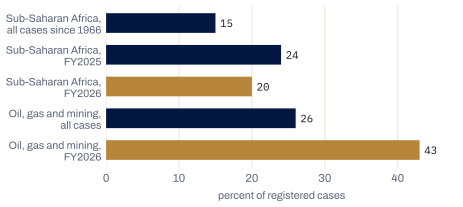
Fiscal 2026 bars are drawn in the signal colour. The fiscal 2025 bar comes from ICSID's fiscal 2025 release, not from Issue 2026-2. Both recent years sit above the all-time share; bases of 67 and 60 cases are small, which is why the signpost asks for a third consecutive year above 15 percent.
Source · ICSID, The ICSID Caseload Statistics, Issue 2026-2 (14 Aug 2026), labels of Charts 10, 12, 15 and 16: 1,118 cases since 1966, 60 in FY2026; ICSID news release on FY2025 (27 Aug 2025): 24 percent of 67 new cases · read 2026-10-20 and 2026-10-21 · SEG-1
Show the underlying numbers
| Item | percent of registered cases |
|---|---|
| Sub-Saharan Africa, all cases since 1966 | 15 |
| Sub-Saharan Africa, FY2025 | 24 |
| Sub-Saharan Africa, FY2026 | 20 |
| Oil, gas and mining, all cases | 26 |
| Oil, gas and mining, FY2026 | 43 |
Mali's Loulo-Gounkoto dispute is the seize-then-settle archetype, and its price is on an audited record. Law 2023-040 lets national participation reach 35 percent against 20 under the 2019 code. The operator's subsidiaries filed for arbitration on 18 December 2024; operations at Loulo-Gounkoto were suspended on 14 January 2025 after about 3 tonnes of gold were seized (press); the complex went under provisional administration on 16 June 2025; the settlement was announced on 24 November 2025 in a release that states no amount; provisional administration ended on 16 December 2025 and the case was discontinued on 21 January 2026. The payment is reported at 244 billion CFA francs, about 430 million dollars, by a wire service citing people familiar with the matter, and at 253 million dollars by a press report naming no document; they reconcile if the second is the cash tranche and the first the total with offsets and a 2024 instalment, on this chapter's arithmetic. The audited statements book a 625 million dollar net expense on regaining control; the filing states that the average royalty rate at the mine "is now 18%"; attributable output went from about 578,000 ounces in 2024 to 29,000 in 2025 and is guided at 260,000 to 290,000 for 2026 (projection); the Council of Ministers approved on 13 February 2026 a draft decree renewing the Loulo permit for ten years (press) (Exhibit 7.2). CH07-C2
Loulo-Gounkoto gold output, Mali, before and after the seizure
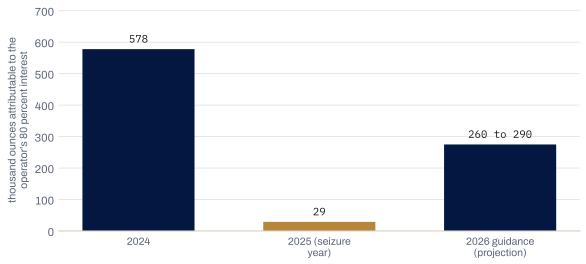
The 2025 bar is drawn in the signal colour. The 2026 figure is the operator's guidance, a projection, drawn at the midpoint of its range.
Source · Barrick Gold Corporation (now Barrick Mining Corporation), Annual Information Form for 2024 (Form 40-F exhibit 99.1, 14 Mar 2025) for 2024; Form 40-F for 2025, exhibit 99.4, for 2025 and the 2026 guidance · read 2026-10-20 and 2026-10-21 · SEG-1
Show the underlying numbers
| Item | thousand ounces attributable to the operator's 80 percent interest |
|---|---|
| 2024 | 578 |
| 2025 (seizure year) | 29 |
| 2026 guidance (projection) | 260 to 290 |
Niger's appropriation of Somaïr is the outright-seizure pole, and the uranium stock has not been sold on the evidence read. The French operator held 63.4 percent of Somaïr and reported losing control in December 2024; its claim was registered on 5 March 2025; the Council of Ministers announced the appropriation on 19 June 2025; the tribunal's order on provisional measures barring any sale is dated 22 September 2025 on the docket and 23 September in the operator's release, and a second order followed on 4 November; a shipment left the Arlit site on or before 27 November 2025 and about 1,000 tonnes were reported moved (press); the proceeding has been suspended under the centre's rules since 16 February 2026. The operator's chair put the stock at about 300 million euros on 21 January 2026; Niger's mines minister said on 4 May 2026 that nothing had yet been sold and put the exportable stock at just over 1,800 tonnes worth about 380 million dollars (press). No compensation has been agreed. CH07-C3
Burkina Faso's SOPAMIB transfers are the state-operator pole, with a data gap where the accounts should be. Acts 016 and 017 of 2024 raised the state's free carry to up to 15 percent from 10 and added a contributing interest of up to 30 percent (law-firm note). Five assets passed to the state company SOPAMIB by decree reported on 12 June 2025, the seller receiving a fixed 60 million dollars (press); Boungou poured first gold in July 2025, yet a July 2026 report describes the two mines as "gradually resuming operations after months of inactivity" (both press); a royalty holder reported non-payment in late 2025 (press); no SOPAMIB accounts appear on the transparency initiative's country page; parliament ratified a 33.21 billion CFA franc regional-bank loan for the two mines on 30 June 2026 and the cabinet approved a fourth state mine on 9 July (press). Where the mine stayed private, one operator's state carry rose to 15 percent and its mine declared a 98.35 million dollar priority dividend to the state (press). National output passed 94 tonnes in 2025, nearly 43 of them artisanal and semi-mechanised, against about 60 in 2024 (press). CH07-C4
Guinea offers one government, one year, two outcomes. The decree withdrawing the Gulf state-owned operator's Boké bauxite concession was read on national television on 4 August 2025, citing non-compliance with article 88 of its 2004 base convention; the government had said in May 2025 that the refinery the convention required had not been built in twenty years, and press had reported the deadline as initially 2022 and extended to September 2026; the assets passed to the new state-owned Nimba Mining Company and redundancies of more than 2,000 staff and contractors began (press). In the same country, Simandou shipped first ore on 11 November 2025 on a structure in which the state holds 15 percent of the mining company and 15 percent, free and non-dilutable under the March 2023 shareholder pact (press), of the infrastructure company that owns the 552 kilometre railway and port, with ownership passing to the state after 35 years and the operator's own access on a non-discriminatory basis; the operator reported an annualised run rate of about 10 million tonnes in the third quarter of 2026. The visible difference is a seat in the infrastructure company and no covenant declared unmet on the evidence read; commodity, partner and scale differ too. CH07-C5
The other structures on the record sit between the poles. Senegal created a contract-review commission in August 2024; an oil operator filed at the dispute centre on 30 May 2025 over a tax assessment; on 12 March 2026 the Prime Minister announced renegotiation of the gas contracts as "leonine" (Prime Minister's office). Gabon decided on 30 May 2025 to ban exports of unprocessed manganese from 1 January 2029, and a 17 July 2025 agreement for local processing of 2 million tonnes named no site, timetable or amount (press); Cameroon's 2023 code fixes a 10 percent free, non-dilutable state stake with a paid option to 35 percent for an industrial mine and a 15 percent local-processing floor; Ghana's Ewoyaa lease carries a 13 percent free carry and was ratified in March 2026, about 29 months after grant, with the royalty aligned to the 2025 sliding scale, with no investment decision (press); the Democratic Republic of Congo set cobalt export quotas of 96,600 tonnes for each of 2026 and 2027 and on 4 December 2025 gave American persons a right of first offer on designated assets. There, a copper and cobalt producer agreed in 2023 to pay the state company 800 million dollars in instalments to 2028 to end a 2022 export halt, and a copper producer booked a 183 million dollar adjustment in early 2026 to settle tax claims (press). CH07-C6
The risk is written into the covenant and the seat, not into the country.
Two external readings serve as signposts: the Fraser Institute's 2025 policy perception scores of 7.36 for Mali, 30.41 for Guinea and 52.31 for Côte d'Ivoire, and 2025 exploration budgets (press), 186 million dollars in Côte d'Ivoire, down a third year in Mali, up 10 percent in the Democratic Republic of Congo. CH07-C7
What is contested
The first objection is that state control means state revenue. Ghana's 2025 figures point the other way: the state gold board routed 10.8 billion dollars, 51.5 percent of 2025 gold exports, yet all 441.82 million dollars of 2025 mineral royalties came from large-scale mines (fiscal institute via press). On these figures the state as trader earned foreign exchange and no royalty; whether small-scale gold paid royalties by another channel was not found.
The second objection is that price, not policy, explains the leverage. Gold rose more than 70 percent in the year to January 2026 (press), Mali's code is reported to index a levy to gold above 1,500 dollars (press, not verified against the law text), and the Malian complex is guided to produce at an 18 percent royalty. Conceded in part: the bargain obsolesces faster at record prices, so the gold price sits on the signposts, and below 3,000 dollars for two quarters the advice changes from defend to renegotiate from strength.
The third objection is that deterrence is reversible. Tanzania's acts of 2017 asserted sovereignty beyond foreign tribunals and let parliament judge terms "unconscionable", with expunction if the government did not renegotiate, and, in the South Centre's reading, met resistance and later raised revenue; the Democratic Republic of Congo's exploration budget rose in the year of its quota while Mali's fell for a third year. Two cases in one year are a reading, not a rule: what deters capital may be arbitrary enforcement rather than the level of take.
The corridor
What we expect in 2027
First, sub-Saharan African states stay above their all-time 15 percent share of new dispute-centre registrations in fiscal 2027, to 30 June, a third consecutive year, which would make the dispute window a structural cost for sub-Saharan hosts rather than a Sahel episode. Falsified if the fiscal 2027 share is at or below 15 percent. Stress-case hypothesis (Scenario 2). CH07-H1
Second, no award is rendered and no compensation is paid in the operator's dispute-centre arbitration against Niger by the end of 2027, and the stock is sold to a buyer outside the operator's offtake rights. Falsified by a paid settlement, by any award rendered in that proceeding, or by the stock remaining unsold at the end of 2027 on the government's own statement. Stress-case hypothesis (Scenario 2). CH07-H2
Third, Côte d'Ivoire adopts a revised code in 2027 that raises the state's take without lifting the free carry above 15 percent, and its exploration budget stays above 150 million dollars in the 2026 data. Falsified if the code is not adopted in 2027, if it leaves the state's take unchanged, if the free carry exceeds 15 percent, or if the budget falls below 150 million dollars. Baseline hypothesis (Scenario 1). CH07-H3
Signposts
| Indicator | Definition fixed | Reading, date | Threshold | Crossing means |
|---|---|---|---|---|
| Sub-Saharan Africa's share of new dispute-centre registrations | share of cases by respondent state region, ICSID caseload statistics, semi-annual | 20 percent of fiscal 2026 cases, after 24 percent in fiscal 2025 (data to 30 June 2026) | a third consecutive fiscal year above the all-time share of 15 percent | arbitration-grade drafting by default; a dispute window of at least a year priced into every capex gate (Mali's ran thirteen months from filing to discontinuance; Niger's has run since March 2025) |
| Policy perception score, host country | Fraser Institute annual survey, February | Côte d'Ivoire 52.31; Guinea 30.41; Mali 7.36 (survey of August to November 2025) | Côte d'Ivoire below 45; or Mali above 30 for two years | the stable comparator is lost; or post-settlement normalisation has begun |
| Exploration budget, host country | S&P Global annual series via press, March | Côte d'Ivoire 186 million dollars; Mali down a third year (2025) | Mali stabilising; or Côte d'Ivoire below 150 million | juniors have re-priced the settled regime; or the Abidjan revision is biting |
| Congolese annual cobalt quota | regulator's notices, quarterly | 96,600 tonnes for 2026 and 2027 (decision of 20 September 2025) | above 120,000 tonnes or the strategic quota abolished; or quota logic extended to copper | market management reversing; or spreading, raising the licence discount on every project there |
| Gold price, London afternoon fix | daily, as posted by Ghana's gold board | 4,147.80 dollars, 19 October 2026 | below 3,000 dollars for two quarters | the bargain reverses; defend becomes renegotiate from strength |
| State operator's accounts and inherited royalties, Burkina Faso | transparency-initiative filings; royalty-holder disclosures | no accounts published; non-payment reported (June 2026) | audited accounts published and royalties resumed | the state operator can honour inherited contracts |
The two arenas
Francophone Europe. Two Paris-based operators bracket the spectrum. The uranium producer has no compensation, a tribunal order barring sale followed by a shipment it condemned, four arbitrations it says are pending against a counterparty that counts at least ten proceedings, a suspended proceeding at the dispute centre and no channel for talks (press). The manganese producer faces no expropriation but a dated covenant that converts a mining right into a smelting obligation by 1 January 2029, with 10,460 jobs in the mine and the railway and an agreement for 2 million tonnes of local processing that names no plant (press). The risk is written into the covenant and the seat, not into the country.
Francophone Africa. Guinea's pair prices the host's discretion: the state judged a refinery promise unmet before the extended deadline press had reported, so a gate must price who decides "unmet", not only the calendar. Senegal renegotiates in public through a commission while defending an operator's claim at the dispute centre, though a social-media post relayed by press reported the Prime Minister's intention in March 2026 to reclaim the Yakaar-Teranga licence without compensation. Mali shows survival's cost: an 18 percent royalty and lost output. Côte d'Ivoire, the comparator, has promised a new code for three years running without adopting it.
What a board should ask
The test before commitment
The test is a licence-to-operate gate in the Authorise step of the STREDGE Evidence-to-Decision Cycle. Before authorisation, the structure is scored against five dated conditions, each with a document reference: the state's stake, free and non-dilutable or paid, and in which entity; any processing covenant, its deadline and the plant's investment status; the stabilisation clause and the arbitration seat; the host's last three code changes and how each was enforced; and the host's docket at the dispute centre. Capital is released in tranches tied to those conditions, so a covenant deadline or code change reopens a tranche, not a sunk position. The gate is built to survive Scenario 2, in which a second seizure follows a first; under Scenario 1 a deploy verdict must still show the state's seat in the shared infrastructure where there is one; where the project has none, the ceiling is keep testing until an equivalent dated, documented term the state values is on file. The verdicts: deploy, when all five conditions are documented and the structure gives the state a free, documented seat in the shared infrastructure; rethink, when an unmet dated covenant was found; keep testing, when the stabilisation terms are unknown, until counsel has read the convention and learned, by interview, how the clause behaved for the last operator who invoked it; stop, when a seizure precedent in the host within 24 months has no settlement. The number the evidence does not contain is how stabilisation clauses were applied in 2024 to 2026; no public source records it.
What to instrument: the months from a code announcement to its adoption in each host; the state's effective take under the code in force and under the announced one; the share of capital released per tranche against conditions met; the covenant deadlines within 24 months of each tranche; the host's new dispute-centre registrations each half-year.
- In which entity does the state sit, the mine or the railway, and is its seat free, paid or dilutable?
- Which dated promise in our convention falls due before our next tranche, and what is the status of the plant it requires?
- If the host rewrote its code tomorrow, which clause would we rely on, where, and how did it behave for the last operator who tried?
- What did the last seizure in this country cost the operator in ounces, and would our balance sheet carry a year of that?
Evidence cards
CH07-C1SEG-1(SEG-2 for the two sums)Sub-Saharan Africa's share of new dispute-centre registrations was 20 percent in fiscal 2026 and 24 percent in fiscal 2025, against 15 percent of all cases since 1966; oil, gas and mining were 43 percent of fiscal 2026 cases against 26 percent of all cases.
- Context
- ICSID Caseload Statistics, Issue 2026-2 (data to 30 June 2026; shares read from the labels of Charts 10, 12, 15 and 16; the fiscal 2026 total of 60 is printed in ICSID's fiscal 2026 release of 14 August 2026; regions by respondent state on the World Bank classification); ICSID news release on fiscal 2025 (27 August 2025; 24 percent of 67 new cases, in its text).
- Contradictory evidence
- the fiscal 2026 share is below fiscal 2025's, and two years on bases of 67 and 60 are a reading, not a trend.
- Review date
- 21 October 2026.
CH07-C2SEG-1(SEG-2 for the chapter's reconciliation of the two figures)Mali: seizure, settlement, the two payment figures, and the audited cost.
- Context
- South Centre, SouthViews 287 (28 April 2025) for the code; ICSID case ARB/25/2 docket; the operator's release of 24 November 2025 (via italaw; no amount); Form 40-F for 2025, exhibits 99.3 and 99.4 (dates, expense adjustments, royalty rate, guidance; the settlement notes sit beyond the readable portion); Annual Information Form for 2024 (Form 40-F exhibit 99.1, 14 March 2025) for the 2024 output of about 578,000 ounces attributable to the operator's 80 percent; Mining Weekly relaying Bloomberg (25 November 2025, press, "people familiar with the matter"); Ecofin (6 February 2026, press); Mining Weekly and Afrik (16 February 2026, press) for the permit.
- Contradictory evidence
- the two payment figures disagree and neither rests on a primary document; Ecofin dates the return of control to 18 December against the filing's 16 December.
- Review date
- 21 October 2026.
CH07-C3SEG-1Niger: appropriation, two provisional-measures orders, a suspended proceeding, a stock reported moved and not reported sold.
- Context
- ICSID case ARB/25/8 docket; the operator's releases of 20 June, 26 September and 27 November 2025; World Nuclear News (1 December 2025, press); Ecofin and Afrik (1 December 2025, press) for the tonnage moved; AFP via Connaissance des Énergies (21 January and 31 July 2026, press); Le360 Afrique and Boursorama with AFP (5 May 2026, press) for the minister's statement.
- Contradictory evidence
- tonnage and value differ by source and date (about 1,500 tonnes and 300 million euros against just over 1,800 tonnes and 380 million dollars).
- Review date
- 21 October 2026.
CH07-C4SEG-1press for most eventsBurkina Faso: a state operator without published accounts.
- Context
- ENSafrica note (2024) on the acts; Mining Weekly (12 June and 5 September 2025, press); Ecofin (29 June 2026 and 10 July 2026, press); Capmad (3 February and 2 July 2026, press); the transparency initiative's country page (read 21 October 2026; no SOPAMIB entry).
- Contradictory evidence
- "first gold in July 2025" and "gradually resuming after months of inactivity" a year later are both press and cannot be arbitrated without accounts.
- Review date
- 21 October 2026.
CH07-C5SEG-1Guinea: withdrawal over a covenant the state judged unmet, and first ore on a free state seat, in the same year.
- Context
- Guinéenews (4 August and 23 May 2025, press) for the decree and its grounds; Mining Weekly and MiningMX (July and August 2025, press) for exports, assets, redundancies and the Gulf parent's position; the Simandou partners' release (11 November 2025) and the operator's 2024 filing (16 July 2024) for the structure, the railway and the access clause; Mining.com relaying Reuters (13 March 2023, press) for the free and non-dilutable terms of the shareholder pact; the operator's third-quarter 2026 release for the run rate.
- Contradictory evidence
- the bauxite operator's Gulf parent called the termination wrongful and said it would seek remedies before international tribunals (press), and the withdrawal came before the September 2026 deadline press had reported.
- Causal confidence
- that the structure explains the outcome is the chapter's reading of two cases, not a tested finding.
- Review date
- 21 October 2026.
CH07-C6SEG-1press where markedThe intermediate structures: Senegal's review, Gabon's covenant, the Cameroonian and Ghanaian terms, the Congolese quota and agreement, two Congolese settlements.
- Context
- Mining Weekly (3 June 2025, press); Ecofin (16 March 2026, press); Gabon Media Time (16 June and 17 July 2025, press); Mining Technology citing Reuters (3 June 2025, press); the Cameroonian code text (a-mla.org); Atlantic Lithium RNS (20 October 2023) and Mining Weekly (20 March 2026, press); IEA policies database for the Congolese decision and agreement; Mining.com relaying Reuters (7 December 2022 and 18 July 2023, press); Mining Weekly (7 May 2026, press).
- Contradictory evidence
- a social-media post relayed by press reported the Senegalese Prime Minister's intention to reclaim the Yakaar-Teranga licence without compensation, which would place Senegal nearer the seizure pole; the Cameroonian and Ghanaian terms are themselves the revision and have not yet faced a later one.
- Review date
- 21 October 2026.
CH07-C7SEG-1Perception scores and exploration budgets diverge by jurisdiction.
- Context
- Fraser Institute, Annual Survey of Mining Companies 2025 (February 2026; 68 jurisdictions, 256 responses); Ecofin relaying the S&P Global series (7 April 2026, press); Ghana Gold Board price posting (19 October 2026).
- Contradictory evidence
- Mali's budget was already falling before the January 2025 seizure and the Congolese quota was set in September 2025, so one year's budget direction is a weak test of either policy.
- Transferability
- a perception survey of companies is not an outcome measure.
- Review date
- 21 October 2026.
CH07-H1 to H3SEG-0Hypotheses for 2027.
Falsification conditions stated above; scenario mapping stated in each.
Sources and limitations
Sources read on 20 and 21 October 2026. ICSID, The ICSID Caseload Statistics, Issue 2026-2, its news releases on fiscal 2025 (27 August 2025) and fiscal 2026 (14 August 2026), and case pages ARB/25/2, ARB/13/16 and ARB/25/8; South Centre, SouthViews 287 (28 April 2025); EITI, Mali and Burkina Faso country pages; Barrick Mining Corporation, release of 24 November 2025 (via italaw); Form 40-F for 2025, exhibits 99.3 and 99.4, and Annual Information Form for 2024, exhibit 99.1 (SEC EDGAR); Mining.com relaying Reuters (13 March 2023, press); Mining Weekly (2 July and 29 November 2024; 12 June, 9 July, 5 September, 25 November 2025; 16 February, 20 March, 7 May 2026, press, several relaying Reuters or Bloomberg); Reuters via Nasdaq (19 September 2025, press); Mining Technology (13 January and 3 June 2025, press); Ecofin Agency (28 May, 22 September, 1 October, 1 December, 4 December 2025; 29 January, 6 February, 16 March, 7 April, 29 June, 10 July 2026, press); Primature du Sénégal, account of 12 March 2026, for the Prime Minister's quotation; IISD Investment Treaty News (9 September 2026); Afrik (1 December 2025 and 16 February 2026, press); Daba Finance via AllAfrica (14 February 2026, press); Orano, releases of 20 June, 26 September and 27 November 2025; World Nuclear News (1 December 2025, press); AFP via Connaissance des Énergies (21 January and 31 July 2026, press); Le360 Afrique and Boursorama with AFP (5 May 2026, press); Agence Nigérienne de Presse via AllAfrica (13 April 2024) and Afrique Sur 7 (14 June 2026, press) on the oil advance; ENSafrica (2024, law firm); Capmad (3 February and 2 July 2026, press); MiningMX citing Bloomberg (5 August and 25 November 2025, press); Guinéenews (23 May, 5 July and 4 August 2025, press); Business Wire (11 November 2025); Rio Tinto, Form 6-K exhibit of 16 July 2024 and third-quarter 2026 release; Senego (8 August 2026, press); Gabon Media Time (16 June and 17 July 2025, press); EcoMatin (19 February 2026, press); AllAfrica (June 2025, press); African Mining Legislation Atlas, Cameroon's Law 2023/014; Atlantic Lithium RNS (20 October 2023); IEA Policies database, ARECOMS Decision 004/2025 and the DRC-US Strategic Partnership Agreement; Mining.com relaying Reuters (7 December 2022 and 18 July 2023, press); Ghana News Agency reporting the Institute for Fiscal Studies (13 August 2026); Graphic Online (9 September 2025, press); Ghana Gold Board price page (19 October 2026); Fraser Institute, Annual Survey of Mining Companies 2025 (February 2026); USGS, Mineral Commodity Summaries 2026, nickel; IEA press release (16 July 2026); Le360 Afrique with MAP (2 February 2025, press) and Team France Export (10 February 2026) on the Ivorian code; FAO ECOLEX records of Tanzania's Acts 5 and 6 of 2017; Herbert Smith Freehills Kramer (27 July 2017), Dentons via Mondaq (27 February 2018) and DLA Piper Africa (24 August 2020), law firms; NRGI (19 August 2026); African Union, Africa's Green Minerals Strategy (document page 18 March 2025); TimesLIVE with Reuters (25 February 2026, press) and Fastmarkets (3 March 2026) on Zimbabwe; International IDEA and Financial Afrik on Guinea's political calendar.
Prior art. Vernon, Sovereignty at Bay (1971), the obsolescing bargain, bibliographic; Bremmer and Johnston, "The Rise and Fall of Resource Nationalism", Survival 51(2), 2009, bibliographic; Ward, IIED primer (May 2009); Ostrowski, Resources Policy 83 (2023); Verisk Maplecroft's Resource Nationalism Index (latest edition located, 14 March 2025); Steptoe, "Resource nationalism in the coup belt" (28 February 2025); the phrase "Resource Nationalism 2.0" is in use and its first user could not be established, so the chapter does not claim or attribute it.
Limitations. The dispute-centre shares are read from chart labels, and the fiscal 2025 share from the release's text; two years on bases of 67 and 60 do not make a trend. The Malian settlement amount is not in any primary document read: the operator's release states none, the wire service cites unnamed people, the press report names no document, and the filing's notes on the settlement sit beyond the portion the reader could open; the reconciliation of the two figures is the chapter's arithmetic. The Malian government's own settlement text and the permit decree were not read. The Niger order's date differs by one day between the docket and the operator; the order itself is not public; only one of the four arbitrations the operator cites was identified; whether any uranium has been sold rests on a ministerial statement of May 2026 and no later reading. No SOPAMIB accounts were found on any page read, and the two press descriptions of Boungou's status a year apart cannot be reconciled. The Guinean refinery directive's official text and the withdrawal decree's number were not found; no further Guinean document was read for this edition. Côte d'Ivoire's code adoption was not found on any page; the government's council page could not be read. Gabon's implementing decree for the 2029 ban was not found. The exploration budgets are read through press, the perception scores are a survey of companies, and the gold price is a single posting. The chapter names structures and the countries in which they were found and ranks none of them.
Exhibits for the web edition: Exhibit 7.1, shares of dispute-centre registrations, all time, fiscal 2025 and fiscal 2026 (ICSID 2026-2; ICSID fiscal 2025 release); Exhibit 7.2, Loulo-Gounkoto gold output attributable to the operator's 80 percent interest, 2024, 2025 and 2026 guidance (Annual Information Form for 2024; Form 40-F for 2025, exhibit 99.4).
Corrections and challenges: through the channel on this page; logged with their dates.
Download the PDFs
The full edition, the executive summary and the eleven parts are free to download. Leave your work email and the files open on this page.