Global Strategic Outlook 2027 · Chapter 4 of 10
Chapter 4. Generation is arriving, reliability is not
Captive power, grid or PPA for industrial operators in seven countries.
Bruno Hounkpati, Founding Partner and Chief Executive Officer
20 October 2026
Chapter 4
Generation is arriving, reliability is not: captive power, grid or PPA for industrial operators in seven countries
Nachtigal and Souapiti added capacity and Cameroon and Guinea still cut power; Côte d'Ivoire sells grid power at a price closer to the European average than operators assume; Morocco alone has a legal route that has produced a corporate contract. The 2027 decision is which route to budget for, site by site, on measured outage hours rather than national averages.
- The decision: for each site in Côte d'Ivoire, Senegal, Guinea, Togo, Benin, Cameroon or Morocco, grid supply at the regulated tariff, captive generation, or a corporate purchase agreement for the 2027 budget and any new plant; owners, the chief operating officer and the chief financial officer, then the investment committee.
- What the evidence says: generation arrived and reliability did not. Nachtigal and Souapiti added capacity while Cameroon and Guinea still cut power; Côte d'Ivoire sells grid power at about 0.13 euros against a European average of 0.18; Morocco alone has a legal route that has produced corporate contracts.
- The test: a delivered-cost-of-power model on the site's own outage logs, against captive solar on a quotation and any offer actually received, under two fuel cases and the host utility's liquidity. The number the evidence lacks: a verified diesel-versus-captive-solar cost for any of the seven countries.
Decision at stake
For an industrial operator in Côte d'Ivoire, Senegal, Guinea, Togo, Benin, Cameroon or Morocco, the 2027 budget and any new plant turn on one choice per site: grid supply at the regulated tariff, captive generation (gas, diesel, or solar with storage), or a corporate power purchase agreement. For an investor the question is where industrial power is bankable: a creditworthy offtaker, a published tariff path and a legal route for third-party sale, each as a dated document. The owners are the chief operating officer and the chief financial officer, then the investment committee. The dated moments are Senegal's gas allocation to the domestic market "by 2027", a projection; Morocco's surplus tariff, in force to 28 February 2027; Cameroon's distributor refinancing; Côte d'Ivoire's next tariff decision. The cost of error is paid in diesel: a plant budgeted on the grid tariff and run on generators, or a captive plant financed against outages that a wires investment removes.
What the evidence shows
What changed, 2024 to 2026
The IEA expects upstream oil and gas investment in sub-Saharan Africa to rise 12 percent to nearly 24 billion dollars in 2026 after an 18 percent fall in 2025, and reports that energy investment in data centres in 2025 exceeded the total invested in Africa's energy sector that year (projections and estimates; the continental total of about 110 billion dollars for 2026 is press-reported only). On the demand side, 655 million people were without electricity in 2024, 563 million of them in sub-Saharan Africa, whose share of the world's deficit rose from 49 percent in 2010 to 86 percent, and the IEA estimates that about 220 million of Africa's unelectrified are unlikely to afford a basic bundle of services; access figures are not paying industrial demand. CH04-C1
Côte d'Ivoire is the grid-supply case. Installed capacity was 3,019 MW in 2024 and gross production 13,919 GWh, 75.13 percent thermal; the average selling price excluding taxes was 85 FCFA per kWh for medium and high voltage after two 10 percent increases, about 0.13 euros at the fixed parity; average outage time per customer fell from 47 hours in 2011 to 29 in 2023; and the Baleine operator took its phase 3 investment decision on 25 May 2026 with all associated gas routed onshore for domestic power. The counter-signal is exports, down from 1,656 GWh in 2016 to 1,052 in 2023 and 730 in 2024, 5.2 percent of production (Exhibit 4.1). The portal's 98.6 percent "access rate" is the share of the population living in an electrified locality; the SEforALL deep dive on the tracking report gives 72.9 percent for 2024; the World Bank targets 80 percent of households by 2026; none is mixed with another. A February 2026 opinion by two lawyers states that the 2014 code's eligible-customer framework "has yielded not a single contract" and that self-generation is "the sole practicable avenue"; the regulator is finalising a wheeling methodology. CH04-C2
Domestic tightness despite new gas: Côte d'Ivoire's electricity exports, 2016 peak and 2024 by destination
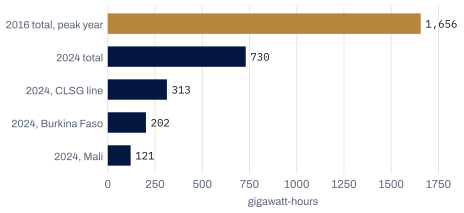
The 2016 bar, in the signal colour, is the peak year. Ghana (57 gigawatt-hours) and direct deliveries to Liberia (37) complete the 2024 total; they are left out of the chart to keep it to five rows.
Source · Côte d'Ivoire Ministère de l'Économie, citing MMPE, CI-Energies and ANARE-CI 2024 (updated 26 Nov 2025) · read 2026-10-20 · SEG-1
Show the underlying numbers
| Item | gigawatt-hours |
|---|---|
| 2016 total, peak year | 1,656 |
| 2024 total | 730 |
| 2024, CLSG line | 313 |
| 2024, Burkina Faso | 202 |
| 2024, Mali | 121 |
The tariff gap with Europe is smaller than operators assume; the difference may sit in reliability, connection delay and backup fuel. The EU weighted average for non-household consumers in the 500 to 2,000 MWh band was 0.1837 euros per kWh in the second half of 2025 excluding VAT and recoverable taxes (France down 14.1 percent year on year), against about 0.13 euros for Ivorian medium and high voltage (Exhibit 4.2). Senegal's regulator published on 27 January 2026 a medium-voltage long-use tariff of 91.93 FCFA off-peak and 151.72 peak, unchanged from 2025 (press for the change note); Togo raised tariffs by an average of 12.5 percent in 2025 after a rate frozen at 102 FCFA since 2011, to 78, 87 and 122 FCFA by time band at medium voltage below 500 kVA (press); Benin's utility lists 96 FCFA above 630 kVA; Cameroon's regulator fixed a 2023 base of 65, 60 and 55 FCFA for the 1 to 2 MW band, escalating 5 percent a year; Morocco's industrial supply is described at 0.74 to 1.42 dirhams by time band, VAT included (press); Guinea's utility gives only a 2023 average of 881 GNF. CH04-C3
The tariff gap is smaller than operators assume: industrial electricity prices, Côte d'Ivoire and the European Union
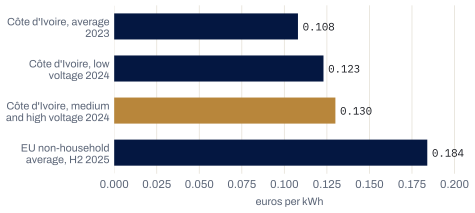
Regulated Ivorian averages after two 10 percent increases (July 2023, January 2024) against an EU weighted average; reliability, connection delay and backup fuel sit in neither price.
Source · Eurostat, Electricity price statistics (H2 2025, 500 to 2,000 MWh band); Côte d'Ivoire Ministère de l'Économie citing ANARE-CI 2024, at 655.957 FCFA per euro · read 2026-10-20 · SEG-2
Show the underlying numbers
| Item | euros per kWh |
|---|---|
| Côte d'Ivoire, average 2023 | 0.108 |
| Côte d'Ivoire, low voltage 2024 | 0.123 |
| Côte d'Ivoire, medium and high voltage 2024 | 0.130 |
| EU non-household average, H2 2025 | 0.184 |
In Cameroon a bankable independent producer has not meant reliable supply. Nachtigal, 420 MW, owned 40 percent by EDF with the IFC, the Republic of Cameroon, Africa50 and STOA, fed its first unit into the grid on 10 May 2024 and its last on 18 March 2025 under a 35-year purchase agreement with Eneo, now SOCADEL (shareholding and dates from a secondary entry citing trade press); its operations director claimed about 3 TWh, reported as 3,613,785 MWh, injected since May 2025 (4 June 2026, press; no company document was read), while outages persist, attributed by the company to equipment downstream of generation. The distributor announced on 31 August 2026 a financing to "increase liquidity, restructure existing commitments and help financially stabilise the electricity sector" and a process to raise 200 billion CFAF from local banks, and the World Bank is preparing a programme to finance an "ENEO recovery plan". The only corporate arrangement found is a 1.8 MWp rooftop plant with 2.5 MWh of storage under construction at a cocoa processor under a 25-year agreement (press). CH04-C4
The cost of error is paid in diesel: a plant budgeted on the grid tariff and run on generators, or a captive plant financed against outages that a wires investment removes.
Guinea is the captive-power market in the set. Installed capacity was 1,253 MW in 2023 on the utility's own report, and the World Bank states that Souapiti and Kaléta export 1,174 GWh a year to Senegal, The Gambia and Guinea-Bissau. The utility's 2023 report records collections equal to 66 percent of sales, a subsidy on energy purchases of 3,200 billion GNF for 2023 (the central bank's figure as cited by press is 2,496.53 billion) and an average outage duration per customer of 165.38 hours in 2023 against 126 in 2022. Among connected households surveyed in mid-2024, 23 percent said electricity worked most or all of the time, against 69 percent in 2022. The World Bank's 40 percent loss figure for 2025 is the opening value of a projection, not a measured outturn. Souapiti, 450 MW, is managed by a Chinese-led company until its loans are repaid, and cuts returned to Conakry in the 2026 rainy season (press opinion). CH04-C5
Senegal's 2027 grid price depends on a gas allocation that is still a projection. Greater Tortue Ahmeyim started production on 31 December 2024 and loaded its first cargo on 17 April 2025 (press); its second phase was unsanctioned as of July 2025 (press); the Prime Minister said in August 2026 that gas imports of 140 billion CFA a year end in 2026, that 20 to 25 percent of the first phase is expected for the domestic market by 2027, and that the 335 MW Bel Air plant is converting to gas (press; projections). The regulator's January 2026 grid takes no position on domestic gas. No corporate purchase agreement with a named industrial offtaker was found. CH04-C6
Morocco is the one market with a legal route that has produced a contract. The regulator set the purchase tariff for surplus electricity from self-producers under laws 40-19 and 82-21 at 0.21 dirhams per kWh in peak hours and 0.18 outside them for a first period from 1 March 2026 to 28 February 2027 (press; the decision is a scanned image), after setting network tariffs and approving the state utility's accounting separation. The Khalladi wind farm, 120 MW connected at the Tétouan substation, sells 80 percent of its output to Holcim Maroc, Asment and Cimat under three long-term contracts under law 13-09 (press). The minister told parliament that renewables reached 46 percent of the mix in 2025, basis unstated (press). Two projects mark the limits: Noor Midelt I, contracted in December 2022 for 800 MW with service then planned for 2024, had no commissioning on record in August 2025 (press); and the 3.6 GW link to Great Britain lost its offtake route on 26 June 2025 when the British government stopped considering a contract for difference. CH04-C7
What is contested
The first objection is that the binding constraint is generation, so the answer is more plants. Nachtigal and Souapiti answer it: capacity was added and both countries still cut power. A World Bank study of 39 sub-Saharan power sectors found only two financially viable; the distributor's cash is the variable a purchase agreement cannot fix.
The second objection is that cheap renewables make captive solar the default. IRENA's global weighted average cost of new utility-scale solar was 0.044 dollars per kWh in 2025, unchanged from 2024 on its 2025 edition's figures, and a four-hour battery about 140 dollars per kWh; but its 2024 report puts African onshore wind at 0.051 against 0.052 in Europe on an assumed cost of capital of 12 percent in Africa against 3.8 percent in Europe, financing being the majority of the African figure. The only peer-reviewed delivered-cost comparison found is Nigerian: a hybrid of solar, battery and generator at 0.106 dollars per kWh against a diesel-only figure of 0.542 cited from an earlier study. No verified figure was found for the seven.
The third objection is that Mission 300 will fix the offtakers. Its sponsors reported 30 million people connected by 25 September 2025 and "over 50 million" by 16 June 2026; the counting method, including off-grid kits, is not shown. Connections are households; the offtakers are utilities, and what would show them recovering is losses, collections and subsidies.
The corridor
What we expect in 2027
First, no gas from Greater Tortue Ahmeyim reaches Bel Air or the new 366 MW plant by 30 June 2027, so Senegal's grid price stays tied to imported fuel and its medium and high-voltage tariffs stay unchanged through 2027. Falsified by a documented first domestic delivery before that date, by any medium or high-voltage tariff decision taking effect in 2027, or by a regulator's decision citing domestic gas. Stress-case hypothesis (Scenario 2). CH04-H1
Second, Côte d'Ivoire's electricity exports stay below 1,000 GWh in both 2025 and 2026 despite the second and third phases of Baleine, which the chapter reads as domestic tightness. Falsified by exports above 1,000 GWh in either year, or by the regulator's annual report attributing the fall to importing countries' demand or to line outages rather than to domestic supply. Baseline hypothesis (Scenario 1). CH04-H2
Third, Morocco remains the only one of the seven with a signed corporate purchase agreement or self-production project above 10 MW with grid sale of surplus at the end of 2027, and its surplus tariff is renewed for a second period. Falsified if any of the other six publishes a signed third-party industrial contract or self-production project above 10 MW with grid sale of surplus, or if the Moroccan regulator lets the tariff lapse. Live-alternative hypothesis (Scenario 3). CH04-H3
Signposts
| Indicator | Definition fixed | Reading, date | Threshold | Crossing means |
|---|---|---|---|---|
| Domestic gas from Greater Tortue Ahmeyim reaching Senegalese plants | documented delivery to Bel Air or the 366 MW plant; operator, Petrosen and regulator statements | none confirmed; 20 to 25 percent of phase 1 projected "by 2027" (August 2026, press) | no delivery by 30 June 2027 | captive solar with storage or a purchase agreement for Senegalese operators; investors weight Côte d'Ivoire and Morocco |
| Côte d'Ivoire electricity exports | annual, regulator and ministry portal | 730 GWh, 2024 (1,052 in 2023; 1,656 in 2016) | below 500 GWh or net imports in a quarter; or above 1,000 | domestic tightness despite Baleine; or the regional-hub case for grid supply strengthens |
| Cameroonian distributor liquidity | company and World Bank announcements | 200 billion CFAF sought from local banks, 31 August 2026 | raise closed and recovery programme approved by mid-2027 | grid or purchase-agreement routes supportable in the southern grid; otherwise captive gas or solar even with Nachtigal |
| Guinean utility subsidy and collections | utility report and central bank, annual | subsidy 3,200 billion GNF (2023, utility); collections 66 percent of sales | subsidy below 2,000 billion GNF for 2026 (the edition's threshold, set on the subsidy because the only loss figure found is a projection) | the utility becomes a conceivable offtaker; otherwise Guinea stays a captive-power market |
| Corporate purchase agreements and self-production above 10 MW with grid sale | signed contracts published by regulators or parties, in the seven | Morocco: 120 MW Khalladi under three contracts; Côte d'Ivoire: none; Senegal: none named | a first signed contract above 10 MW in any of the other six | a second route has produced a contract; in Côte d'Ivoire, the wheeling methodology has become a tariff |
| Mission 300 cumulative connections | sponsor announcements, about twice a year | over 50 million, 16 June 2026 (30 million, 25 September 2025) | fewer than 100 million by 31 December 2027 | compact conditions slipping; offtaker risk rises in Benin, Cameroon, Guinea and Togo |
The two arenas
Francophone Europe. The French utility's Cameroonian plant is the clearest case: construction and generation delivered, the risk downstream of the busbar in the distributor's cash flow and the wires, the purchase agreement's counterparty refinancing through local banks seventeen months after the last unit came on line. The British-Moroccan link is the second: resource quality did not substitute for a sovereign-grade offtaker. For a French operator weighing a West African site, at 0.18 euros in the Union and 0.13 in Côte d'Ivoire the tariff is not the variable; outage hours, months to a connection and the diesel burned in between are.
Francophone Africa. Côte d'Ivoire offers grid supply with a published price path and gas as the bridge, and no contract route until a wheeling tariff is published; the data centre that opened at Grand-Bassam in 2024 with a 15 kV utility feed and 48 hours of fuel is what a demanding customer chose there. Senegal offers a grid whose 2027 price depends on an allocation that is still a statement. Guinea offers 450 MW at Souapiti under foreign management and a utility collecting two thirds of what it bills, so Simandou-linked demand is expected here to be met captively. Morocco offers a self-production regime with a surplus tariff that expires on 28 February 2027, and the only operating corporate contracts in the set. Togo and Benin offer grids at 78 to 122 and 96 FCFA with access rates of 75 percent for 2025 in Togo and 42.6 percent for 2024 in Benin on their ministries' definitions (press; the Beninese compact), against 61.13 percent for Togo in 2024 in the tracking report.
Exhibit 4.3. Seven countries, one grid.
| Country | Industrial tariff, as published | Reliability, utility cash or price path | Access, on whose definition | Route to a contract or self-production |
|---|---|---|---|---|
| Benin | 96 FCFA per kWh above 630 kVA, utility list | not printed in this edition | 42.6 percent, 2024, national compact | no operating corporate contract; route not printed in this edition |
| Cameroon | 65, 60 and 55 FCFA, 1 to 2 MW band, 2023 base, rising 5 percent a year | distributor refinancing announced 31 August 2026; outages persist | not printed in this edition | a 1.8 MWp rooftop plant under construction, 25-year agreement (press) |
| Côte d'Ivoire | 85 FCFA, medium and high voltage, 2024 average excluding taxes, about 0.13 euros | 29 outage hours per customer in 2023, 47 in 2011 | 72.9 percent, 2024, tracking report; 98.6 percent of people in electrified localities, national portal | eligible-customer framework with no contract on a February 2026 legal opinion; wheeling methodology being finalised |
| Guinea | 881 GNF average, 2023, utility report | collections 66 percent of sales; 165.38 outage hours per customer in 2023 | not printed in this edition | captive supply; no operating corporate contract |
| Morocco | 0.74 to 1.42 dirhams by time band, VAT included (press) | not printed in this edition | not printed in this edition | laws 13-09, 40-19 and 82-21; surplus tariff of 0.21 and 0.18 dirhams to 28 February 2027; three contracts at Khalladi, 120 MW (press) |
| Senegal | 91.93 FCFA off-peak and 151.72 peak, medium-voltage long use, 2026 | 2027 grid price tied to a domestic gas share still projected (press) | not printed in this edition | no agreement with a named industrial offtaker found |
| Togo | 78, 87 and 122 FCFA by time band, medium voltage below 500 kVA, 2025 (press) | average rise of 12.5 percent in 2025 after a tariff frozen since 2011 (press) | 75 percent, 2025, ministry (press); 61.13 percent, 2024, tracking report | no operating corporate contract; route not printed in this edition |
What a board should ask
The test before commitment
The test is a delivered-cost-of-power model built in the Simulate step of the STREDGE Evidence-to-Decision Cycle before the plant or budget decision. Delivered cost per kWh equals the regulated tariff on the share of hours supplied by the grid, plus the generator's fuel and maintenance cost per kWh on the backup share, plus the value of production lost in the hours neither covers, with outage hours from the operator's own logs, never national averages. That figure is set against captive solar with storage on a quotation, not a global average, and against any purchase-agreement offer actually received, each under two fuel cases, Brent at the 84 dollar base case and at the 110 dollar stress threshold of chapter 6, and under the host utility's liquidity status. The test is built to survive Scenario 3, in which the oil shock unwinds but power tightens; under Scenario 1 the grid route must still win at the base case for a deploy verdict. For an investor the model adds the three bankability documents. The verdicts: deploy, when one route dominates under both fuel cases; rethink, when the ranking flips with outage hours; keep testing, when no offer or tariff path is in hand; stop, when no route serves the site's load at a cost the product bears, and, in Côte d'Ivoire, stop pursuing a third-party contract until the wheeling methodology is a published tariff. A Moroccan self-production case must be run before 28 February 2027; a company's 2027 Senegal budget must carry a no-gas line to 30 June 2027. The number the evidence does not contain is a verified diesel-versus-solar cost in any of the seven.
What to instrument: outage hours per site per month from the operator's own logs; generator run hours and litres per kWh delivered; the months from application to connection; the fuel share of the bill; the dates of each host utility's last audited accounts and tariff decision.
- For each of our sites, how many outage hours did our own logs record in 2026, and what did the generators burn per kilowatt-hour delivered?
- Which of the three bankability documents do we hold for each host?
- If the tariff rose 10 percent and outages halved, would we choose the same route, and does the answer hold with Brent above 110?
- Who in this company signs the gas-delivery assumption in the 2027 Senegal budget?
Evidence cards
CH04-C1SEG-1Sub-Saharan upstream and data-centre investment lead the IEA's 2026 readings; access is not paying demand.
- Context
- IEA, World Energy Investment 2026 (28 May 2026; pages 7, 10, 34 and 40; 2026 figures are projections); the continental total is press-reported (ThisDay, 29 June 2026) and was not found on an IEA page; Tracking SDG7 2026 (24 June 2026); IEA, Financing Electricity Access in Africa (20 October 2025).
- Contradictory evidence
- none found in the sources read.
- Review date
- 21 October 2026.
CH04-C2SEG-1(SEG-2 for the euro conversion at 655Côte d'Ivoire: grid supply with a price path, falling exports, three access definitions, no contract route yet.
957 FCFA).
- Context
- Ministère de l'Économie portal citing ANARE-CI 2024 (updated 26 November 2025; definitions quoted from the page); Eni's country page (phase 3 decision dated 25 May 2026); SEforALL deep dive (July 2026); World Bank country overview (9 September 2026); lawyers' opinion in Africa Legal (18 February 2026; a legal reading, not a regulator's statement).
- Contradictory evidence
- the regulator's wheeling methodology, if published as a tariff, would open the route the opinion says is closed.
- Review date
- 21 October 2026.
CH04-C3SEG-1(SEG-2 for conversions)The tariff gap with Europe is small; six national grids read.
- Context
- Eurostat (second half of 2025; French level shown only in a chart and not used); CRSE grid of 27 January 2026 and press of 30 December 2025 on what changed; Togolese government portal (16 May 2025) and press (15 May 2025), which disagree on the application date; SBEE professional tariff page (modified 17 September 2024, no effective date); ARSEL decision 00000427 of 12 December 2022 (base grid and escalation percentages; resulting figures not printed); Challenge (10 June 2026, press) for Morocco; EDG 2023 activity report for Guinea.
- Contradictory evidence
- the comparison sets the 2024 average for all Ivorian medium and high-voltage customers against one EU consumption band in the second half of 2025, so populations, periods and definitions differ.
- Transferability
- time-band grids are not comparable to a single average; the exhibit uses the Ivorian average and the EU weighted average only.
- Review date
- 21 October 2026.
CH04-C4SEG-1press for the output figureCameroon: a bankable producer, outages downstream, a distributor refinancing.
- Context
- Business in Cameroon (7 June 2026) and EcoMatin (8 June 2026) reporting a company statement at a site visit; Eneo site (31 August 2026 announcement); World Bank Cameroon overview (5 October 2026); SolarQuarter (28 April 2026, press); shareholding and dates via a secondary encyclopaedia entry citing trade press.
- Contradictory evidence
- the same EcoMatin report records the suspension of the Kribi and Dibamba gas plants (304 MW) for financial reasons, so generation also contracted.
- Causal confidence
- the attribution of outages to the wires is the company's, not a tested finding.
- Review date
- 21 October 2026.
CH04-C5SEG-1Guinea: capacity added and power exported, with collections at two thirds of sales and reliability falling.
- Context
- EDG, Rapport d'activités 2023 (production totals internally inconsistent: 3,759.20 and 3,696 GWh); World Bank feature (23 October 2025; export year not stated; trade capacity given as 340,000 and 440,000 kVA on the same page); Afrobarometer dispatch 1096 (22 December 2025; 1,200 adults); Guinéenews opinion (15 September 2026, press) for the 2026 cuts and the Souapiti management arrangement.
- Contradictory evidence
- two subsidy figures for 2023 (3,200 billion from the utility; 2,496.53 billion from the central bank as cited).
- Review date
- 21 October 2026.
CH04-C6SEG-1press for the gas statementsSenegal: a projected gas allocation, an unchanged industrial tariff, no named corporate contract.
- Context
- Telquel (18 April 2025, press) and S&P Global Commodity Insights (14 July 2025, press); Energy News Network (31 August 2026, press); CRSE grid (27 January 2026); PIDG portfolio page (undated).
- Contradictory evidence
- that page lists a platform for up to 27 MWp of commercial and industrial projects in Senegal under lease-to-own or offtake agreements, with no offtaker named.
- Review date
- 21 October 2026.
CH04-C7SEG-1press for tariff amounts and the Khalladi figuresMorocco: a regulated self-production route, operating corporate contracts, two projects that mark its limits.
- Context
- ANRE decision list (decisions 02/26, 03/26, 04/26 and 04/25; PDFs are scanned images); Finances News Hebdo (20 February 2026, press); Le Matin (18 November 2025, press); Masen projects page; The North Africa Post (22 May 2026, press; basis of the 46 percent unstated); Hespress (21 December 2022, press), Bladi citing Reuters (29 February 2024, press) and Africa Energy (6 August 2025, press, summary only) for Noor Midelt I; Xlinks project and news pages.
- Contradictory evidence
- the Khalladi contracts run under law 13-09 (press), and no contract under the self-production laws 40-19 and 82-21 was found.
- Review date
- 21 October 2026.
CH04-H1 to H3SEG-0Hypotheses for 2027.
Falsification conditions stated above; scenario mapping stated in each.
Sources and limitations
Sources read on 20 and 21 October 2026. IEA, World Energy Investment 2026 (28 May 2026), Africa regional page, Financing Electricity Access in Africa (20 October 2025) and Africa Energy Outlook 2022; ThisDay (29 June 2026, press); IEA, IRENA, UNSD, World Bank and WHO, Tracking SDG7: The Energy Progress Report 2026 (24 June 2026); SEforALL, Tracking SDG7 Deep Dive (July 2026); Ministère de l'Économie, du Plan et du Développement de Côte d'Ivoire, "Électricité" (updated 26 November 2025) and "Une ambition de 5 000 MW à l'horizon 2030" (5 May 2025); World Bank, country overviews for Côte d'Ivoire (9 September 2026), Guinea (9 October 2026) and Cameroon (5 October 2026), Energizing Africa, Results (11 May 2026), Guinea feature (23 October 2025), B-READY pages, and Kojima and Trimble, "Making power affordable for Africa and viable for its utilities"; Eni, Côte d'Ivoire activities page; Africa Legal, opinion by two CMS Francis Lefebvre lawyers (18 February 2026); Eurostat, Electricity price statistics (second half of 2025); CRSE, tariff grid (27 January 2026); Sud Quotidien via AllAfrica (30 December 2025, press); République Togolaise portal (16 May 2025) and L-Frii (15 May 2025, press); Le360 Afrique with MAP (29 March 2025, press) and Togonews via AllAfrica (12 December 2025, press); SBEE, professional tariffs and Cotonou reliability pages; Republic of Benin, National Energy Compact (undated, World Bank-hosted); ARSEL, medium-voltage tariffs and decision 00000427 (12 December 2022); Eneo, now SOCADEL, corporate tariff page and announcements (3 and 31 August 2026); Ecofin, on the renaming (9 May 2026, press); Business in Cameroon (7 June 2026, press); EcoMatin (8 June 2026, press); Mongabay (10 October 2025, press); SolarQuarter (28 April 2026, press); EDG SA, Rapport d'activités exercice 2023; Afrobarometer, Dépêche 1096 (22 December 2025); Guinéenews (15 September 2026, press, opinion); Telquel (18 April 2025, press); S&P Global Commodity Insights (14 July 2025, press); Energy News Network (31 August 2026, press); Senelec homepage; PIDG, Afreenergy Solar page; ANRE, decision list; Finances News Hebdo (20 February 2026, press); Challenge (10 June 2026, press); Le Matin (18 November 2025, press); Masen, projects page; Ministère de la Transition Énergétique et du Développement Durable, homepage; The North Africa Post (22 May 2026, press); Hespress (21 December 2022 and 24 August 2026, press); Bladi (29 February 2024, press); Africa Energy (6 August 2025, press); Xlinks, project and news pages; Raxio Group, Côte d'Ivoire page; IRENA, Renewable Power Generation Costs in 2025, executive summary (July 2026), and in 2024, summary (July 2025); Ijeoma and others, Frontiers in Energy Research (14 May 2024); IFC, Rooftop Solar Solutions Nigeria (file dated April 2021); AfDB (25 September 2025); SEforALL (16 June 2026); Mission 300 site; WAPP documentation and news; Energy Regulators Institute article via the Africa Energy Portal (2026). Prior art declared here: IEA Africa Energy Outlook 2019 and 2022; Tracking SDG7 (annual since 2018); Kojima and Trimble (World Bank); Mission 300 and the National Energy Compacts; the African Energy Chamber's 2027 outlook as the advocacy pole; "energy addition" as a phrase in academic use by 2018 to 2019 (Fressoz, Le Monde, 23 October 2018; York and Bell, Energy Research & Social Science, 2019), coiner not established.
Limitations. Exhibit 4.3 restates readings from cards CH04-C2 to CH04-C7 and the two arenas paragraph and adds none; a cell marked not printed has no reading in this edition, and the countries are listed alphabetically, not ranked. The continental investment total rests on press. The Nachtigal output figure is a company statement at a site visit reported by two press titles; no producer document was read. Tariff grids for Togo and Morocco are press-read because the utilities' pages are closed to readers, and no high-voltage tariff was found for Togo, Benin or Morocco; Cameroon's 2026 figures are implied by published escalation percentages, not printed. Guinea's utility report is internally inconsistent on production and its subsidy figure for 2023 disagrees with the central bank's as cited; the 2026 cuts and the Souapiti management arrangement rest on an opinion piece. Outage statistics were found only for Côte d'Ivoire as a ministry average, for Guinea nationally and for Cotonou, where the published series is internally inconsistent; the World Bank's utility-service scores could not be downloaded. Cross-border trade volumes for the regional pool were not found. Noor Midelt I's commissioning status rests on an August 2025 press summary. Morocco's 46 percent renewable share is a ministerial statement with its basis unstated. No verified diesel-versus-captive-solar cost was found for any of the seven countries; the Nigerian figures are a neighbouring reference. Access rates for Côte d'Ivoire and Togo differ by source and definition and are shown side by side rather than reconciled. Senegal's gas sequencing is a political statement; the second phase of the field was unsanctioned at the last reading.
Exhibits for the web edition: Exhibit 4.2, industrial electricity prices, Côte d'Ivoire and the European Union (Eurostat; ANARE-CI via the ministry portal; conversion shown); Exhibit 4.1, Côte d'Ivoire's electricity exports, 2016 peak and 2024 by destination (ministry portal citing CI-Energies and ANARE-CI).
Corrections and challenges: through the channel on this page; logged with their dates.
Download the PDFs
The full edition, the executive summary and the eleven parts are free to download. Leave your work email and the files open on this page.