
Global Strategic Outlook 2027 · Chapter 5 of 10
Chapter 5. One firm in five, not nine in ten
Which decisions to instrument with AI in 2027, and who stays accountable.
Bruno Hounkpati, Founding Partner and Chief Executive Officer
20 October 2026
Chapter 5
One firm in five, not nine in ten: which decisions to instrument with AI in 2027, and who stays accountable
Official statistics put enterprise AI use at one firm in five; the survey everyone quotes says nine in ten and measures something else. The measured gains are bounded and fall on junior work, the regulatory clock now runs to 2 December 2027, and the compute announced for Casablanca is not yet built, and none of processor grade is announced for Abidjan. The 2027 decision is which two or three decision types to instrument, with the outcome defined and the executive named before the tool is bought.
- The decision: which two or three decision types the company instruments with AI in 2027, with what pre-defined measure of value, and which named executive stays accountable; owner, the chief executive with the executive committee, the board holding oversight.
- What the evidence says: official statistics put enterprise AI use at one firm in five in the European Union, France and the United States; the survey everyone quotes says nine in ten and measures something else. Measured gains are bounded and fall on junior work; the high-risk obligations now bite on 2 December 2027; the compute announced for Casablanca is not yet built, and none of processor grade is announced for Abidjan.
- The test: a measured pilot on one decision type, eight to twelve weeks against a control or a pre-period baseline, outcome and signatory fixed before the licence is bought. The number the evidence lacks: an audited before-and-after result from a mid-sized company in France, Belgium, Switzerland, Luxembourg or francophone Africa.
Decision at stake
Which two or three decision types does the company instrument with AI in 2027, with what pre-defined measure of value, and which named executive remains accountable for the outcome? The owner is the chief executive with the executive committee; the board oversees. The dated moments are the 2027 budget, where the tooling and training lines are set, the training line now carrying a measures-based AI literacy duty, and, for any decision system touching recruitment, credit, education or essential services, the compliance-build window closing on 2 December 2027, when the high-risk obligations of the European AI regulation apply to the deployer. The consequence of error runs two ways: licences bought against a self-reported gain no measured series supports, or a decision system in an Annex III use with no accountable executive named on the day the obligations bite.
What the evidence shows
What changed, 2024 to 2026
Official statistics put enterprise AI use at about one firm in five across all sizes, one in three to one in two in the reader's size bands. In 2025, 19.95 percent of European Union enterprises with 10 or more employees used at least one of eight AI technologies, 6.47 points more than in 2024, with 17 percent of small enterprises, 30.36 percent of medium and 55.03 percent of large, from a survey of about 157,000 of 1.53 million enterprises in the first months of 2025. In France the figure was 18 percent in 2025 against 10 percent in 2024 and 6 percent in 2023: 15 percent of firms with 10 to 49 employees, 31 percent with 50 to 249 and 58 percent with 250 or more, from about 11,000 enterprises, counting organised use within departments. In the United States, 19.8 percent of businesses reported using AI in any business function in the two weeks to 3 May 2026, a share between 17 and 20 percent since December 2025 after a rewording of the question. Among EU non-users that had considered AI, 70.89 percent cited lack of expertise; 20.68 percent said AI was not useful. CH05-C1
The figure everyone quotes measures something else. The 88 percent of organisations "using AI" in the Stanford AI Index 2026 is drawn, in the Index chapter's own words, from a strategy consultancy's annual surveys, which it calls "self-reported" and "directional rather than comprehensive": the 2025 wave had 1,993 participants in 105 nations between 25 June and 29 July 2025, 38 percent at organisations with more than 1 billion dollars of revenue; 39 percent attributed any operating-profit impact to AI and 7 percent reported AI fully scaled (survey). The two series count different things, respondent organisations reporting regular use in at least one function against enterprises above a size threshold reporting organised use, and they are kept apart in Exhibit 5.1. CH05-C2
Two series that cannot be mixed: official enterprise adoption against a respondent survey, 2025
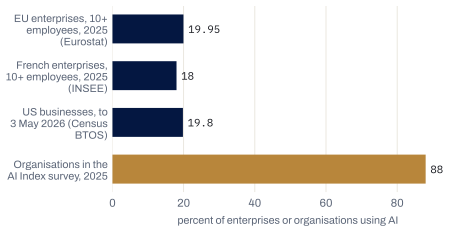
The 88 percent is drawn in the signal colour because it measures something else: respondent organisations reporting any use. It is not a reading of the same quantity as the three official series.
Source · Eurostat (Dec 2025); INSEE, Insee Première n° 2120 (21 Jul 2026); US Census BTOS (to 3 May 2026); Stanford HAI, AI Index 2026 (respondent survey) · read 2026-10-20 · SEG-1
Show the underlying numbers
| Item | percent of enterprises or organisations using AI |
|---|---|
| EU enterprises, 10+ employees, 2025 (Eurostat) | 19.95 |
| French enterprises, 10+ employees, 2025 (INSEE) | 18 |
| US businesses, to 3 May 2026 (Census BTOS) | 19.8 |
| Organisations in the AI Index survey, 2025 | 88 |
Where value is measured, it is bounded and it falls on junior work. Access to a generative assistant raised issues resolved per hour by 14 percent across 5,179 customer-support agents, by 34 percent for novices and minimally for experienced staff (Quarterly Journal of Economics, 2025). Three field experiments on 4,867 developers at a software group, a consultancy and a Fortune 100 company found 26.08 percent more completed tasks among users, standard error 10.3 percent, results that "vary between experiments", with larger gains for the less experienced (Management Science). Danish register data on about 25,000 workers in eleven exposed occupations rule out earnings or hours effects larger than 2 percent two years after the chatbot launch, even where employers encouraged use, supplied a tool and trained staff (use 93 percent of workers against 41 percent without such initiatives); 85 percent of users reallocated the time saved (preliminary, not peer reviewed). Perception runs ahead of measurement: 16 experienced open-source developers took 19 percent longer on 246 tasks with early-2025 tools while believing they had been 20 percent faster, and the February 2026 update on 57 developers found point estimates of 18 and 4 percent with intervals spanning zero, "very weak evidence" in its authors' words. CH05-C3
Where value is measured, it is bounded and it falls on junior work.
The most quoted failure statistic does not hold. The report behind "95 percent of pilots fail" rests on 52 interviews, 153 survey responses collected at four conferences and a review of more than 300 disclosed initiatives; its methodology defines success as "deployment beyond pilot phase with measurable KPIs" six months after the pilot, acknowledges possible selection bias, finds that external partnerships reached deployment about 67 percent of the time against about 33 percent for internal builds, and recommends agentic frameworks "like NANDA", the project with which it was produced, without an explicit financial-interest disclosure. Read from its own chart by its critics, about a quarter of the organisations that ran a pilot succeeded, and most never ran a custom pilot. The 2025 AI Index removed a figure citing a retracted paper. CH05-C4
The regulatory clock moved; the accountable party did not. Regulation (EU) 2026/1744 of 8 July 2026, in force on 27 July, moved the high-risk obligations to 2 December 2027 for Annex III systems and 2 August 2028 for Annex I, general-purpose model obligations staying on their August 2025 schedule. The French corporate-governance monitor's December 2025 report records the chairs' group agreeing that boards should treat AI systems "as tools of analysis and decision support, and not of decision-making", and itself finds that AI governance "is not yet systematically mentioned in companies' annual reports"; the market regulator announced on 9 June 2026 a study of how listed companies account for AI, not yet published. The court decisions found so far leave responsibility with the human who files or signs: a Quebec court fined a litigant 5,000 Canadian dollars on 1 October 2025 for fabricated authorities, and on 22 April 2026 another annulled an arbitral award resting on four non-existent decisions because the arbitrator had "abdicated his role" of reviewing the result (law-firm summaries); French courts issued warnings without sanction in at least seven decisions between December 2025 and February 2026 (law-firm note and legal press), and the Conseil d'État's December 2025 charter states "it is always the judge who bears responsibility for the decision". CH05-C5
In the francophone African arena compute is announced rather than delivered, and the physical constraint is measured in demand, not price. Data-centre electricity demand rose 17 percent in 2025 against 3 percent for all electricity, to about 485 TWh according to trade press reporting the release (press; the IEA release gives growth rates only), and the IEA's base case projects around 945 TWh by 2030 (projection); the IEA says power per AI task is "declining rapidly", and the last dated price series found, to February 2025, shows list prices for a fixed capability falling by factors of 9 to 900 a year. Morocco had 1.5 MW of operational data-centre capacity across 14 sites in the second quarter of 2026 against 140 MW under construction and 400 MW planned (research firm via press); the Naver-led 500 MW project near Casablanca, whose 40 MW first phase was due in the first quarter of 2026, had slipped several months by April 2026 (press); the Maroc IA 2030 roadmap of 8 September 2026 targets 100 billion dirhams of value added by 2030; and no official Moroccan statistic of enterprise AI use was found, the only 2026 reading being an online survey its authors call non-representative (press) (Exhibit 5.2). Côte d'Ivoire's 1 MW national data centre at Marcory was still under construction in mid 2025 at a cost reported at two different amounts a year apart (press), beside a 3 MW private facility at Grand-Bassam; none of the disclosed capacity is described as processor-grade. CH05-C6
Announced is not operational: Morocco's data-centre capacity, second quarter 2026
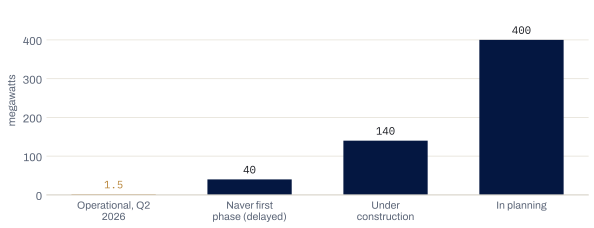
The operational figure, 1.5 megawatts, is too small to show as a bar at this scale and is printed in the signal colour. What share of the 140 megawatts under construction is processor-grade was not found.
Source · BMI (Fitch Solutions) via Le360 (24 Jun 2026, press); Naver-led consortium first phase via MEA Tech Watch (3 Apr 2026, press) · read 2026-10-20 · SEG-1
Show the underlying numbers
| Item | megawatts |
|---|---|
| Operational, Q2 2026 | 1.5 |
| Naver first phase (delayed) | 40 |
| Under construction | 140 |
| In planning | 400 |
France's numbers are announcements. The 109 billion euros of private AI investment announced on 9 February 2025 had, by 19 February 2026, one presidential status line, 58 billion euros in 2025, with no breakdown into committed, started or delivered; and the government's adoption plan, targeting 80 percent of small and mid-sized companies by 2030, reported more than 35,000 companies reached in its first year and an adoption rate "tripled in two years" without naming its source, although the official series (6 percent in 2023, 18 percent in 2025) supports it. The one named case, whose size the bank does not disclose, is a programme testimonial: an aeronautical tooling company that automated the checking of quotes and the processing of purchase orders in sales administration in February 2024, with "up to 1.75 days of productivity per week" per administrator reported by the public bank that sells the programme. CH05-C7
What is contested
The first objection is that adoption is taking off, not plateauing. The American series sat between 17 and 20 percent from December 2025 to May 2026 while France tripled in two years, from 6 to 18 percent, and the EU gained 6.47 points in one; the two readings support different 2027 plans, and both sit in the signposts.
The second objection is that "pilot purgatory" is a technology problem. The report that named it defines success as a measured outcome six months after a pilot, and its own chart, as read by its critics, shows that most organisations never ran a pilot with one; the Danish and developer studies show that where an outcome is measured the effect is small, concentrated or inside the noise. On this reading the purgatory is a measurement problem: no outcome was defined to fail against.
The third objection is that AI raises the ceiling of executive judgment. Every measured study above that reports a skill gradient points to the floor: novices, the less experienced, junior tasks. The theory behind this reading makes the same point conditionally, that prediction and judgment are complements "as long as judgment is not too difficult"; where it is difficult, the executive keeps it.
The corridor
What we expect in 2027
First, French enterprises with 50 to 249 employees using AI reach 40 percent in the 2026 reading published in July 2027, with the gain concentrated in administrative, IT-security and text tasks rather than strategic decisions. Falsified if the reading for that band is below 35 percent, or if the published purposes show strategy or planning among the three most cited; a reading between 35 and 40 percent leaves the hypothesis open and is reported as such. Baseline hypothesis (Scenario 1). CH05-H1
Second, no peer-reviewed study published by the end of 2027 shows earnings or hours effects above 2 percent attributable to general-purpose chatbots at population scale, whichever scenario holds. Falsified by one such study with public data or pre-registration. Baseline hypothesis (Scenario 1). CH05-H2
Third, Morocco commissions at least 40 MW of processor-grade capacity by the end of 2027 and Côte d'Ivoire and Senegal do not, so in-country inference becomes an option in one of the three. Falsified if no Moroccan site has commissioned 40 MW of processor-grade capacity by December 2027, if Abidjan or Dakar commissions processor-grade capacity before the end of 2027, or if the commissioned capacity is not open to enterprise customers. Live-alternative hypothesis (Scenario 3), which lengthens grid queues in Morocco: the hypothesis survives there only if the phase's renewable supply agreement is commissioned with it, and a grid-queue delay is the scenario's own route to falsification. CH05-H3
Signposts
| Indicator | Definition fixed | Reading, date | Threshold | Crossing means |
|---|---|---|---|---|
| French enterprises using AI, 50 to 249 employees | INSEE enterprise ICT survey, organised use of at least one of eight technologies, annual (July) | 31 percent, 2025 | 45 percent in the 2026 reading | AI use is the norm among mid-sized French firms; the question becomes which decisions and whose accountability |
| EU enterprises using AI, 10 or more employees | Eurostat, same definition, annual (December) | 19.95 percent, 2025 | 25 percent EU-wide, or 40 percent for medium enterprises | a six-point pace sustained; supplier pricing power and talent competition change |
| US businesses using AI in any function | Census BTOS, biweekly, question as reworded in November 2025 | 19.8 percent, period to 3 May 2026 | above 25 percent for three readings | the plateau has broken |
| Data-centre electricity demand growth | IEA annual estimate | plus 17 percent in 2025 (the 485 TWh level is a trade-press figure, not on the IEA release) | below 10 percent in 2026; or an IEA statement that AI demand runs above its base case | inference prices ease; or availability risk lands on buyers (chapter 6, row 11) |
| Annex III application and harmonised standards | Official Journal; Commission publications | 2 December 2027, fixed by Regulation (EU) 2026/1744 | harmonised standards published before 30 June 2027; or a second deferral | 2027 is the compliance-build year; or enforcement, not the calendar, is the variable |
| Operational processor-grade capacity in Morocco | operator announcements; research-firm counts via press | 1.5 MW operational across all grades, second quarter of 2026; 40 MW processor-grade first phase delayed | commissioning of the Casablanca first phase | in-country inference and data residency become real for arena B |
The two arenas
Francophone Europe. The French case is bounded, rule-based and high-volume, the head of sales administration accountable; bounded, repeatable tasks are where the studies measured gains. After the governance monitor's report and the market regulator's pending study, a French board is likely to be asked in 2027 what it reviews, by whom, and whether AI sits in the risk map; the administrative courts have answered for themselves, with the human signatory responsible. The 109 billion euros is an announcement, not an outcome: one status line in a year, no site named.
Francophone Africa. The Casablanca project puts Moroccan processor-grade compute, on Stredge Partners' reading, in 2027 to 2028; the press gives no cause for the slip, and Stredge Partners reads grid readiness rather than capital as the constraint. A Moroccan company instrumenting a decision in 2027 runs inference abroad unless processor-grade capacity is commissioned at home, with the custody consequences that implies; no latency or transfer figure was found. An Ivorian company runs it abroad with local hosting at best, the state having signed a memorandum of understanding on hosting sensitive data with the Grand-Bassam operator in June 2025 while its own 1 MW centre was unfinished. A Senegalese company reads Diamniadio, the 1.4 MW national data centre: a sovereignty announcement whose operator's own figures contradicted the "largest in West Africa" claim and to which almost no institution had migrated by October 2023 (press investigation).
What a board should ask
The test before commitment
The test is a measured pilot on one decision type, run in the Experiment step of the STREDGE Evidence-to-Decision Cycle before the 2027 tooling budget is released, with an AI-readiness diagnostic first and the value test owned by the function that owns the decision. The outcome metric and the accountable executive are defined before the tool is bought; the pilot runs eight to twelve weeks against a control group or a pre-period baseline; the effect is counted in measured time or error rates, never self-reported hours, because the developer trial shows self-report running 39 points ahead of measurement; and the record states where inference runs and whether the use falls under Annex III. The test is built to survive Scenario 3, in which power and compute tighten and inference availability moves against the buyer; under Scenario 1 a deploy verdict must still clear the threshold with the reviewer's hours costed. The verdicts: deploy, when the measured effect exceeds the pre-set threshold and a named executive signs; rethink, when the effect is present but accountability is unclear or the Annex III exposure unpriced; keep testing, when the effect sits inside the noise; stop, when the tool's withdrawal would move no number the company tracks. The number the evidence does not contain is an audited before-and-after result from a mid-sized company in France, Belgium, Switzerland, Luxembourg or francophone Africa.
What to instrument: measured time per task against a pre-period baseline; the error rate of the instrumented decision, the share of outputs checked by a named person and reviewer hours per hundred outputs; the decision systems in Annex III uses and the date each will be compliant; the country in which inference runs; the share of the AI budget spent on licences against training.
- Which two decisions will we instrument in 2027, and what number must move, by how much, for the pilot to pass?
- Who signs the outcome of each instrumented decision, and would that person sign the same outcome produced without the tool?
- Which of our systems touch recruitment, credit or essential services, and what must be in place by 2 December 2027?
- If every licence were withdrawn tomorrow, which figure in the management accounts would move first?
Evidence cards
CH05-C1SEG-1Official enterprise AI use is about one firm in five in the EU, France and the United States.
- Context
- Eurostat, Statistics Explained (data extracted December 2025; survey in the first months of 2025 on the 2024 questionnaire); INSEE, Insee Première 2120 (21 July 2026; organised use, reference period first quarter of 2025) and 2061 (1 July 2025); US Census Bureau BTOS story (26 May 2026; question reworded November 2025, earlier readings not comparable) and working paper CES-26-25 (April 2026).
- Contradictory evidence
- a respondent survey cited by the AI Index 2026 puts regular use at 88 percent of organisations, on a different population and definition.
- Transferability
- definitions differ across the three series; none covers francophone Africa.
- Review date
- 21 October 2026.
CH05-C2SEG-1The 88 percent figure is a self-selected respondent survey, not an enterprise statistic.
- Context
- Stanford HAI, AI Index 2026, Economy chapter (pp. 193 to 194, source named and caveat quoted); the consultancy's 2025 survey methodology read from a hosted PDF copy and its chart page of 10 December 2025; the 2026 wave (25 August 2026; 1,719 participants, "nearly nine in ten", 37 percent operating-profit impact).
- Contradictory evidence
- part of the gap is firm size: 38 percent of respondents work at organisations above 1 billion dollars of revenue, and official use among large enterprises reaches 55.03 percent in the EU and 58 percent in France.
- Review date
- 21 October 2026.
CH05-C3SEG-1Measured gains are bounded, skill-graded and smaller than perceived.
- Context
- Brynjolfsson, Li and Raymond (QJE 140(2), 2025; one firm, one task); Cui and others (Management Science, DOI 10.1287/mnsc.2025.00535; three firms, developer tooling, results noisy); Humlum and Vestergaard (RFBerlin DP 078/26, 13 March 2026, preliminary; BFI WP 2025-56); METR (10 July 2025; 24 February 2026, with 30 to 50 percent of developers withholding tasks they did not want to do without AI).
- Contradictory evidence
- the February 2026 update found speed-ups of 18 and 4 percent, reversing the sign of the 2025 slowdown, with intervals spanning zero.
- Causal confidence
- the skill gradient is reported in the support-desk, three-firm developer and open-source developer studies, and the Danish registers report a population null without a gradient; the chapter's reading that gains fall on the floor rather than the ceiling is an inference across them, not a tested finding.
- Review date
- 21 October 2026.
CH05-C4SEG-1The "95 percent" statistic rests on a small, self-selected sample and an undefined success test.
- Context
- MIT NANDA, The GenAI Divide (cover dated July 2025; method p. 2, p. 25; interests pp. 18, 23 to 24), read from a law-firm mirror; the February 2026 critique recorded by 80,000 Hours; Stanford HAI, AI Index 2025, chapter 4, p. 54 (correction notice).
- Contradictory evidence
- the consultancy's 2025 survey finds only 7 percent reporting AI fully scaled, consistent with a high failure rate even if this statistic's basis is weak.
- Review date
- 21 October 2026.
CH05-C5SEG-1The regulatory calendar is fixed to 2027 and 2028; boards, regulators and courts leave accountability with the human.
- Context
- Regulation (EU) 2026/1744 (OJ L, 24 July 2026; recitals 38 to 40 and 46 read; the operative articles are truncated in both EUR-Lex renderings and were checked against a secondary reproduction); Haut Comité de gouvernement d'entreprise, twelfth report (December 2025; chairs' group agreement at p. 13, the report's own finding at section 3.5, p. 20; quotations translated by the chapter); AMF announcement (9 June 2026); IFA guide (19 November 2024; recommendations paywalled, not read); FRC pages (2025 and 8 July 2026); Specter Aviation v. Laprade, 2025 QCCS 3521, and 2026 QCCS 1360 via law-firm notes; seven French decisions via a law-firm note and legal press; Conseil d'État charter (December 2025).
- Contradictory evidence
- no francophone decision awarding damages for an AI error in a commercial dispute between companies was found.
- Review date
- 21 October 2026.
CH05-C6SEG-1press for the capacity countsData-centre demand rose 17 percent; arena B compute is announced, not delivered.
- Context
- IEA, Key Questions on Energy and AI (news release, October 2026); Le360 (2026, press) citing a research firm (24 June 2026); MEA Tech Watch (2025 and 3 April 2026, press); Portail national du Maroc and TelQuel (9 September 2026); HCP (2019 survey) and ANRT (2025 brochure); Digital Mag CI (30 October 2024, press); OSIRIS republishing Agence Ecofin (17 June 2025 and 9 May 2026, press) and WeAreTech Africa (14 March 2025, press); OSIRIS investigation review (21 October 2023); Raxio and Business Wire (26 June 2025).
- Contradictory evidence
- the 3 MW private facility at Grand-Bassam was inaugurated on 24 September 2024, so some capacity is delivered, though none is described as processor-grade.
- Review date
- 21 October 2026.
CH05-C7SEG-1France's investment and adoption figures are announcements; the one mid-sized case is a programme testimonial.
- Context
- Gouvernement français (6 February 2025); Élysée transcript (19 February 2026); Direction générale des Entreprises (4 June 2026); Ministère de l'Économie press release 990 (3 September 2026); Bpifrance white paper (April 2025; company size not disclosed).
- Contradictory evidence
- the official series (6 percent in 2023, 18 percent in 2025) supports the plan's "tripled in two years".
- Review date
- 21 October 2026.
CH05-H1 to H3SEG-0Hypotheses for 2027.
Falsification conditions stated above; scenario mapping stated in each.
Sources and limitations
Sources read on 20 and 21 October 2026. Eurostat, Use of artificial intelligence in enterprises (data extracted December 2025); INSEE, Insee Première 2120 (21 July 2026) and 2061 (1 July 2025); US Census Bureau, Large Firms With at Least 20 Employees Biggest AI Users (26 May 2026), BTOS programme page (16 September 2026), working paper CES-26-25 (April 2026) and Household Pulse story on AI at work (August 2026); Stanford HAI, AI Index 2026 (chapters 1, 2 and 4) and AI Index 2025 (chapter 4); McKinsey & Company, State of AI 2025 (November 2025, hosted PDF copy), chart page (10 December 2025) and State of AI 2026 (25 August 2026), named here as the source of the survey series and nowhere in the body; Epoch AI, LLM inference price trends (12 March 2025); Brynjolfsson, Li and Raymond, Generative AI at Work (NBER 31161; QJE 2025); Cui, Demirer, Jaffe, Musolff, Peng and Salz, Management Science (DOI 10.1287/mnsc.2025.00535) and SSRN 4945566; Humlum and Vestergaard, RFBerlin DP 078/26 (13 March 2026) and BFI WP 2025-56 (May 2025); METR (10 July 2025 and 24 February 2026); Fang and others, arXiv 2510.12049 (revised 29 June 2026); MIT NANDA, The GenAI Divide (July 2025, law-firm mirror); Fortune (18 August 2025, press); 80,000 Hours via the EA Forum (recorded 13 February 2026); IEA, Energy and AI (2025) and Key Questions on Energy and AI (news release, October 2026); Enlit (16 October 2026, trade press, source of the 485 TWh level); EUR-Lex, Regulation (EU) 2026/1744 (OJ L, 24 July 2026); artificialintelligenceact.eu, Article 113 (secondary reproduction); Future of Privacy Forum timeline (July 2026); Lewis Silkin (27 July 2026) and Gibson Dunn (2026), law firms; Haut Comité de gouvernement d'entreprise, twelfth report and communiqué (2 December 2025); IFA (19 November 2024); AMF (9 June 2026); FRC (insight report; 8 July 2026; June 2025); Gowling WLG (19 November 2025), Blakes (3 July 2026), Daily Jus (5 June 2026), Noovo Info with La Presse Canadienne (17 August 2026, press), Morgan Lewis (18 March 2026), Landot avocats (21 March 2026) and Le Monde du Droit (3 March 2026); Conseil d'État, charte (December 2025); Conseil national des barreaux (18 June 2025); Gouvernement français (6 February 2025); Élysée (19 February 2026); Direction générale des Entreprises (4 June 2026); Ministère de l'Économie, press release 990 (3 September 2026); Bpifrance, white paper (April 2025) and Le Lab survey via ActuIA and L'Info Durable (4 and 5 June 2025, press); Portail national du Maroc (9 September 2026); TelQuel (9 September 2026, press); Finances News Hebdo (3 July 2025, press); HCP (19 November 2019; 2 February 2022); ANRT (2025 brochure; Data Entreprises); Médias24 (25 June 2026, press); Le360 (2026, press, citing BMI); MEA Tech Watch (18 June 2025 and 3 April 2026, press); Digital Mag Côte d'Ivoire (30 October 2024, press); OSIRIS (21 October 2023; and republications of 14 March 2025, 17 June 2025, 22 December 2025 and 9 May 2026, press); Business Wire (26 June 2025); Data Center Dynamics (8 October 2025, press); OECD.AI policy navigator (Senegal); US District Court SDNY, Mata v. Avianca (22 June 2023). Prior art declared here: Agrawal, Gans and Goldfarb, Prediction, Judgment and Complexity (NBER 24243, 2018) and Prediction Machines (2018); Lancefield, "Don't Let AI Flatten Your Leadership Style" (HBR, 3 August 2026); Goldman Sachs Research, Briggs and Kodnani (5 April 2023), origin of the "7 percent of GDP" headlines; MIT NANDA (2025), origin of the "95 percent" claim; the AI Index adoption series, which originates in the consultancy's survey; publishers of four- and five-level maturity ladders not verified and not named.
Limitations. The 88 percent figure's methodology was read from a hosted copy of the survey report because the publisher's page now serves the 2026 edition. The operative articles of the amended AI regulation are truncated in both Official Journal renderings; dates rest on the recitals and a secondary reproduction that agrees with them. The French governance monitor's quotations are the chapter's translations. The IFA's recommendations are paywalled and unread; the market regulator's study is announced, not published. The Quebec and French court decisions are read through law-firm and legal-press summaries, not the judgments; no francophone decision on damages for an AI error between companies was found. The Moroccan, Ivorian and Senegalese capacity figures are press counts; what share of the 140 MW under construction in Morocco is processor-grade is not stated, and no official Moroccan enterprise AI statistic was found. The 109 billion euro status is one presidential sentence. The developer, support-desk and Danish studies cover single tasks or one labour market and none covers a mid-sized francophone company; no audited before-and-after result from such a company was found. No per-token inference-cost series for 2025 to 2026 was found in the AI Index; the latest dated series ends in February 2025. The edition's threshold for the energy signpost is read as two-directional, following the table's own column on what a crossing means.
Exhibits for the web edition: Exhibit 5.1, two series that cannot be mixed, official enterprise adoption against the respondent survey, 2025 (Eurostat, INSEE, Census, AI Index); Exhibit 5.2, Morocco's data-centre capacity, operational against under construction and planned, second quarter of 2026 (research firm via press; operator announcements via press).
Corrections and challenges: through the channel on this page; logged with their dates.
Download the PDFs
The full edition, the executive summary and the eleven parts are free to download. Leave your work email and the files open on this page.