
Global Strategic Outlook 2027 · Chapter 2 of 10
Chapter 2. Concentration rose while prices fell
Which input exposures to resolve in 2027, and which processing partnerships reached production.
Bruno Hounkpati, Founding Partner and Chief Executive Officer
20 October 2026
Chapter 2
Concentration rose while prices fell: which input exposures to resolve in 2027, and which processing partnerships reached production
The top refiner's share of key energy minerals reached 72 percent while investment fell and lithium collapsed then doubled. Exposure is licence and lead time, not price; and in francophone Africa only one structure has brought a processing line into production.
- The decision: which two or three input exposures to resolve before the 2027 procurement budget closes, and which processing-partnership structure to finance; owners, the chief operating officer and head of procurement, then the investment committee.
- What the evidence says: refining concentration rose to 72 percent while lithium fell 86 percent and then recovered; exposure is licence and lead time, not price. Guinea revoked a bauxite concession and shipped Simandou's first ore in the same year; Morocco alone brought a new processing line into production.
- The test: a second-source qualification trial for the two longest-lead inputs, priced against stock held to 10 November 2026; for the investor, a term-sheet stress test against a mandate shock and a price shock. The number the evidence lacks: a measured licence lead time.
Decision at stake
An industrial operator must decide, before the 2027 procurement budget closes, which two or three input exposures it resolves this year, by qualifying a second source, by redesign or by stockholding, where an exposure means a single refiner, a licence requirement or a lead time rather than a price. An investor in francophone Africa must decide which processing-partnership structure it is prepared to finance: a state operator carrying a refinery promise, a shared-infrastructure company with a 15 percent state stake, or a joint venture built on Chinese technology with a state-linked local partner. The owners are the chief operating officer and head of procurement, then the investment committee. To Chapter 1's dates (10 November 2026 for the suspended Chinese measures; 10 January 2027 for the trade truce) this chapter adds two: the Democratic Republic of Congo's cobalt quota regime runs to the end of 2027, and Gabon's ban on unprocessed manganese exports takes effect on 1 January 2029, which makes 2027 the year its investment window is either used or lost.
What the evidence shows
What changed, 2024 to 2026
Refining concentration rose. The International Energy Agency's 2026 outlook on critical minerals puts the average share of the single largest refining country across key energy minerals, excluding rare earths, at 72 percent in 2025, from 70 percent in 2023. Mineral by mineral, as relayed from the same report by the Bank of Finland's emerging-economies institute, China refined 74 percent of the world's lithium, 76 percent of its cobalt, 94 percent of its battery-grade graphite, 47 percent of its copper and 31 percent of its nickel in 2025, and about 84 percent of the rare earths that go into magnets, down from over 90 percent in earlier years; Chinese-owned firms control about three quarters of Indonesia's nickel refining capacity. For gallium, graphite, manganese and rare earths China accounts for over 90 percent of supply. CH02-C1
China's share of world refining, 2025, by mineral
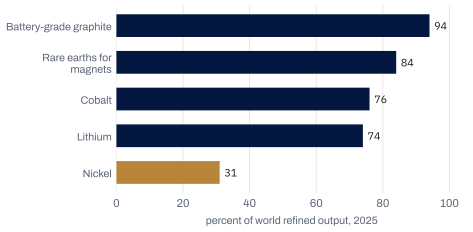
Nickel is drawn in the signal colour: the 31 percent is by location; by ownership about three quarters of Indonesia's capacity is Chinese.
Source · IEA, Global Critical Minerals Outlook 2026, as relayed by BOFIT Weekly Review 32/2026 (secondary) · read 2026-10-20 · SEG-1
Show the underlying numbers
| Item | percent of world refined output, 2025 |
|---|---|
| Battery-grade graphite | 94 |
| Rare earths for magnets | 84 |
| Cobalt | 76 |
| Lithium | 74 |
| Nickel | 31 |
Investment fell as prices rose. Capital spending on critical-mineral projects fell 9 percent in 2025, ending several years of growth: battery-metal spending down more than 20 percent, lithium companies down about 40 percent, copper-focused companies up 8 percent; exploration down more than 10 percent. Between January 2025 and April 2026 base-metal prices rose by a third with copper at records, lithium more than doubled, cobalt rose about 130 percent and tungsten sixfold, and European prices for gallium, germanium and heavy rare earths stood at several times Chinese domestic prices. CH02-C2
Before that recovery came a collapse. The annual average price of battery-grade lithium carbonate ran 11,700 dollars a tonne in 2021, 63,700 in 2022, 39,000 in 2023, 11,800 in 2024 and an estimated 9,000 in 2025, an 86 percent fall from peak to trough with oversupply cited for the first half of 2025, before the Chinese spot benchmark recovered to about 102,000 yuan a tonne on 20 October 2026. The chemistry moved too: lithium-iron-phosphate cells, which use no cobalt or nickel, were more than 55 percent of electric-vehicle batteries deployed worldwide in 2025 and more than 90 percent of stationary storage, while sodium-ion manufacturing capacity stood at just over 1 percent of lithium-ion's. CH02-C3
The collapse before the recovery: battery-grade lithium carbonate, annual average price
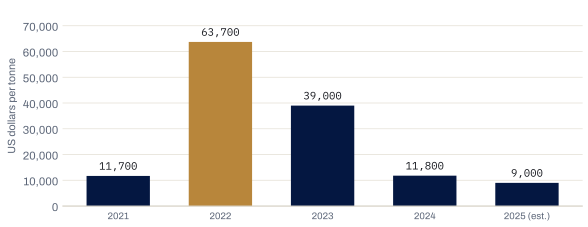
The 2026 recovery (about 102,000 yuan a tonne on 20 October 2026) is a spot benchmark in another currency and is not drawn on the same axis.
Source · United States Geological Survey, Mineral Commodity Summaries 2026 (lithium); 2025 is a USGS estimate · read 2026-10-20 · SEG-1
Show the underlying numbers
| Item | US dollars per tonne |
|---|---|
| 2021 | 11,700 |
| 2022 | 63,700 |
| 2023 | 39,000 |
| 2024 | 11,800 |
| 2025 (est.) | 9,000 |
The controls described in Chapter 1 are suspended, not repealed, and the Congo turned a ban into a quota. In the Democratic Republic of Congo, which mined about 74 percent of the world's cobalt in 2025, an export ban from February 2025 gave way in October to quotas of 87,000 tonnes a year plus a 9,600-tonne strategic reserve for 2026 and 2027. Cobalt hydroxide stood at 22 to 23 dollars a pound on 11 August 2026, four times its level on the day before the ban; one Chinese-owned producer's export quota for 2025 and 2026 is under half its nine-month 2025 output (press); and recycled material rose from about 13 percent to about 34 percent of China's cobalt raw material between the first quarter of 2025 and the second quarter of 2026 (market-intelligence provider, press-equivalent). The price stands at four times its pre-ban level and substitution has gathered pace; whether the quota produced the second is the chapter's reading of the sequence, not a tested finding. CH02-C4
The price stands at four times its pre-ban level and substitution has gathered pace; whether the quota produced the second is the chapter's reading of the sequence, not a tested finding.
Guinea revoked and settled. The decree withdrawing the Gulf state-owned operator's Boké bauxite concession was read on national television on 4 August 2025 (Guinean press), citing non-compliance with article 88 of the company's 2004 base convention and its 2005 and 2013 amendments, which the government said required an alumina refinery the company had not built in twenty years; the assets passed to the new state-owned Nimba Mining Company; a settlement with the parent was announced on 6 May 2026, sum undisclosed; two unrelated arbitration claims by other licence holders, of 28.9 billion and 100 million dollars, are pending. The general rule, under presidential directives of 2022 and 2023, is that bauxite producers submit an alumina-refinery plan and start by 2027 or partner with an approved local project; the country's existing alumina refinery ran at 52 percent of capacity in 2024. National bauxite exports still rose from about 145 million tonnes in 2024 (press citing the ministry) to 182.8 million in 2025, 74 percent of them to China, and the World Bank records volumes up a further 20 percent in the first quarter of 2026, although one major operator's own output ran below its 2025 level in the year to date. The state operator's refinery remains a plan, dated 2030. CH02-C5
Simandou's operations were launched on 11 November 2025; 2.2 million tonnes shipped in the third quarter of 2026 on the operator's blocks, an annualised run-rate of about 10 million tonnes against a target of 60 million a year in the second half of 2028; the state holds 15 percent of both mining consortia and of the company that owns the 552-kilometre shared railway and the port, which revert to the state after 35 years of operation. CH02-C6
Morocco is the only jurisdiction in the francophone African arena where a new processing partnership has brought a line into production: a precursor line for nickel-manganese-cobalt cathodes, a joint venture between a Chinese materials group and a state-linked Moroccan holding, was inaugurated in June 2025 (press); the first cell line of a Chinese-owned battery plant at Kenitra was due to start in October 2026 (press; whether it started on schedule was not verifiable on 20 October 2026); one anode plant was cancelled in 2026 as its sponsor redirected investment to China and Oman. Guinea's existing alumina refinery and Gabon's metallurgical complex at Moanda (653,000 tonnes in 2025) are established plants, not partnerships of this kind. The fiscal base beneath the Moroccan structures is phosphate: Morocco holds about 68 percent of world reserves, and its state producer reported 2025 revenue of 113.9 billion dirhams, up 17 percent, with 43.6 billion of capital expenditure (communiqué of 27 February 2026, read through press); the listed mining group's cobalt-sulphate line, contracted in 2022 for delivery from 2025, is now due to start in 2026. Gabon, for its part, decided in its Council of Ministers of 30 May 2025 (Gabonese press) to ban unprocessed manganese exports from 1 January 2029, notice to an industry that mines about a quarter of the world's manganese content, and on 17 July 2025 announced an agreement with the French operator for local processing of 2 million tonnes, without a site, a timetable or an amount; the same operator produced 7.1 million tonnes in 2025 and transported 5.5 million, with rail problems reported in the third quarter, so the railway may bind before the mandate does (press). CH02-C7
What is contested
The strongest objection to this chapter is that scarcity is cyclical and the controls are theatre. The lithium price history supports the first half; the second half fails on the licensing calendar: this chapter's reading is that the exposure created by Chinese licensing is lead time and licence denial for sensitive end uses, not cost, a reading supported by the licensing calendar, not by measured lead times, which no public series records; the Agency's policy chapter puts the effect of tripled rare-earth prices on the cost of an electric car at about 0.1 percent, critical minerals being about 3 percent of an average vehicle's price, a vehicle-level average rather than a component-level one.
The second objection is that beneficiation mandates work, Indonesia being the case. Two November 2025 studies say something more exact. Indonesia's nickel exports rose from 3.1 billion dollars in 2013 to 19.2 billion in 2023 and employment in the average nickel district rose 3 percent; its bauxite exports, under the same policy, fell from 2.4 billion to 1.6 billion dollars because processing investment did not follow and buyers switched suppliers, and employment in the average bauxite district fell 1.5 percent. A peer-reviewed review of July 2025 finds many such policies set without data on reserves or viability; the OECD's 2026 inventory records export restrictions at historically high levels, covering up to 70 percent of world cobalt and manganese exports. Guinea's revocation was followed by a settlement before any refinery, while two other licence holders went to arbitration; Zimbabwe's mandate escalated to a blanket suspension of unprocessed-mineral exports on 25 February 2026.
The third objection is that Côte d'Ivoire is the quiet success. Its 2025 gold record was marginal (59.33 tonnes, per the director general of mines in June 2026, against 59.1 in 2024), its new mining code still awaited adoption in 2026, it has no lithium mine or declared resource, and its most advanced lithium prospect was placed under a 90-day option for 100,000 Australian dollars in September 2026.
The corridor
What we expect in 2027
First, at least one of China's suspended measures is in force without a general licence in the first half of 2027, and buyers in francophone Europe of magnets, heavy rare earths, gallium or graphite face lead-time rather than price exposure. Falsified if the suspension of the October 2025 measures and the trade truce are both extended by numbered notice through 30 June 2027 and European premiums over Chinese domestic prices narrow. The stress-case hypothesis (Scenario 2). CH02-H1
Second, no alumina refinery in Guinea reaches a final investment decision in 2027, while bauxite export volumes hold or rise. Falsified by a published decision by the state operator or any other holder, or by a 2026 export total below 2025, a total known in January 2027. Holds in the tight-systems scenario (Scenario 3). CH02-H2
Third, Morocco commissions battery-cell production in 2027 and no other country in the francophone African arena commissions a new critical-mineral processing partnership. Falsified if the Kenitra line slips past December 2027, or if Guinea, Côte d'Ivoire, Senegal or Gabon commissions one first. Holds in the tight-systems scenario (Scenario 3), where it is francophone Africa's upside. CH02-H3
Signposts
| Indicator | Definition fixed | Reading, date | Threshold | Crossing means |
|---|---|---|---|---|
| Status of the October 2025 rare-earth measures | MOFCOM announcements | suspended to 10 November 2026; April licensing in force | lapse with the 0.1 percent rule reinstated, or formal extension | "qualify a second source during 2027" becomes "stockpile and redesign now" |
| Cobalt hydroxide price and the Congolese quota | price-reporting assessment, 30 percent Co min, CIF China; agency decisions | 22 to 23 dollars a pound, 11 August 2026; 87,000 t plus 9,600 t | below 15 dollars; or above 30, or a cut below 87,000 t | substitution has outrun the quota; or the quota binds harder and non-Congolese intermediate routes gain |
| Average top-country refining share | IEA, annual | 72 percent, 2025 (series excluding rare earths) | at or below 70 in the 2027 edition, or at or above 73 | diversification capital is moving the map; or no relief before 2030 |
| Guinea bauxite exports and refinery decisions | ministry weekly data via press; annual totals | 182.8 million tonnes, 2025 | 2026 total below 2025, or a refinery FID | revocations are costing output; or the mandate produces a plant |
| Simandou shipments | operator quarterly reports | 2.2 million tonnes, Q3 2026; run-rate about 10 million a year | 2026 sales below 5 million tonnes, or a 2027 exit run-rate below 30 million | the shared-infrastructure model is slipping; third-party rail access not assumable before 2029 |
| Lithium carbonate price | USGS annual average; market assessments | 9,000 dollars a tonne, 2025 average (estimate); more than doubled into April 2026 | sustained above 20,000; or below 12,000 | West African lithium exploration fundable again; or exploration optionality only |
The two arenas
Francophone Europe. The French group that operates Gabon's manganese mine faces a dated covenant rather than an expropriation: the 2029 ban converts a mining right into a smelting obligation, with 10,460 Gabonese employees at the mine and its railway. No implementing decree had been read on the access date. The legal frame on the European side is the Critical Raw Materials Act, in force since May 2024, which sets 2030 benchmarks of 10 percent of annual consumption extracted, 40 percent processed and 15 percent recycled within the Union and caps dependence on any single third country at 65 percent per strategic raw material. For rare earths, graphite and gallium, each over 90 percent Chinese, the cap is the number against which 2027 sourcing will be measured.
Francophone Africa. Three structures stand side by side in the evidence, named for what each reached rather than ranked. The state-operator model reached a settlement and a refinery plan while volumes held; the shared-infrastructure model reached production with a non-discriminatory third-party access clause in the operator's 2024 investment release but no published tariff and no verifiable fiscal terms; the joint-venture model, Chinese technology and capital with a state-linked partner and free-zone incentives aimed at European carmakers, reached a first production line on a phosphate fiscal base that Guinea and Gabon lack. The difference the evidence shows between the two Guinean outcomes is that the revoked structure carried an unmet, dated covenant and the producing one does not yet face one; the state's stake in the revoked concession was not read, and Simandou's own dated tests (60 million tonnes by the second half of 2028; third-party access) have not come due. What an outside investor can enter in Guinea is narrower than the headlines: the consortia's shareholdings are fully allocated, the state operator is state-owned, and the entry points are rail access at an unpublished tariff or a refinery partnership under a directive not yet read.
What a board should ask
The test before commitment
For the operator, the test runs in two steps of the STREDGE Evidence-to-Decision Cycle. In the Diagnose step, an input-exposure map: the bill of materials read against the production and technology rows of the exposure map, recording for each critical input its origin, its refiner, its licence status and the lead time at the last three orders. In the Experiment step, a second-source qualification trial for the two inputs with the longest lead times, priced against the cost of holding stock to the next suspension date: qualification cost plus the price premium on the trial volume, against weeks of cover times landed cost times the annual carrying rate. For the investor, a term-sheet stress test in the Simulate step: the three structures run against a mandate shock (revocation, quota, export ban) and a price shock (lithium at 9,000 and at 20,000 dollars a tonne; cobalt at 15 and at 30 dollars a pound), with the state's stake and the infrastructure-access terms written down rather than assumed. Both feed the capex decision. The operator's test is built to survive Scenario 2, the investor's Scenario 3; in Scenario 1 the investor's question is the one the scenario set names, which partnership to sign while hosts still need capital. Verdicts: deploy, when the structure survives both shocks with the access terms in hand; rethink, when it survives one; keep testing, when access terms are unknown; stop, when it survives neither.
What to instrument: the number of critical inputs with a single refiner; the lead time at the last three orders for each input under a suspended control; the weeks of stock held against 10 November 2026; for an investor, the presence of a dated covenant in the structure and the plant's financing status against it.
- Which of our inputs would need a Chinese licence on 11 November, and who in this company would file for it?
- What did our longest-lead input cost us in schedule, not price, in 2026?
- If we are financing a processing partnership, is there an unmet, dated covenant anywhere in the structure, and what happened to the last holder who missed one in that jurisdiction?
Evidence cards
CH02-C1SEG-1Refining concentration rose to 72 percent in 2025 (series excluding rare earths, 2023 base).
- Context
- IEA Global Critical Minerals Outlook 2026, 16 July 2026 (top refiners, Indonesia for nickel and China for the rest, took more than three quarters of the growth in refined supply over two years); mineral-by-mineral shares via the Bank of Finland's institute citing the same report (secondary; the IEA data pages were not readable as text).
- Contradictory evidence
- a second IEA aggregate including rare earths reads 70 percent in 2025 from 68 percent in 2020; rare-earth concentration declined modestly 2023 to 2025; China's share of copper smelting capacity (about 50 percent) is a capacity measure, not the refining share quoted.
- Transferability
- global.
- Review date
- 20 October 2026.
CH02-C2SEG-1Investment fell 9 percent in 2025 while prices rose into 2026.
- Context
- global project and exploration spending (lithium and nickel exploration down about 45 percent); prices January 2025 to April 2026.
- Method
- IEA investment tracking.
- Contradictory evidence
- public finance commitments in advanced economies reached about 65 billion dollars in 2025, more than four times the 2023 level, and copper-focused companies raised spending 8 percent.
- Causal confidence
- none claimed.
- Review date
- 20 October 2026.
CH02-C3SEG-1Lithium carbonate fell 86 percent from 2022 to 2025 and recovered in 2026; chemistry shifted to lithium-iron-phosphate.
- Context
- USGS Mineral Commodity Summaries 2026 (annual averages 2021 to 2025; the 2025 figure is a USGS estimate); a data aggregator's contract-for-difference series on the Chinese spot benchmark (20 October 2026: 38 percent above a year earlier); IEA Global EV Outlook 2026 (20 May 2026) for chemistry shares; nickel in surplus since 2022 with Indonesia at about two thirds of mine supply and a 2026 ore quota cut of roughly 30 percent (press).
- Contradictory evidence
- the same series stood 24 percent below a month earlier, a partial reversal of the 2026 recovery.
- Review date
- 20 October 2026.
CH02-C4SEG-1Under the Congolese regime the cobalt price stands at four times its pre-ban level and substitution gathered pace.
- Context
- agency decisions of October 2025 (quota replacing the February 2025 ban); price assessment of 11 August 2026; Chinese market data for the first half of 2026 (market-intelligence provider); the Agency attributes to the quota a widening of its projected 2035 cobalt gap from just over 15 percent to over 25 percent.
- Contradictory evidence
- under the quota the price fell to its August level from 26.00 to 26.25 dollars in mid-April 2026, and lithium-iron-phosphate was already nearly half of electric-vehicle batteries in 2024 (IEA), so substitution predates the ban.
- Causal confidence
- the sequence is documented; the fourfold rise is measured from the eve of the ban and spans the ban period; the link between quota and recycling share is the chapter's reading, not a tested finding.
- Review date
- 20 October 2026.
CH02-C5SEG-1Guinea terminated the Boké agreement, settled, and still exported about 25 percent more bauxite.
- Context
- withdrawal decree read on television on 4 August 2025 (Guinean press), preceded by the government's statement of 22 May 2025; directive summary via a market-intelligence provider; 2024 and 2025 export volumes via press citing the ministry; World Bank Macro Poverty Outlook (October 2026); one major operator's year-to-date output from its quarterly review (14 October 2026).
- Contradictory evidence
- the official texts of the refinery directive and the withdrawal decree were not read; the two pending arbitrations concern other permits (Boffa bauxite; Lola graphite).
- Review date
- 20 October 2026.
CH02-C6SEG-1Simandou reached a 10-million-tonne run-rate in the third quarter of 2026.
- Context
- operator's quarterly operations review (14 October 2026; 17,430 employed, 75 percent Guinean); first 200,000-tonne cargo of 2 December 2025 (Chinese official outlet and press) and investment release (16 July 2024, Form 6-K: 536-kilometre mainline and 16-kilometre spur; state 15 percent in the infrastructure company alongside two 42.5 percent holders); World Bank Macro Poverty Outlook (October 2026).
- Contradictory evidence
- the World Bank's first-half 2026 export figure ("at least 9 million tons") exceeds the operator's year-to-date shipments on an unstated basis and may include the other consortium's blocks; no access tariff published.
- Review date
- 20 October 2026.
CH02-C7SEG-1press-reliantMorocco is the only arena jurisdiction where a new processing partnership has brought a line into production.
- Context
- project announcements and press reports to 11 September 2026 (no production volume read for the precursor line; Kenitra first phase 12.8 billion dirhams and 20 gigawatt-hours, start not verifiable at the edition date; the cobalt-sulphate line was contracted in June 2022 to supply a French carmaker from 2025; two further Chinese anode and cathode projects at Tanger Tech); phosphate reserves from USGS; the phosphate producer's 2025 indicators via press reports of its communiqué of 27 February 2026 (primary site not readable); the mining group's 2025 results release of 25 March 2026 (primary; revenue 13.7 billion dirhams, up 55 percent); Gabon's Council of Ministers decision and the 17 July 2025 agreement via Gabonese press; the French operator's 2025 production and transport via press; Moanda complex output via press.
- Contradictory evidence
- the cobalt-sulphate line has slipped at least a year from its 2022 contract date.
- Review date
- 20 October 2026.
CH02-H1 to H3SEG-0Hypotheses for 2027.
Falsification conditions and scenario mapping stated in each.
Sources and limitations
Sources read on 20 October 2026. International Energy Agency, Global Critical Minerals Outlook 2026 (16 July 2026), executive summary, market overview, outlook and policy pathways chapters; Global EV Outlook 2026 (20 May 2026), executive summary and batteries chapter; Bank of Finland Institute for Emerging Economies, BOFIT Weekly Review 32/2026 (7 August 2026); Trading Economics and Shanghai Metals Market headlines (20 October 2026) for the lithium benchmark; World Bank Policy Research Working Paper 11249 (Kee and Xie, 10 November 2025, abstract) and CEPR Discussion Paper 20791 (Bosker, Van Den Herik, Pelzl and Poelhekke) via VoxEU (25 November 2025); OECD, Inventory of Export Restrictions on Critical Raw Materials 2026; Guinéenews (23 May, 5 July and 4 August 2025); Shanghai Metals Market (12 May 2025) on the refinery directive; World Bank, Macro Poverty Outlook for Guinea (October 2026) and Country Partnership Framework for Guinea FY27 to FY33 (27 May 2026); Rio Tinto plc, "Conditions on Simandou investment now satisfied" (Form 6-K, 16 July 2024) and third-quarter 2026 operations review (Form 6-K, 14 October 2026); IMF staff release on the 2026 Article IV mission to Guinea (12 August 2026, as republished); Boursenews and Hespress (27 and 28 February 2026, press) on the phosphate producer's indicators; Managem, communiqué de résultats annuels 2025 (25 March 2026); Gabon Media Time (16 June, 17 July 2025 and 24 April 2026) and EcoMatin (30 October and 6 November 2025, 19 February 2026), press, on Gabon; Mining Weekly citing Reuters (11 June 2026) and Team France Export (10 February 2026) on Côte d'Ivoire; United States Geological Survey, Mineral Commodity Summaries 2026 (rare earths, cobalt, bauxite and alumina, phosphate rock, manganese, nickel, lithium); Ministry of Commerce of China, Announcements 18, 70 and 72 (via legal practice summaries; numbered as in Chapter 1's sources); Fastmarkets, 12 August 2026 (price-reporting agency); Shanghai Metals Market, 13 July 2026 (market intelligence); press reports of the Congolese quota allocations (29 October 2025); Reuters via Mining Weekly, 26 January 2026 (Guinean export data); Afronomicslaw, 15 May 2026; Bilaterals.org, 16 March 2026; AlCircle, 31 December 2025; Shanghai municipal news, 14 November 2025, and Mongabay, January 2026 (Simandou launch and first shipment); TelQuel, 11 September 2026 (Moroccan battery projects); North Africa Post, 27 November 2025, and Milling MEA, 6 March 2026 (phosphate producer results, press); Ivorian Ministry of Mines data via the government economic portal (updated 19 November 2025) and Le360 Afrique, 21 September 2026; Rio Times, 30 September 2026; Mining Technology and AllAfrica, 2 and 3 June 2025 (Gabon); IDNFinancials, 19 January 2026 (Indonesia, press); McCarthy Tétrault, 10 April 2026 (Zimbabwe); Hale, Ali et al., Global Sustainability 8, e25 (14 July 2025).
Limitations. Mineral-by-mineral refining shares were read through a central-bank institute's summary of the Agency's report, not from the Agency's own pages. The status of the Chinese suspensions after 10 November 2026 is unknown at the edition date. No public series measures licence lead times; the lead-time reading rests on the licensing calendar and on qualitative assessments, and the structured interviews with procurement heads that would measure it have not been conducted. The official texts of Guinea's refinery directive and of the withdrawal decree were not read; the 2024 export base rests on press citing the ministry; the state's stake in the revoked Boké concession was not read. The phosphate producer's primary release was not readable and its 2025 operating result below EBITDA was not found; the start of the Kenitra cell line and the output of the precursor line were not verifiable. Gabon's implementing instrument beyond the Council of Ministers decision was not found, and the French operator's 2025 transported volume (5.5 million tonnes, press) sits below the guidance it gave in October 2025 (6.1 to 6.3 million), a discrepancy to be checked against the company's full-year release. No evaluation with primary data of Indonesia's 2023 bauxite ban, Tanzania's 2017 measures or Zimbabwe's lithium bans was found; the two Indonesian studies cover the 2014 ban to 2023.
Corrections and challenges: through the channel on this page; logged with their dates.
Download the PDFs
The full edition, the executive summary and the eleven parts are free to download. Leave your work email and the files open on this page.