Global Strategic Outlook 2027 · Chapter 1 of 10
Chapter 1. Fragmentation is narrow
Where the next unit of capacity goes, and under whose standard.
Bruno Hounkpati, Founding Partner and Chief Executive Officer
20 October 2026
Chapter 1
Fragmentation is narrow: where the next unit of capacity goes, and under whose standard
The bloc penalty measures four to five percent, the American tariff level held an 11 to 12 percent band from April to August 2026 through one change of legal basis, and China's controls are suspended rather than repealed. The location decision turns on which standard survives, not on which bloc.
- The decision: where the next unit of physical capacity goes, and under which standard, before the capex committee of the first quarter of 2027; owner, the chief executive with the chief financial officer.
- What the evidence says: fragmentation is narrow. The bloc penalty measures 4 to 5 percent once Russia is set aside, the American statutory tariff rate held an 11 to 12 percent band from April to August 2026 through a change of legal basis, and China's controls are suspended to 10 and 27 November 2026, not repealed. The question is which standard survives, not which bloc.
- The test: price the shortlisted site three times, European, American under its Section 301 tier, Chinese with the 0.1 percent rule reactivated, before the committee meets. The number the evidence lacks: licence lead time under the suspended controls, and the cost of dual certification.
Decision at stake
In the first quarter of 2027 companies of 30 to 500 million euros of revenue that run a first-quarter capex round will approve the location of their next unit of physical capacity: a plant, a warehouse or a production line (data environments and teams are outside this chapter's evidence). The decision will be taken between two dates that matter more than any forecast. On 10 and 27 November 2026 the suspensions of China's October 2025 export-control measures and of its 2024 licensing aimed at the United States expire unless a numbered notice extends them; on 10 January 2027 the political truce between Washington and Beijing, extended in September, runs out again. The owner of the decision is the chief executive, with the chief financial officer, and the consequence of getting it wrong is not a tariff bill but a site built to a technical, customs or financial standard and rendered uncompetitive within the year by a change of legal basis.
Geoeconomic fragmentation entering 2027 is real but narrow on the question this chapter treats: one axis, the United States and China; one product family, the inputs of artificial-intelligence hardware and the critical materials behind it; and one instrument, a tariff authority that has changed faster than the tariff level it sets. The Gulf shock of 2026 (Middle East imports down 15.4 percent in the WTO's 2026 forecast) is a second axis, carried by the chapters on chokepoints and energy; "narrow" here refers to standards. For an operator in Lyon, Brussels, Casablanca or Abidjan the question is not "which side" but "which standard survives".
What the evidence shows
What changed, 2024 to 2026
Trade did not shrink; it re-routed and re-priced. The World Trade Organization forecast merchandise trade volume growth of 0.5 percent for 2026 in October 2025, raised it to 1.9 percent in March 2026 and to 3.9 percent on 8 October 2026, with 4.1 percent for 2027, after an outturn of 4.2 percent in 2025. First-half 2026 volume grew 3.5 percent and value 15 percent; goods that enable artificial intelligence accounted for 47 percent of the growth in value. UNCTAD's nowcast puts first-half 2026 goods trade at a record 13.7 trillion dollars, up 12.5 percent, a large share of it price. The International Monetary Fund's October 2026 tables, read directly, project world trade volume in goods and services growing 5.0 percent in 2025, 4.6 percent in 2026 and 4.7 percent in 2027, a slowdown the Fund attributes to "the drag from tariffs" on unchanged trade policies. CH01-C1
The forecast that moved: world merchandise trade volume growth
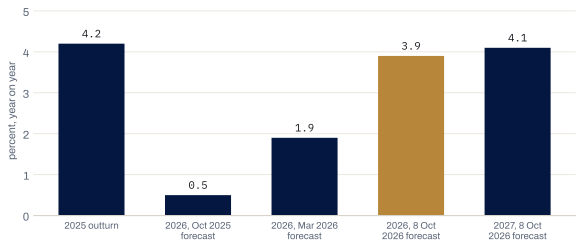
The October 2026 figures were first read through two press reports that agree and were confirmed on the WTO's own pages on 21 October 2026.
Source · World Trade Organization, Global Trade Outlook (7 Oct 2025, Mar 2026, 8 Oct 2026), first via press reports, the October 2026 release confirmed on the WTO's pages · read 2026-10-20 and 21 · SEG-1
Show the underlying numbers
| Item | percent, year on year |
|---|---|
| 2025 outturn | 4.2 |
| 2026, Oct 2025 forecast | 0.5 |
| 2026, Mar 2026 forecast | 1.9 |
| 2026, 8 Oct 2026 forecast | 3.9 |
| 2027, 8 Oct 2026 forecast | 4.1 |
The measured bloc penalty is small. The WTO's own gravity estimation, run on monthly trade among 97 reporters and 118 partners with blocs defined by voting distance at the United Nations General Assembly, finds that trade between a hypothetical "East" and "West" grew about 4 to 4.7 percent more slowly than trade within blocs after March 2022, concentrated in the least complex products. Economists at the Banque de France, using a different alignment index and 55 reporters, find a decline of about 10 percent in inter-bloc trade in 2022 that halves to about 5 percent once Russia is excluded, with little evidence of rerouting through connector countries. CH01-C2
The two trends have separated. The WTO's October 2026 update reads them apart: the gap between trade within and across rival blocs narrowed in 2025 and into 2026 and is no longer widening, while decoupling between the United States and China accelerated. American imports from China fell 29 percent in 2025 and China's share of American imports fell to 9.3 percent, from above 20 percent before 2018 (press). The WTO's report, read on 21 October 2026, gives the bloc wording and the other figures. CH01-C3
The American tariff level held an 11 to 12 percent band from April to August 2026, through the July change of legal basis, after the ruling of February had removed the first. On 20 February 2026 the Supreme Court held, six to three, that the International Emergency Economic Powers Act does not authorise the President to impose tariffs. A surcharge under Section 122 of the Trade Act ran from 24 February to 24 July 2026 at 10 percent on imports from all countries. On 24 July 2026 it was replaced by tariffs under Section 301 in four tiers, with the European Union at a floor of 10 percent net of most-favoured-nation duty, inside the 15 percent ceiling of the July 2025 EU-US framework. Section 232 duties, on goods the Section 301 tiers exempt, did not move with the legal basis: 50 percent on steel, aluminium and copper; 25 percent on cars, heavy trucks and furniture; and 100 percent on patented pharmaceuticals from 29 September 2026, 15 percent for European products (trade-compliance alert). The Budget Lab at Yale put the average tariff rate at 11.8 percent on 8 April 2026 on its pre-substitution effective definition, and the average statutory rate at 11.1 percent on 24 July and 11.0 percent on 24 August, and projects 11.8 percent by the end of 2026 under current law. CH01-C4
China's controls are suspended, not repealed. Announcement 70 of the Ministry of Commerce, dated 7 November 2025, suspends the six October 2025 directives, including the rule that brings any product containing 0.1 percent or more of Chinese-origin rare-earth content under Chinese licensing wherever it is made, until 10 November 2026. Announcement 72, dated 9 November 2025, suspends the licensing aimed at the United States on gallium, germanium, antimony, graphite and superhard materials until 27 November 2026. The licensing on seven medium and heavy rare earths introduced by Announcement 18 in April 2025 never stopped. As of 14 October 2026 no numbered notice had amended Announcement 70, although the broader truce had been extended to 10 January 2027 in a statement that, on press and commercial reporting, did not mention rare earths. The suspension has not restored flows: Chinese customs data cited in the trade press show exports of dysprosium, terbium and yttrium about half their pre-restriction level, and no dysprosium or terbium oxide shipped to Japan in 2026 while finished magnets kept moving. The licence, not the tariff, is the instrument that bites. CH01-C5
In the francophone African arena the split runs between revenue standards and operating standards, not between blocs. Europe took 69.7 percent of Morocco's exports and supplied 54.2 percent of its imports in 2025, its share of total trade slipping to 59.8 percent from 62 percent in 2024, while trade with China grew 25.1 percent for a fourteenth consecutive year and Asia's share of total trade rose to 21.9 percent. The West African monetary union sent 43.8 percent of its 2024 goods exports to Europe, 19.6 percent of it to Switzerland, mostly gold, and bought 53.6 percent of its capital goods from Asia, 35.9 percent from China alone. Senegal, Guinea and Togo run the same way: China supplied 21.4 percent of Senegal's imports and 32.9 percent of Guinea's in December 2025 and 29.9 percent of Togo's in the fourth quarter, while the clients were European and regional for Senegal (Switzerland, Belgium and Mali) and Indian and regional for Togo (India, Côte d'Ivoire, Burkina Faso and Benin), monthly and quarterly shares rather than annual ones. Guinea is the exception that sharpens the test: China took 65.6 percent of its December exports, so, on one month's data, both of its standards look Chinese. A plant in Tangier or Abidjan sells, increasingly, under one standard and runs on equipment built to another. CH01-C6
Revenue standard against operating standard: the West African monetary union, 2024
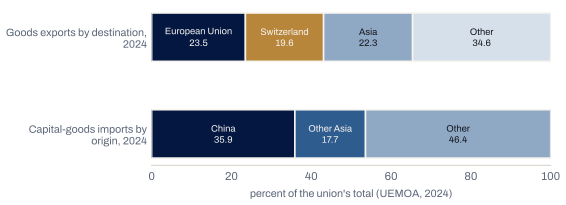
Switzerland is drawn in the signal colour because its share is carried by gold; without it Europe's share is 24.2 percent against Asia's 22.3.
Source · BCEAO, Rapport sur le commerce extérieur de l'UEMOA 2024 (Oct 2025); residuals computed · read 2026-10-20 · SEG-1
Show the underlying numbers
| Item | percent of the union's total (UEMOA, 2024) | Series |
|---|---|---|
| Goods exports by destination, 2024 | 23.5 | European Union |
| Goods exports by destination, 2024 | 19.6 | Switzerland |
| Goods exports by destination, 2024 | 22.3 | Asia |
| Goods exports by destination, 2024 | 34.6 | Other |
| Capital-goods imports by origin, 2024 | 35.9 | China |
| Capital-goods imports by origin, 2024 | 17.7 | Other Asia |
| Capital-goods imports by origin, 2024 | 46.4 | Other |
A plant in Tangier or Abidjan sells, increasingly, under one standard and runs on equipment built to another.
What is contested
Three readings of the same data deserve a hearing. The first holds that fragmentation is general and accelerating. Against it stand the Czech National Bank's finding of only "slight and creeping" signs in the trade of European Union members, visible at bloc level and invisible in partner-concentration measures, and the WTO's October 2026 finding that the bloc gap narrowed. The second holds that connector economies merely relabel Chinese goods. Against it, IMF researchers find that Vietnam's gains were reallocation rather than rerouting, with domestic value added in exports to the United States 10 to 12 percentage points above the counterfactual in two strategic sectors, and the Banque de France finds little rerouting at all; Alfaro and Chor (2023) find a five-point fall in China's share of American imports associated with import prices from Vietnam about 9.8 percent higher: reallocation is real, and it appears to be paid for. No comparable study was found for Senegal or Côte d'Ivoire. The third holds that trade deals set the tariff. The record of 2026 says otherwise: the Section 122 surcharge breached the EU-US ceiling within days of the ruling, and the level returned inside it five months later under a different statute.
The corridor
What we expect in 2027
First, the American average statutory tariff rate stays within 10 to 13 percent through 2027 whatever the legal instrument, on the reading that the level is set by domestic political economy rather than by the authority invoked; the band is wider than the observed 11 to 12 because the choice of definition alone moves the reading by up to about two points. Falsified if the Budget Lab reading sits outside that band at two consecutive quarter ends. This holds in the baseline scenario (Scenario 1); it fails in the stress case. CH01-H1
Second, at least one of China's suspended measures, most likely the 0.1 percent extraterritorial rule, returns in some form by mid-2027 without a general licence, so that "which standard" becomes "whose licence" for any user of magnets, motors or semiconductors with Chinese-origin rare-earth content, in Lyon, Tangier or Abidjan alike. Falsified if both suspensions are extended by numbered notice through 30 June 2027, or if any measure returns only under a general licence. This is the stress-case hypothesis (Scenario 2). CH01-H2
Third, the operative customs standard for sites in Abidjan, Dakar and Lomé that serve Mali, Burkina Faso and Niger remains that of the West African monetary union, not of the Economic Community of West African States, with the 0.5 percent confederal levy applied by the three Sahel states since March 2025 as the price of the new border. Falsified if any of the three leaves the monetary union or extends the levy to goods of union origin. This holds in the baseline scenario (Scenario 1) and is not tested by the other two. CH01-H3
Signposts
| Indicator | Definition fixed | Reading, date | Threshold | Crossing means |
|---|---|---|---|---|
| American average tariff rate | statutory, Budget Lab at Yale | 11.0 percent, 24 August 2026; 11.8 projected end 2026 | above 15 or below 8 at two consecutive quarter ends | the ceiling has failed, so US-bound capacity sits inside North America; or the regime is unwinding |
| China's suspensions | MOFCOM numbered announcements | 10 and 27 November 2026 | reactivation of the 0.1 percent rule without a general licence | Chinese licence needed for any plant using Chinese-origin rare-earth content above 0.1 percent |
| WTO merchandise volume forecast | April and October releases | 3.9 percent 2026; 4.1 percent 2027 | 2027 below 2 percent, or a within-year swing above 2 points | fragmentation has reached aggregate demand; or forecasts too unstable to anchor capacity |
| Europe's share of Morocco's trade | Office des Changes, annual report | 59.8 percent, 2025 (62 percent, 2024) | below 55 percent, or Asia above 25 | dual-certification cost rises for plants in Tangier and Kenitra |
| Union exports to Europe against Asia; China's share of capital-goods imports | BCEAO, annual | 43.8 (European Union 23.5) against 22.3 percent; 35.9 percent (2024) | Asia above the European Union; China above 40 percent | the revenue standard is no longer European; the operating standard is predominantly Chinese |
The two arenas
Francophone Europe. After the February 2026 ruling the European Parliament froze ratification of the July 2025 framework; the Union nonetheless removed its tariffs on American industrial goods on 1 July 2026. The refund position differs by period: American data from mid-July 2026, as reported in the press, showed 81 billion dollars refunded for duties imposed under the struck-down authority, while duties paid under Section 122 between 24 February and 24 July were still in litigation in August. An American importer that paid duties on European goods between April 2025 and February 2026 holds a recoverable asset; one that paid between February and July 2026 does not yet; a French or Belgian seller invoicing ex works holds neither.
Francophone Africa. Morocco is the arena's case of a country that sells to one bloc and buys from another: Spain and France alone account for close to half of its European trade. The site that results sells under European standards; its imports from China grew 23.8 billion dirhams in a year, of unknown composition; the cost to price is that of carrying both certifications. Niger is the counter-case: its uranium exports fell 73.1 percent in 2024, the year before its exit from the regional community took effect, a single line in a central-bank report, recorded in the year of a jurisdictional rupture for a single-commodity export under a foreign operator's standards, which the report does not explain. Between the two, Côte d'Ivoire (44.3 percent of the union's 2024 goods exports), Senegal (14.3 percent) and Togo (29.5 percent of the union's transport-services exports) are the gateways through which the Sahel is now served, under the union's customs standard and the Sahel states' half-percent levy. The regional development bank's 2025 outlook puts trade inside the wider community at 8.6 percent of its members' trade over three years and projects a fall to 5.2 percent after the three departures, an ex ante estimate.
What a board should ask
The test before commitment
The test before commitment is a standards stress test, run in the Simulate step of the STREDGE Evidence-to-Decision Cycle before the capex committee meets. The shortlisted site is priced three times: to the European standard, to the American standard under its Section 301 tier, and to the Chinese standard with the 0.1 percent rule reactivated. Each pricing makes the dual-certification and licence costs explicit lines rather than contingencies, and carries the refund status of duties already paid as a working-capital line by period. The exercise feeds the capex decision. It is designed to survive the stress case (Scenario 2), in which the 0.1 percent rule returns without a general licence and the statutory average breaks 15 percent. No public figure for dual-certification cost or for licence lead time under the suspended controls was found; measuring both is Stredge Partners' first primary-research item for 2027. The verdict options are Stredge Partners' four: deploy, when one regime dominates under all three pricings; rethink, when the ranking flips under one of them; keep testing, when licence costs cannot yet be quantified; stop. On timing, the chapter's position is this: a committee that meets before 10 November 2026 approves with a licence contingency and a certification budget written into the resolution; one that can wait approves in the week after 27 November with both readings in hand; a decision that can neither wait nor carry a contingency is split, the site now and the standard-specific equipment after.
What the board should instrument, in its own numbers rather than anyone else's: the share of revenue by standard regime, the share of installed equipment and spares by standard of origin, the lead time at the last three orders of any input under a suspended control, the value of duties paid by period and their refund status, and the gap in unit cost between the site's two best regimes.
- Under which standard is our next site certified, and what does the second certification cost per year?
- Which of our inputs would require a Chinese licence if the 0.1 percent rule returned on 11 November, and how many weeks of stock do we hold against that date?
- Which customs regime governs our Sahel-bound goods today, and what did the half-percent levy cost us in the last quarter?
- Who in this company reads the five signposts above each quarter, and what will they do on the day one crosses?
Evidence cards
CH01-C1SEG-1documented patternTrade re-routed and re-priced rather than shrinking.
- Context
- world merchandise trade, 2025 to first half 2026; IMF goods-and-services volume to 2027 (the two institutions measure different aggregates; both read 2027 as stabilisation).
- Period
- forecasts of October 2025, March and October 2026; nowcast to June 2026.
- Method
- WTO forecast series (press; semiconductor and data-centre equipment trade up 67 percent year on year in the first half of 2026); UNCTAD nowcast; IMF World Economic Outlook October 2026, Chapter 1, Table 1.1 (primary).
- Contradictory evidence
- a large share of the 2026 value gain is price (traded-goods prices up about 3.6 percent in the first quarter and an estimated 5 percent in the second).
- Causal confidence
- none claimed.
- Transferability
- global aggregate; country effects differ.
- Review date
- 20 October 2026.
CH01-C2SEG-1The bloc penalty is 4 to 5 percent, not a rupture.
- Context
- 97 reporters and 118 partners (WTO); 55 reporters and 221 partners (Banque de France).
- Period
- 2016 to early 2024 (WTO); 2017 to 2023 (Banque de France).
- Method
- gravity estimation with high-dimensional fixed effects; bloc definitions by UNGA voting distance and by the ECB alignment index.
- Contradictory evidence
- the IMF's long-run cost range runs from 0.2 percent of world output in a mild case to 7 percent under extreme fragmentation; the 7 percent is a scenario, not an outturn.
- Causal confidence
- association with the post-February-2022 period; no causal claim.
- Transferability
- aggregate trade; product effects concentrated in less complex goods.
- Review date
- 20 October 2026.
CH01-C3SEG-1The bloc gap narrowed in 2025 and into 2026 while US-China decoupling accelerated.
- Context
- WTO, Global Trade Outlook and Statistics Update, October 2026 (8 October 2026), pages 3 and 22 to 23, read on 21 October 2026, which replaces the wording first read through two press outlets on 8 and 9 October 2026; bloc series from Blanga-Gubbay and Rubínová (2024) updated by the WTO Secretariat; the share above 20 percent before 2018 rests on those press outlets.
- Contradictory evidence
- none found in the sources read.
- Causal confidence
- none claimed.
- Review date
- 21 October 2026.
CH01-C4SEG-1The American tariff level held an 11 to 12 percent band from April to August 2026 across the Section 122 to Section 301 transition.
- Context
- United States, February to August 2026.
- Method
- Supreme Court decision; Federal Register actions as summarised in practice notes; Budget Lab tariff tracking (the 8 April reading is on the pre-substitution effective definition; the 24 July and 24 August readings are statutory; the 24 August reading is from the chapter 6 scan); Section 232 list from a think-tank tracker (10 September 2026: steel, aluminium and copper 50 percent; autos, heavy trucks and furniture 25; lumber 10; drones 100 and 25; polysilicon 15 from 4 December 2026) and a trade-compliance alert (28 September 2026: pharmaceuticals 100 percent from 31 July 2026 for companies listed in the proclamation's annex and from 29 September for all others; 15 percent for the European Union, Japan, South Korea and Switzerland; generics exempt; collection from 29 September not confirmed).
- Contradictory evidence
- the effective post-substitution rate is lower (9.05 percent in the July model; 7.2 percent in the think tank's 2026 estimate; the think tank's applied rate is 11.8 percent on 10 September); a 12 percent threshold would be crossed or missed by definition alone; no reading from the period before the February ruling is used.
- Review date
- 20 October 2026.
CH01-C5SEG-1China's October 2025 controls are suspended to 10 November 2026 and the 2024 US-focused licensing to 27 November 2026; April 2025 licensing continues.
- Context
- MOFCOM Announcements 18, 70 and 72.
- Method
- legal practice summaries of the announcements; two sources, one press and one commercial, report that the 28 September statement did not mention rare earths and that no numbered notice had amended Announcement 70 by 14 October 2026.
- Contradictory evidence
- absence of a notice in the sources read is not evidence of absence; the customs figures on dysprosium, terbium and yttrium are press citations of Chinese customs data, undated.
- Review date
- 20 October 2026.
CH01-C6SEG-1In Morocco and the West African monetary union the split is revenue standard against operating standard.
- Context
- Morocco 2025 (Office des Changes annual report PDF, 15 October 2026, read directly; from the European side, a record 62.2 billion euros of EU-Morocco goods trade in 2025, half of EU imports from Morocco being machinery and transport equipment, Commission figures via press); union 2024 (BCEAO report, October 2025; Switzerland takes 19.6 percent of union exports and 58.9 percent of union gold); Senegal and Guinea December 2025 and Togo fourth-quarter 2025 partner shares (national statistics offices, the Togo figures via press); intra-community trade share from the ECOWAS Bank for Investment and Development (June 2025; press ranges of 11.5 to 15 percent are unsourced and not used).
- Contradictory evidence
- no cumulative 2025 partner shares were found for Senegal, Guinea or Togo (an unread May 2026 note exists for Guinea); the Moroccan report gives no origin for its 199.2 billion dirhams of capital-goods imports (24.2 percent of imports), so the operating standard is read from the union's data, not Morocco's.
- Transferability
- Morocco and the union only.
- Review date
- 20 October 2026.
CH01-H1, H2, H3SEG-0Hypotheses for 2027.
Falsification conditions and scenario mapping stated above.
Sources and limitations
Sources read on 20 and 21 October 2026. World Trade Organization, Global Trade Outlook update of 8 October 2026 (first read via Reuters, China Daily and Asharq Al-Awsat reports of 8 and 9 October; the news item and the report, Global Trade Outlook and Statistics Update: October 2026, read on 21 October 2026) and Global Trade Outlook of 7 October 2025 (United Nations audiovisual record); WTO Staff Working Paper ERSD-2023-10 (Blanga-Gubbay and Rubínová, revised October 2024); UNCTAD, Global Trade Update, 21 July 2026; International Monetary Fund, World Economic Outlook October 2026 (13 October 2026; Chapter 1 PDF, Table 1.1 and executive summary read directly) and July 2026 update, Staff Discussion Note SDN/2023/001 (Aiyar et al., January 2023), speech of 7 May 2024 (Gopinath), Working Paper 2025/129 (Schulze and Xin, via VoxEU, 12 January 2026); Banque de France, "Tracking Fragmentation in World Trade" (Carluccio, Gaulier, Smagghue and Stumpner, July 2024); Czech National Bank blog, 12 January 2024; Supreme Court of the United States, Learning Resources, Inc. v. Trump, 20 February 2026 (via a legal practice summary of the same date); Section 122 and Section 301 actions of February and July 2026 (via a Bruegel analysis of 23 February 2026 and a legal practice note of 3 August 2026); The Budget Lab at Yale, "The State of U.S. Tariffs" of 8 April, 24 July and 24 August 2026 and the model note of 20 July 2026; Tax Foundation, tariff tracker (updated 10 September 2026); GHY International, trade-compliance alert on Section 232 pharmaceuticals (updated 28 September 2026); Alfaro and Chor, NBER Working Paper 31661 (September 2023; China's share of American goods imports 21.6 percent in 2017 and 16.5 percent in 2022, Vietnam up two points, Mexico 14 percent); Ministry of Commerce of China, Announcements 18 (April 2025), 70 (7 November 2025) and 72 (9 November 2025), via legal practice summaries of 24 November 2025 and 12 February 2026; press report of the truce extension, 23 September 2026, and the MOFCOM statement of 28 September 2026 as reported on 14 October 2026; FXStreet (14 October 2026), THG News (updated 7 October 2026) and Carraglobe (modified 14 October 2026) on the status of Announcement 70 (press and commercial); Office des Changes (Morocco), Rapport annuel du commerce extérieur 2025 (15 October 2026, PDF read directly); ANSD (Senegal), bulletin mensuel du commerce extérieur, décembre 2025; Institut National de la Statistique (Guinea), note sur le commerce extérieur, décembre 2025; INSEED (Togo) fourth-quarter 2025 figures via Ecofin Agency and Togonews (press, May 2026); EBID, West Africa Development Outlook 2025 (June 2025); North Africa Post (press, 5 June 2026) on Commission EU-Morocco figures; Direction générale du Trésor, Brèves économiques Nigeria et Ghana no. 37 (February 2026) and Afrique de l'Ouest no. 641 (4 September 2026) (French goods trade with sub-Saharan Africa 25.1 billion euros in 2025, up 2.7 percent; exports to the monetary union up 10.4 percent to 3.9 billion, imports from it up 47 percent to 2.6 billion; Côte d'Ivoire France's first client in the region; offered to Chapter 8); BCEAO, Rapport sur le commerce extérieur de l'UEMOA 2024 (October 2025); Direction générale du Trésor, Objectif Afrique no. 253 (22 September 2025) and no. 245 (11 April 2024); Euronews (press), 21 July 2026; Wipfli, tariff update of 18 August 2026 (advisory note); NIESR, 5 February 2025; press reports on the Sahel states' levy and the ECOWAS summit of July 2026.
Limitations. The WTO's October 2026 release was first read through press; its own pages, read on 21 October 2026, replaced the press wording on fragmentation, and China's share of American imports before 2018 still rests on press. The IMF and Office des Changes figures were confirmed from the primary documents. No Budget Lab reading from before the February 2026 ruling is used, so the chapter shows the tariff band through one change of legal basis, not across all three; the 24 August reading was read in the chapter 6 scan, and no later edition was found. Global Trade Alert's counts of harmful and liberalising interventions for 2025 and 2026 were not retrievable (the published chart is an image and the data export requires a licence). For Guinea, Senegal and Togo only monthly or quarterly 2025 partner shares were found, not annual ones. The only quantification of the trade effect of the Sahel states' departure is a regional development bank's ex ante projection; no outturn study was found. The pharmaceutical tariff's entry into force rests on a trade-compliance alert; collection from 29 September 2026 was not confirmed from a customs source. No public figure for dual-certification cost or for licence lead times under the suspended controls was found. Where this chapter says "not found", it means not found on 20 October 2026, not that the figure does not exist.
Exhibits for the web edition (to be drawn in the build from the figures above): the forecast that moved (WTO 2026 merchandise volume forecast at its three readings, with the IMF goods-and-services series alongside); the revenue standard against the operating standard (union exports by destination, European Union and Switzerland shown separately, against capital-goods imports by origin, 2024; Morocco's trade shares by partner, 2025, with the capital-goods origin marked as not published).
Corrections and challenges: through the channel on this page; logged with their dates.
Download the PDFs
The full edition, the executive summary and the eleven parts are free to download. Leave your work email and the files open on this page.