Global Strategic Outlook 2027 · Executive summary and letter
Global Strategic Outlook 2027: executive summary and the Founding Partner's letter
Ten decisions the year 2027 puts in front of the chief executive of a company of 30 to 500 million euros in francophone Europe and francophone Africa: the summary in three pages, the letter, and the 2027 decision calendar.
Bruno Hounkpati, Founding Partner and Chief Executive Officer
20 October 2026
Executive summary
Executive summary
The Outlook in three pages
What the edition is
The STREDGE Global Strategic Outlook 2027 is a decision document, not a forecast: ten decisions that 2027 puts in front of the chief executive of a company of 30 to 500 million euros of revenue in francophone Europe, in francophone Africa or on the corridors between them, each with its evidence, the point where the evidence stops, and the test to run before committing. Every figure was read on its cited page on 20 or 21 October 2026. Nothing is graded above reproducible analysis (SEG-2); every 2027 expectation is a hypothesis (SEG-0) with its falsification condition in the same paragraph. This edition carries the Founding Partner's letter and all ten chapters, each through three reviewer gates and a re-check.
One scenario set, twenty signposts
Scenario 1, the baseline, is an unwinding energy shock under managed rivalry; Scenario 2, the stress case, a persistent shock under hard decoupling; Scenario 3, the live alternative, tight metals and power under managed rivalry. Chapter 6 prints the twenty signposts with fixed definitions, readings of October 2026, pre-committed thresholds and a status tag, and the rule: a shift is declared when at least three of five Scenario 2 rows, or two of three rows for the other scenarios, cross in the same quarter, never on one headline.
Ten decisions, ten tests, ten missing numbers
Chapter 1, where the next unit of capacity goes and under whose standard. Fragmentation is narrow; the standard, not the bloc, is the variable. Test: price the shortlisted site three times before the capex committee. Missing: licence lead time under the suspended controls.
Chapter 2, which input exposures to resolve and which processing partnership to finance. Refining concentration rose while prices fell; exposure is licence and lead time. Test: a second-source qualification trial; for investors, a term-sheet stress test. Missing: a measured licence lead time.
Chapter 3, which single points of failure to remove and at what cost of carry. Test: a single-point-of-failure map and the carry arithmetic under three freight cases and a closure. Missing: the company's own cargo and interruption quotations.
Chapter 4, grid, captive power or a purchase agreement, site by site, in seven countries. Generation arrived and reliability did not; Côte d'Ivoire's industrial price, about 0.13 euros, sits below the EU's 0.18; Morocco alone has a legal route that has produced corporate contracts. Test: a delivered-cost model on the site's own outage logs under two fuel cases. Missing: a verified diesel-versus-solar cost in any of the seven.
Chapter 5, which two or three decisions to instrument with AI and who stays accountable. Official statistics say one firm in five, nearer one in three at the reader's size; the "nine in ten" is a respondent survey; measured gains are bounded and fall on junior work; the high-risk obligations bite on 2 December 2027. Test: an eight-to-twelve-week measured pilot with outcome and signatory fixed before purchase. Missing: an audited before-and-after result from a mid-sized francophone company.
Chapter 6, the dashboard itself. The year opens on an energy shock over a managed trade rivalry: Brent averaged an estimated 114 dollars in September 2026 and both reserve-currency central banks raised rates, while activity surveys, below 50 in April and May, read above 50 again by July. On 21 October geopolitical attention sat below its lower line (146 in September) while Brent stood at its upper one, and of the three sovereigns only Senegal read beyond the 12 percent yield line. Test: twenty readings on the last Friday of each quarter and a one-paragraph verdict. Missing: the company's own exposure weight on each row.
Chapter 7, which contract structure survives the next code revision, and licence to operate as a capex gate. Simandou shipped on a free state seat in the railway company while a bauxite concession in the same country was withdrawn over a covenant the state judged unmet; Mali's settlement cost a year of output; Niger's stock is moved and, on the minister's word, unsold. Test: five dated conditions and capital in tranches. Missing: how stabilisation clauses behaved in 2024 to 2026.
Chapter 8, on-corridor or off-corridor, which corridor, under whose rules. Finance arrives years before tonnage: Lobito closed 753 million dollars of loans after carrying more than 200,000 tonnes in 2025 against a plan of 430,000; Mali-bound transit through Abidjan reached 1.47 million tonnes in 2025 while Dakar's director claims nearly 65 percent of Mali's transit (press). Test: a corridor-rules dossier and a landed-cost run with a 90-day closure line. Missing: the door-to-door time and cost of one container to Bamako, Ouagadougou or Niamey, measured on one method.
Chapter 9, which sustainability investments pay on the site's own costs, and who carries the carbon-border cost. The EU reporting duty now binds only companies above 1,000 employees and 450 million euros of turnover; the certificate price rose from 75.36 to 82.32 euros across three quarters of 2026, and 2026 imports are surrendered by 30 September 2027. Test: a border-exposure ledger by product code and a payback model at Brent 84 and 110 dollars. Missing: the share of the certificate cost EU importers pass back to Moroccan, Tunisian and Cameroonian suppliers.
Chapter 10, how much financial flexibility to carry into 2027, and in which quarter each decision passes its gate. The best-measured crash premium is financial: among 1,857 US listed firms in early 2020, high cash and low debt went with returns 9.7 points higher; French mid-sized firms held a median 52 days of cash in 2025; under one central bank, new lending rose 13.9 percent in Côte d'Ivoire and fell 23.7 percent in Mali. Test: the 2027 calendar, thirty dated moments from the ten chapters, with each irreversible commitment placed after the reading that decides it. Missing: what a day of cash is worth to an unlisted company of 30 to 500 million euros.
How the evidence was checked
Each chapter passed three gates by a reviewer separate from the author (evidence integrity, the sceptical chief executive, claim calibration) and a second re-check of every correction. Dashboard readings published only in spreadsheets or on live data pages were read on 21 October 2026; where a primary page disagreed with an earlier reading, the chapter was corrected and the correction logged with its date.
What stays open
One signpost, the quarterly count of trade measures in the Iran-conflict thread, could not be read on the access date. The ten missing numbers above are the firm's primary-research agenda for 2027. The twenty signposts are read on the last Friday of each quarter of 2027, and in early 2028 the firm publishes what the edition got right and what it got wrong.
Where to go next
The full edition carries the letter, the ten chapters and an appendix with the 2027 calendar; each chapter is also published as a part of its own. Corrections and challenges: through the channel on each page of the web edition; logged with their dates.
A letter from the Founding Partner
Why an evidence firm publishes an outlook, what this edition is and is not, and how to challenge it
Why an evidence firm publishes an outlook
Our firm exists to stop capable executives from executing assumptions. Most of what we do is private: a decision put under test before capital, credibility and organisational capacity are committed to it. An annual outlook sits uneasily with that discipline. The genre is full of confident predictions, attractive frameworks and borrowed statistics, and we have said in our own publishing charter that this is how authority gets manufactured rather than earned. So the first thing to say about the pages that follow is what they are not.
This edition is not a forecast. It makes no prediction it would not be prepared to see fail, and every expectation it states for 2027 carries, in the same paragraph, the condition that would prove it wrong. It is not original research. It is a synthesis of public evidence, read on the dates given, from official statistics, multilateral institutions, regulators, peer-reviewed work, company filings and, where nothing better existed, the dated press, and each material finding carries a grade that says how far the evidence behind it reaches. Nothing in it is graded above "reproducible analysis", because nothing in it rests on data we collected ourselves. It is not a ranking. It builds no league table of countries or companies, no index, no maturity ladder and no new named framework; where it quotes someone else's ranking, it says whose. The one reading device it reuses, a map of five questions about where revenue, production, critical skills, technology and growth capital sit, carries no trademark and no score.
What it is, then, is a decision document. Ten decisions that the year 2027 will put in front of the chief executive of a company of 30 to 500 million euros of revenue operating in francophone Europe, in francophone Africa or along the corridors that join them, with the evidence each decision needs, the point at which the evidence stops, and the test we would run before committing.
The year the shocks met
The draft of this outlook was written in a trade-war frame. The evidence refused it. As of October 2026 the operating environment is an energy shock layered on a managed trade rivalry. Brent averaged an estimated 114 dollars a barrel in September, on the US Energy Information Administration's reading, after container lines halted their Strait of Hormuz transits following the strikes on Iran at the end of February and later attacks reached Saudi export infrastructure; the TTF gas price is back at 80 to 84 euros a megawatt-hour after storage fell to a four-year low in April; the Federal Reserve raised rates in September. At the same time the American average statutory tariff rate held between 11 and 12 percent from April to August 2026, through one change of legal basis, world goods trade is on course for a record annual value, much of the gain being price, weekly container capacity through the Suez Canal is back to about half its 2023 level and the euro area's purchasing managers report expansion. We read prices as running ahead of activity by several quarters, and the signposts will show whether they do. That is the environment the ten chapters read.
We call the period we are in the decade of strategic convergence, and we claim no originality for the idea: the International Monetary Fund's work on geoeconomic fragmentation, the risk perception surveys of the World Economic Forum and the "polycrisis" vocabulary of the historian Adam Tooze all describe the same thing, which is that a geopolitical event is followed by an energy event, an energy event by an inflation and interest-rate event, and a licensing decision in Beijing by a lead-time problem in Lyon and Tangier alike. What we add is narrower and, we think, more useful: a way of reading these interactions decision by decision, with the evidence graded and the signposts fixed in advance.
What the evidence did to our own draft
A publication that grades evidence has to accept what the evidence says about its own premises, and ours lost several. We expected to write that the world was fragmenting into blocs; the measured penalty on trade between blocs is about 4 to 5 percent once Russia is set aside, and roughly 10 percent with it, and the World Trade Organization raised its 2026 trade forecast twice in twelve months, from 0.5 to 3.9 percent. We expected to write about "just-in-case" inventories; the American ratio of business inventories to sales fell from 1.40 to 1.33 in the year to August 2026 and only one French industrial firm in nine reports supply difficulties. We expected the adoption of artificial intelligence in enterprises to be near-universal; the official statistics of France, the European Union and the United States put it at one firm in five. We expected to describe a "resource nationalism 2.0" of sophisticated participation; the record of 2025 and 2026 runs from Simandou's shared-infrastructure model in Guinea to the seizure of a uranium mine in Niger and the shipment of its stock despite an arbitral order barring its sale, and sub-Saharan African states, in the dispute centre's own regional category, were respondents in a fifth of the new cases registered at the World Bank's investment-dispute centre in its last fiscal year and nearly a quarter the year before, against 15 percent of all cases since 1966. We expected to argue that sustainability had moved beyond compliance; the reporting duty itself is being removed for practically every company in our segment, with the French transposition due by March 2027, while the European carbon border price rose from 75 to 82 euros a tonne between the first and third quarters of 2026 and its extension to several hundred manufactured goods is in negotiation this week. And we expected to find a "resilience premium"; what the peer-reviewed studies of listed companies in the 2020 shock find is a financial-flexibility premium, associated with low leverage and cash on hand, which is a different thing, and one a board can act on.
Three scenarios, twenty signposts, one commitment
Rather than ten unrelated sets of scenarios, the edition uses one set of three, built on the two uncertainties every chapter shares: how intense the geoeconomic rivalry becomes, and whether the 2026 energy shock unwinds or persists, with the tightness of metals and power read separately. The baseline for 2027 is an unwinding shock under managed rivalry. The stress case is a persistent shock with hard decoupling. The live alternative is tight metals and power under managed rivalry; we hypothesise that it is the upside case for Guinea, Morocco, Côte d'Ivoire and the corridor ports, because the ore, the routes and the renewable sites are there, and the chapters say what would falsify that. A fourth combination is excluded as incoherent over twelve months, and the exclusion is printed so that readers can dispute it.
Three scenarios on two axes; the fourth quadrant excluded and printed
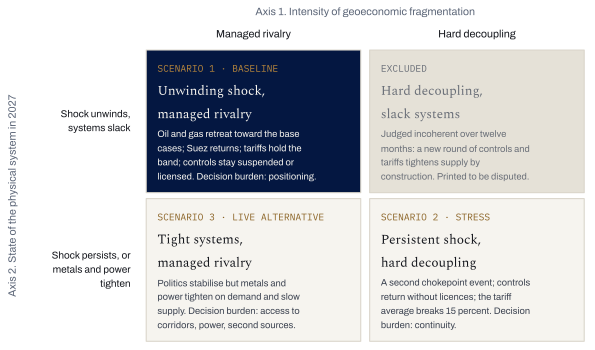
Source · STREDGE Outlook 2027 scenario set (this edition), readings of 20 October 2026 · SEG-0
Show the underlying numbers
| Item | Value |
|---|
Twenty public indicators, each with a fixed definition, a source, an update frequency, a threshold decided in advance and, wherever one could be read, a reading dated October 2026, tell the reader when the environment has moved from one scenario to another. A shift is declared when a majority of a scenario's signposts cross in the same quarter, never on one headline. We will refresh them each quarter of 2027, under my signature and on dates printed with the dashboard, and in early 2028 we will publish what the edition got right and what it got wrong. An outlook that will not audit itself should not be read.
An outlook that will not audit itself should not be read.
Two arenas, one footprint
The two arenas of this edition are the ground the firm stands on, not a marketing choice: francophone Europe, and francophone Africa with the diaspora and trade corridors that connect it to Europe and the Gulf, served from our offices in London, Paris, Casablanca, Abidjan, Lomé and Conakry. Every chapter names its countries. No claim of ours treats the continent as a unit, because the data forbid it, and where a source reports a continental or regional aggregate we say whose it is and name the countries behind it: one central bank, the BCEAO, presided in 2025 over new lending that rose 14 percent in Côte d'Ivoire and fell 24 percent in Mali.
How to challenge it
Every figure in this edition can be traced to a source and a date in the evidence cards and sources section that close each chapter, and in this letter's own sources section. Where two sources disagree, both are printed and the reconciliation is marked as ours. Where we could not verify something, the text says so rather than filling the gap. Readers who find an error, a better source or a counter-example will find the channel for saying so on each page, and corrections will be logged with their dates. That is the only kind of authority we are interested in. The one thing we ask of a reader is to pick the decision among the ten that is theirs in 2027, open the signpost dashboard and the decision calendar that follow this letter, and run the test before committing.
Bruno Hounkpati
Founding Partner and Chief Executive Officer
Stredge Partners, The Evidence Company
Edition dated 20 October 2026
Sources for the figures in this letter
Each figure above is carried, with its source, date and grade, by the chapter named here. Brent, the TTF price and storage, the Federal Reserve and the euro-area purchasing managers: Chapter 6 (Brent is the Energy Information Administration's September estimate; the TTF reading is a secondary relay of market data). The tariff rate, the bloc penalty and the WTO forecast revisions: Chapter 1, cards C1, C2 and C4 (the WTO figures were read through press reports of the release). The Hormuz halt, the Suez capacity share, the inventories-to-sales ratio and the Banque de France survey: Chapter 3, cards C1, C2 and C5. Enterprise adoption of artificial intelligence: Chapter 5. Simandou, Niger and the investment-dispute registrations: Chapter 7, card C1 for the registrations, read from the chart labels of the dispute centre's Caseload Statistics, Issue 2026-2, and from its fiscal 2025 release (the Simandou structure is also in Chapter 2, card C6). The reporting duty and the carbon border price: Chapter 9. The financial-flexibility premium and BCEAO credit data: Chapter 10. The IMF's work on fragmentation, the World Economic Forum surveys and Adam Tooze's column of 28 October 2022 are recorded in the edition's prior-art declaration.
Download the PDFs
The full edition, the executive summary and the eleven parts are free to download. Leave your work email and the files open on this page.