APS-01
Specimen · APS-01 · blank instrument
The AI Proof Sheet
No proof, no next budget. Twenty checks for AI projects in Africa, across four decisions, each with the evidence to ask for, who signs and the signal to stop.
In brief
- AI projects rarely fail on the day they launch. They drift: a pilot is extended, a licence renews, and nobody records a stop.
- The sheet turns each funding decision into a gate. At every gate the approver asks for five proofs, one per area. A missing proof is fixed by the next review, or the project stops.
- Four proofs carry the conditions African operations add to every AI project: the plan for jobs and host communities (10), data that crosses borders (13), the weakest site, usually a remote one (14), and the fallback when the link or power drops (15).
- Already running AI? Put each live project in the column it has reached and check every proof to its left.
Why AI projects survive without proof
In July 2024, Gartner predicted that at least 30% of generative AI projects would be abandoned after proof of concept by the end of 2025, “due to poor data quality, inadequate risk controls, escalating costs or unclear business value”. In June 2025 it predicted that more than 40% of agentic AI projects would be canceled by the end of 2027, with escalating costs and unclear business value among the causes reported by Reuters. Both are forecasts, not counts. They point at the same place: projects end late, after the money is spent.
The cost sits in the months between the first warning sign and the decision. Three habits keep a weak project alive. Nobody holds the authority to stop it. No date was set for the decision. And the evidence on the table is activity (logins, hours saved, satisfied users) where the board pack needs money.
African operations add a fourth. Vendor business cases tend to assume a constant connection, usable records at every site, data that can cross borders freely and a workforce that absorbs automation quietly. Remote sites break the first two. Data protection law breaks the third. Labour codes, unions and host communities break the fourth. A pilot that worked at head office can break at the third site, or in the town around it. The sheet tests those assumptions before each budget, instead of after the rollout.
Four decisions, one rule
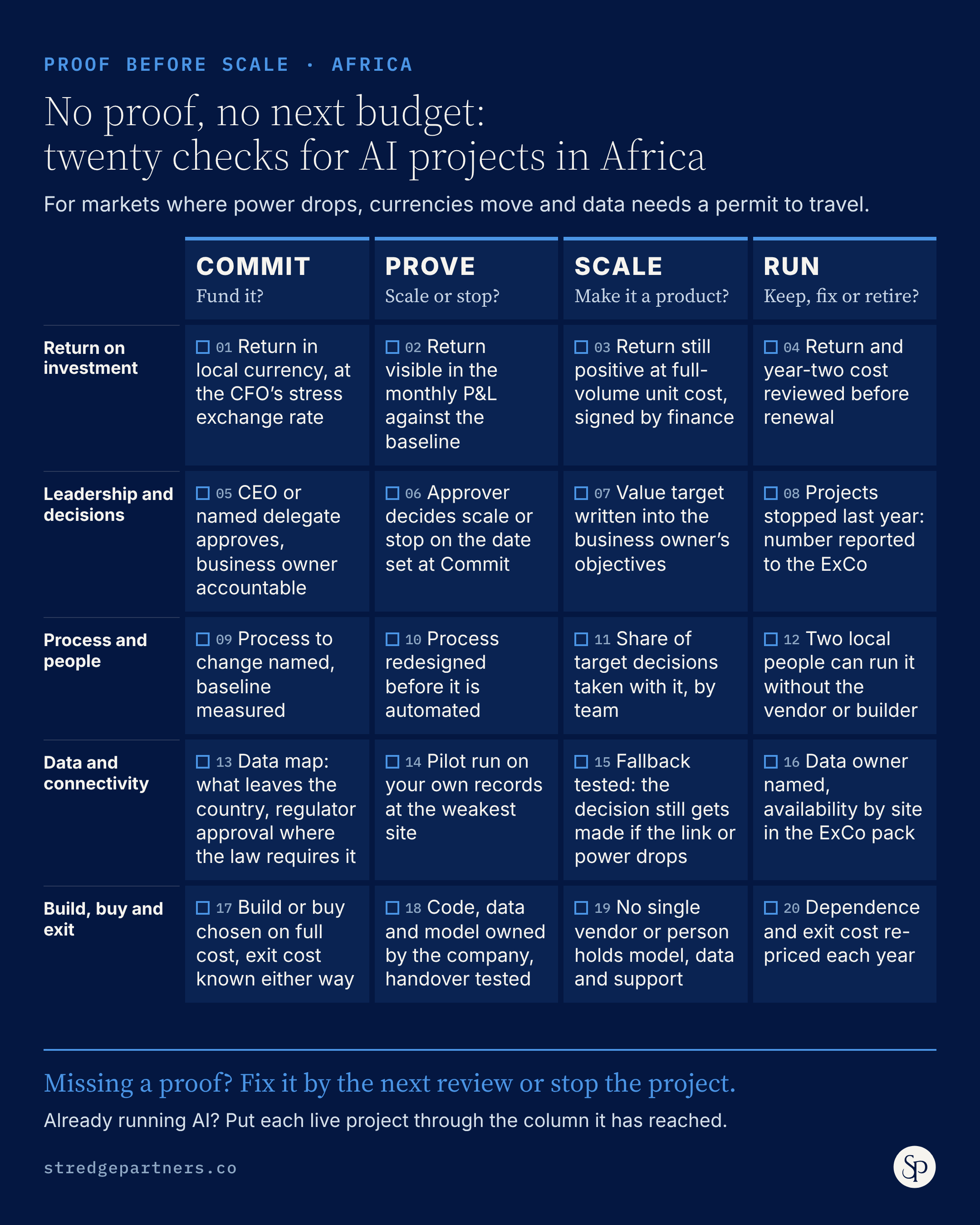
Every AI project passes four decisions. Commit asks whether to fund it. Prove asks whether to scale it or stop it. Scale asks whether to make it a product. Run asks whether to keep, fix or retire it.
Each column of the sheet holds five proofs, one for each area: return on investment, leadership and decisions, process and people, data and connectivity, and build, buy and exit. The approver, the CEO or a delegate named under the delegation of authority, takes the decision at every gate. The business owner presents. The AI team and the vendor supply evidence, and do not mark their own proofs.
The rule fits on one line. Missing a proof? Fix it by the next review or stop the project.
- CommitFund it?
- ProveScale or stop?
- ScaleMake it a product?
- RunKeep, fix or retire?
The twenty proofs
Each proof below gives what it checks, the evidence to ask for, who produces and signs it, what counts as a pass and the signal to stop.
Return on investment
01 · Commit · Return in local currency, at the CFO’s stress exchange rate
- What it checks
- The business case is priced in the currency your accounts report in, and it still pays back if the exchange rate moves against you.
- Evidence to ask for
- Business case in local currency, rerun at the stress rate the CFO sets. Licences, cloud and support billed in dollars or euros shown on their own line.
- Who produces and signs
- Business owner builds it. CFO sets the stress rate and signs.
- Pass
- Payback stays inside the target period at the stress rate.
- Stop signal
- The case only works at today’s rate, or foreign-currency costs are missing.
02 · Prove · Return visible in the monthly P&L against the baseline
- What it checks
- The pilot’s effect shows up in the management accounts, measured against the baseline taken at Commit (proof 09).
- Evidence to ask for
- Monthly P&L line or cost-centre report for the pilot sites, set against the baseline or against comparable sites.
- Who produces and signs
- Finance business partner produces it. Business owner explains it.
- Pass
- The gain shows in the accounts, net of the pilot’s running cost.
- Stop signal
- The only evidence is usage counts, estimated hours saved or user surveys.
03 · Scale · Return still positive at full-volume unit cost, signed by finance
- What it checks
- At full volume, the cost per transaction, user or site (compute, licences, support, connectivity and people) still leaves a positive return.
- Evidence to ask for
- Unit-cost model at full volume, the vendor’s price at that volume in writing, finance sign-off.
- Who produces and signs
- Project lead builds it. CFO or finance director signs.
- Pass
- Positive return at full volume, on written prices.
- Stop signal
- Pilot prices or time-limited discounts extrapolated to full scale.
04 · Run · Return and year-two cost reviewed before renewal
- What it checks
- Before any contract or budget renews, the return actually achieved is set against next year’s full cost.
- Evidence to ask for
- Renewal memo: return achieved, year-two cost with price rises and usage growth, options to renew, renegotiate or exit.
- Who produces and signs
- Business owner and procurement prepare it. The approver decides.
- Pass
- Renewal decided on actual figures, before the notice date.
- Stop signal
- Automatic renewal, or a decision taken after the notice date has passed.
Leadership and decisions
05 · Commit · CEO or named delegate approves, business owner accountable
- What it checks
- Funding is approved by the CEO, or by a delegate named in writing under the delegation of authority. One business owner answers for the value.
- Evidence to ask for
- Signed approval stating the amount and the delegation it relies on, with the business owner named.
- Who produces and signs
- CEO or named delegate.
- Pass
- The approver acts within the delegated limit and is neither the project’s builder nor the vendor’s sponsor. The owner sits in the business line that gets the value.
- Stop signal
- The team building the project approved it, or the owner is the vendor or the AI team.
06 · Prove · Approver decides scale or stop on the date set at Commit
- What it checks
- The scale-or-stop decision has a date fixed at Commit, and the approver takes it on that date. If the scale budget exceeds the approver’s limit, the decision goes up the delegation of authority on the same date.
- Evidence to ask for
- Decision record dated on or before the planned date, listing the proofs reviewed.
- Who produces and signs
- The approver decides. The business owner presents.
- Pass
- A decision taken on time, whichever way it goes.
- Stop signal
- The pilot runs on with no decision. An extension counts only with a new date, a reason and a budget cap.
07 · Scale · Value target written into the business owner’s objectives
- What it checks
- The value promised for scale is part of the business owner’s annual objectives and variable pay.
- Evidence to ask for
- The owner’s objective sheet with the target, in the same unit as the business case.
- Who produces and signs
- The owner’s line manager sets it. HR records it.
- Pass
- Target in the objectives before scale spending starts.
- Stop signal
- The target lives only in the project plan or with the AI team.
08 · Run · Projects stopped last year: number reported to the ExCo
- What it checks
- The ExCo sees how many AI projects were stopped, at which gate, why, and how much budget that released.
- Evidence to ask for
- Annual portfolio report: projects started, projects stopped by gate, budget released.
- Who produces and signs
- CFO or portfolio lead. Reported to the ExCo.
- Pass
- The report exists and stops are recorded as decisions taken on evidence.
- Stop signal
- Zero stops in a year with several projects live. Ask why none failed a gate.
Process and people
09 · Commit · Process to change named, baseline measured
- What it checks
- The project names the business process and the decision it changes, and measures how that process performs today.
- Evidence to ask for
- Process and target decision named, baseline figures (cycle time, cost, error rate, volume) over a stated period.
- Who produces and signs
- Business owner, with operations.
- Pass
- Baseline measured before the pilot starts.
- Stop signal
- “Improve productivity” with no named process and no baseline.
10 · Prove · Process redesigned before it is automated
- What it checks
- The process is simplified first (steps removed, approvals cut, data entry fixed) so the AI does not speed up waste, and the effect on jobs is planned before rollout.
- Evidence to ask for
- Process map before and after, the list of steps removed, the roles affected and the plan for each, and who was consulted: employee representatives where the labour code or collective agreements require it, host communities where local employment commitments exist.
- Who produces and signs
- Business owner and process lead. HR signs the people plan.
- Pass
- Redesign tested at the pilot sites, people plan agreed before Scale.
- Stop signal
- The pilot automates the current process as it is, workarounds included, or job changes surface after rollout.
11 · Scale · Share of target decisions taken with it, by team
- What it checks
- Adoption is measured on the decisions the project was built for, team by team, instead of logins or licences issued.
- Evidence to ask for
- System log or sample audit: decisions in scope, decisions taken with the tool, by team and by site.
- Who produces and signs
- Business owner. Data from the project lead.
- Pass
- Each team reaches the adoption threshold set at Commit before rollout continues.
- Stop signal
- The average looks good while key teams work around the tool.
12 · Run · Two local people can run it without the vendor or builder
- What it checks
- At least two employees in the country can operate, troubleshoot and reconfigure the system without calling the vendor or the original builder.
- Evidence to ask for
- Two names, a written runbook, and a test in which they ran the system alone for a set period.
- Who produces and signs
- Business owner with HR. Operations signs the test.
- Pass
- Test passed and a retention plan in place for both people.
- Stop signal
- One person or nobody holds the know-how.
Data and connectivity
13 · Commit · Data map: what leaves the country, regulator approval where the law requires it
- What it checks
- Before funding, the project maps the data it uses, where it is stored and processed, and which flows cross a border, with the legal basis for each flow and any sector regulator’s rules on outsourcing or cloud (banking, insurance, telecoms).
- Evidence to ask for
- Data-flow map by country, the legal basis for each flow, and the filing or authorisation reference where the law or a sector regulator requires one.
- Who produces and signs
- Data protection officer or legal. Business owner signs.
- Pass
- Every cross-border flow has its legal basis or authorisation before live data moves.
- Stop signal
- Personal data sent to a foreign cloud or vendor with no filing where the law requires one.
Proof 13: where the law requires approval
The table covers five countries where we checked the text of the law. For any other country, check the rule with the national data protection authority before live data moves.
| Country | Law | What it requires for transfers abroad | Authority |
|---|---|---|---|
| Morocco | Law 09-08 (2009) | Transfers abroad need prior authorisation from the CNDP, which publishes a list of countries it considers adequate. | CNDP |
| Côte d’Ivoire | Law 2013-450, Art. 7 and 26 | Transfers to a country outside ECOWAS need prior authorisation from the protection authority. | ARTCI |
| Senegal | Law 2008-12, Art. 49 to 51 | The destination must offer adequate protection and the CDP must be informed before the transfer. Without adequacy, only listed exceptions or a CDP authorisation with safeguards. | CDP |
| Togo | Law 2019-014, Art. 28 to 30 | Every country other than Togo is a third country. Adequate protection required and the IPDCP informed beforehand. Without adequacy, only listed exceptions or an IPDCP authorisation. | IPDCP |
| Nigeria | Data Protection Act 2023, s. 41 to 43 | Transfer only if the recipient is bound by an adequate law, binding corporate rules, contract clauses or similar, or a section 43 ground applies. The basis must be recorded. | NDPC |
This summary helps scope proof 13. It is not legal advice, and laws change: confirm the current text with the authority or your counsel before any transfer.
14 · Prove · Pilot run on your own records at the weakest site
- What it checks
- The pilot uses the company’s real records, gaps included, at the site with the weakest data, connectivity or staffing. That is usually a remote site, where records are thinner, kept on paper or entered late.
- Evidence to ask for
- Pilot plan naming the site and why it is the weakest, a data-quality log, a sample of outputs checked by people, the rule for which outputs a person must confirm, error rate and results by site.
- Who produces and signs
- Project lead. Operations chooses the site.
- Pass
- Results hold at the weakest site, with an error rate within the threshold set at Commit, in the languages used there.
- Stop signal
- Results come only from vendor data, cleaned samples or head office, or nobody measured the error rate.
15 · Scale · Fallback tested: the decision still gets made if the link or power drops
- What it checks
- When connectivity or power fails, the business decision the tool supports still gets made, through an offline mode, a cached model or a manual procedure.
- Evidence to ask for
- Written fallback procedure and the log of a real or simulated outage at a live remote site.
- Who produces and signs
- Operations. IT supports.
- Pass
- The decision is made within the agreed time during the outage test.
- Stop signal
- Work stops when the network drops, or the fallback has never been tested.
16 · Run · Data owner named, availability by site in the ExCo pack
- What it checks
- Every dataset the system depends on has a named owner, and system availability is reported site by site.
- Evidence to ask for
- Data-owner register and monthly availability by site in the ExCo pack.
- Who produces and signs
- Data owners. The CIO reports.
- Pass
- Owners named and availability reported every month.
- Stop signal
- Availability reported only as a group average, or datasets with no owner.
Build, buy and exit
17 · Commit · Build or buy chosen on full cost, exit cost known either way
- What it checks
- Internal build, vendor product and partner build are compared on full cost over the project’s life, including people, running cost and the cost of leaving.
- Evidence to ask for
- Option table with full cost over three years or the project’s life, and the exit cost of each option.
- Who produces and signs
- Project lead with procurement. CFO reviews.
- Pass
- Option chosen on full cost, exit cost written down.
- Stop signal
- The choice rests on a licence price or a demo.
18 · Prove · Code, data and model owned by the company, handover tested
- What it checks
- Contracts and internal rules make the company the owner of its data, of the outputs, and of the code or model built for it, and a handover has been tested.
- Evidence to ask for
- Contract clauses on ownership and return of data, repository access in the company’s name, handover test record.
- Who produces and signs
- Legal and procurement. The project lead runs the test.
- Pass
- Clauses signed and handover tested before Scale.
- Stop signal
- The vendor keeps the trained model or the data, or the code sits on one person’s account.
19 · Scale · No single vendor or person holds model, data and support
- What it checks
- No single vendor, and no single employee, controls the model, the data and the support at the same time.
- Evidence to ask for
- A map of who holds the model, the data and the support, with a tested backup for each.
- Who produces and signs
- CIO with procurement.
- Pass
- The three are not all in one hand, and each has a tested backup.
- Stop signal
- One provider or one person can stop the service.
20 · Run · Dependence and exit cost re-priced each year
- What it checks
- Every year, the cost of leaving the current vendor or set-up is re-estimated and the alternatives are checked.
- Evidence to ask for
- Annual exit-cost estimate, alternatives reviewed, dependence rating.
- Who produces and signs
- Procurement. The approver reviews.
- Pass
- Re-priced before each renewal decision (proof 04).
- Stop signal
- Exit cost unknown, or last estimated at signature.
Running the gate review
One meeting per gate, sixty minutes, chaired by the approver.
- Five working days before The business owner sends the proof pack: one page per proof, evidence attached.
- Decision asked (5 min) The owner names the gate and what is asked: budget, scope and date.
- This column (30 min) Each proof is marked met or missing, on the evidence alone.
- Earlier columns (10 min) Anything that slipped since the last gate, such as a new site that changes proof 13.
- Decision (15 min) The approver decides: go, go with a fix date, or stop. A fix date is the next review at the latest.
- Two working days after Decision record: proofs met, proofs missing, an owner and a date for each fix, next review date.
Already running AI
If AI is already in production, start with the portfolio before approving anything new.
- List every live AI project with its annual cost, its business owner and its approver.
- Place each one in the column it has reached: in pilot means Prove, in rollout means Scale, in production means Run.
- Check every proof in that column and in the columns to its left. A project in Run with no proof 05 has no approver on record.
- Give each missing proof an owner and a date, no later than the next review.
- Start with the largest spend and the nearest renewal date (proof 04).
Page 6 of the guide does this in one table.
Questions executives ask
Is this too heavy for a small pilot?
The Commit column asks for five proofs and most fit on a page. A pilot that cannot name its process, its baseline, its approver and its data flows is not ready for money, whatever its size.
Who runs the review?
The approver chairs it, the business owner presents and finance checks the figures. The AI team or the vendor brings evidence and answers questions, and does not mark its own proofs.
Does this replace our investment process?
No. It plugs into your delegation of authority and your budget cycle. The proofs are the evidence pack your existing approval should ask for.
What if a proof cannot be met in our market, such as a fallback at a site with no reliable link?
Then building that capacity becomes part of the Scale budget, with a date. Until the proof is met, the project stays in Prove.
Is this list really specific to Africa?
The method is not, and should not be. A gate works the same way in Lyon or Lagos, and most proofs apply anywhere. What Africa changes is where projects break. Four proofs carry that: the plan for jobs and host communities (10), data that crosses borders (13), results at the weakest site, usually a remote one (14), and the fallback when the link or power drops (15). Outside Africa, keep them and adjust the thresholds.
Download
Free to use and share with attribution.
Sources
- Gartner, press release, 29 July 2024: “Gartner Predicts 30% of Generative AI Projects Will Be Abandoned After Proof of Concept By End of 2025” (opens in a new tab)
- Gartner, press release, 25 June 2025: “Gartner Predicts Over 40% of Agentic AI Projects Will Be Canceled by End of 2027” (opens in a new tab)
- Reuters, via The Star, 25 June 2025: “Over 40% of agentic AI projects will be scrapped by 2027, Gartner says” (opens in a new tab)
- Morocco, CNDP, press release, 6 April 2022 (prior authorisation for transfers abroad under Law 09-08) (opens in a new tab)
- Côte d’Ivoire, Law 2013-450 of 19 June 2013 on personal data protection, Journal officiel (opens in a new tab)
- Senegal, Law 2008-12 of 25 January 2008 on personal data protection (WIPO Lex) (opens in a new tab)
- Togo, Law 2019-014 of 29 October 2019 on personal data protection, Journal officiel (opens in a new tab)
- Nigeria, Nigeria Data Protection Act 2023 (opens in a new tab)